
Short answer
You can treat and clean a mattress with low-moisture tools, but whether it's 'sanitized' depends on what you measure. Heat from dry-vapor steam has inactivated microbes in seconds on lab test surfaces and reduced bacteria on hospital surfaces, and HEPA vacuuming removes allergen without water. We haven't found a published study measuring germ reduction on in-use mattresses for any method, so claims should be modest.
Key terms used on this page
- Cleaning, sanitizing and disinfecting:
- As the CDC uses the words: cleaning removes dirt and germs from a surface; sanitizing lowers the number of germs to a safer level; disinfecting kills germs on a surface, usually with a registered chemical used as labeled. These words describe different results and should not be used interchangeably.
- Dry-vapor steam:
- Steam made in a sealed, pressurized boiler and released through a hose and nozzle as hot vapor with a low liquid-water content. In the vendor specifications we reviewed, professional units are rated from 80 psi (Ladybug 2350) to 150 psi (Daimer), with stated boiler temperatures from about 345°F (Optima) to 360°F (Daimer); these are maker claims. Daimer describes its steam as about 5% water or less and Vapor Clean claims 'just 5-6% moisture'; that is a vendor claim, not an independent standard.
- HEPA vacuuming:
- Vacuuming with a sealed system and a filter meeting the HEPA standard, which the EPA says can theoretically remove at least 99.97% of airborne particles 0.3 microns in size. It removes loose dust and allergen-carrying particles without adding water or heat.
- Dwell time:
- How long heat or a cleaning product stays in contact with a given spot. Heat-related lab results are reported as a temperature held for a time, so a temperature figure without a dwell time is incomplete.
- Moisture load:
- The total amount of water a cleaning process puts into a mattress, whether from spray, steam condensate, shampoo or rinse. It is the main thing that decides how long a mattress takes to dry.
- Der p 1:
- One of the main dust mite allergens, a protein carried mostly on mite fecal particles. It is the allergen most often measured in mattress and carpet studies. It is stable enough that removing it matters as much as killing live mites.
Yes, you can treat and clean a mattress with low-moisture tools, but whether the result counts as "sanitized" depends on what you measure. Heat from steam vapor has inactivated microbes within seconds on laboratory test surfaces and reduced bacteria on hospital surfaces, and HEPA vacuuming removes dust mite allergen without adding any water. What we haven't found is a published study that measures germ reduction on in-use mattresses, for steam or any other method. So the accurate claim is that low-moisture methods can clean and heat-treat a mattress without soaking it, not that any of them is proven to sanitize mattresses to a specific level.
The question usually comes from someone who has been told a mattress has to be soaked to get truly clean. Below we separate cleaning from sanitizing, look at heat, UV-C and chemistry one at a time, and mark where the published evidence runs out. The tools themselves are compared in the flagship guide to mattress cleaning methods, and the Cleaning Methods hub defines the terms.
What "sanitize" means
The CDC uses three words for three different results (see cleaning, sanitizing and disinfecting):
- Cleaning removes dirt and germs from surfaces.
- Sanitizing lowers the number of germs to a level considered safe.
- Disinfecting kills germs on surfaces, typically with an EPA-registered product used as directed.
Those definitions come from the CDC's cleaning and disinfecting guidance. Notice they describe outcomes, not methods. "Sanitize" is a claim about a reduction in germs, and that reduction has to be measured on the surface in question.
Why soaking is the usual route, and why it's a problem on a mattress
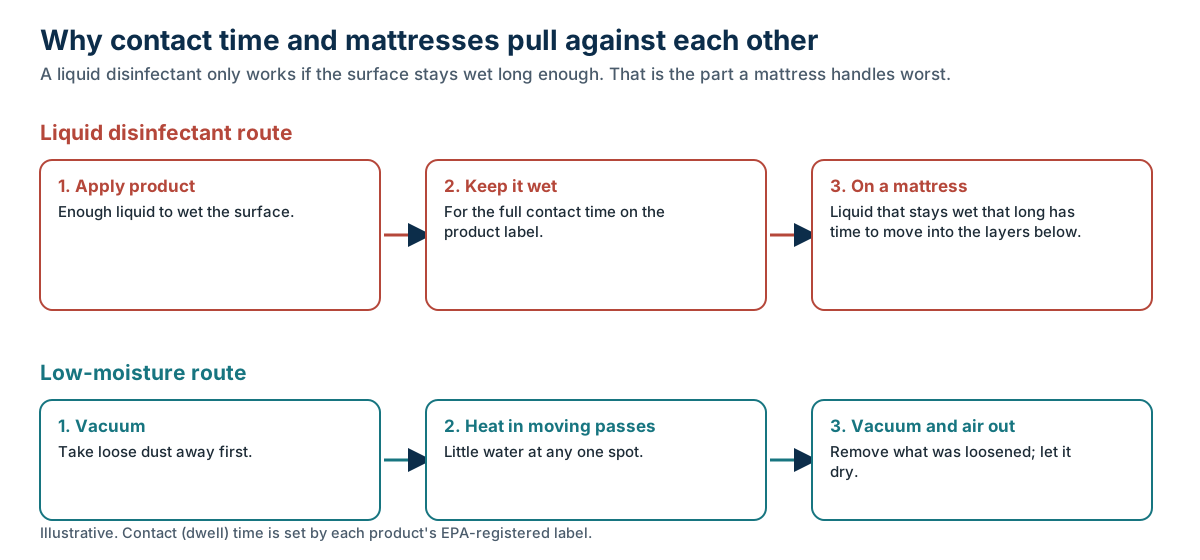
Chemical disinfection depends on liquid. The EPA explains that a disinfectant's contact time is how long the treated surface should remain wet for the product to work, and that the surface should be visibly wet for that whole time. On a countertop, that's easy. On a mattress, keeping the fabric visibly wet for minutes means pushing liquid into the comfort layers, which every major manufacturer warns against. Tempur UK, for instance, says soaking its material with water or cleaning fluids carries a high risk of irreversible damage. The chemical also stays in the fabric you sleep on.
That's the case for low-moisture approaches. The question is what they can and can't do.
Low-moisture tools and what the evidence shows
| Tool | How it works | Strongest evidence we found | What that evidence doesn't show |
|---|---|---|---|
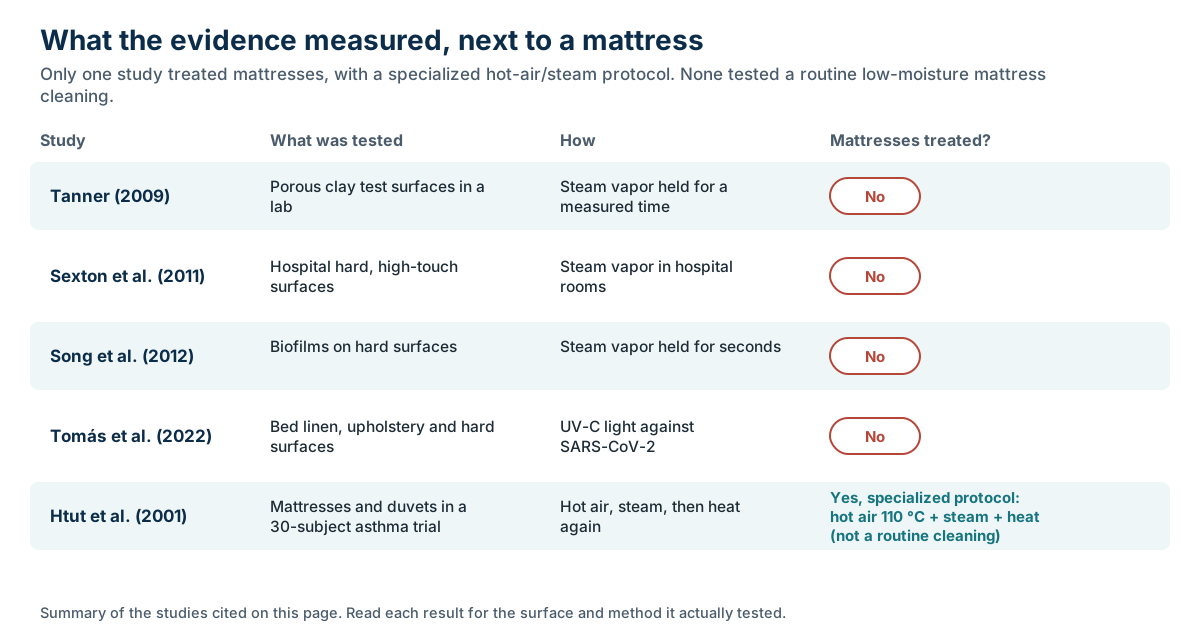
| Dry-vapor steam | Heat delivered by condensing vapor | Steam vapor inactivated all pathogens tested on porous clay test surfaces within 5 seconds (Tanner, 2009); more than 90% bacterial reduction on hospital high-touch surfaces (Sexton et al., 2011); more than 99.95% kill of biofilms on hard test surfaces after 3 seconds (Song et al., 2012) | Results on mattress fabric, at the surface temperatures a moving tool reaches, in homes |
| HEPA vacuuming | Removes particles; filter can theoretically remove at least 99.97% of airborne particles at 0.3 microns (EPA) | Vacuuming removes allergen-carrying fecal particles; HEPA vacuuming is recommended for mite control (AAAAI/ACAAI) | Killing germs; removing all live mites |
| UV-C | Ultraviolet light inactivates microbes it reaches | In tests against SARS-CoV-2, porous materials such as bed linen and upholstery needed much higher, more variable doses than hard surfaces (Tomás et al., 2022) | Results inside fabric; results from a lamp passing briefly over a mattress |
| Combined heat treatment | Hot air, steam and heat | In a 30-subject trial (two treatment groups vs a sham group), bronchial hyper-reactivity improved about four-fold in the treated homes, with sustained mite allergen reduction (Htut et al., 2001) | A typical in-home cleaning; the protocol used hot air at 110°C and a specialized process |
What the steam studies mean
The steam studies are encouraging, and they're also specific. Tanner's work used test surfaces in a lab. Sexton's was in hospital rooms, on hard high-touch surfaces. Song's was on hard surfaces with biofilms. In each case the steam tool was held in contact for a measured time. On a mattress, the tool keeps moving to avoid adding moisture and heat in one spot, and the fabric is porous and insulating. The temperature and dwell time a microbe on mattress fabric experiences are unknown. So these results show steam can work against microbes under the right conditions. They don't tell us what percentage reduction happens on a mattress.
What about dust mites and allergen?
Mites and allergen are a different problem. Heat can kill mites (see why heat and moisture have to be considered separately), but the main mite allergen, Der p 1, needs around 30 minutes at 120°C of dry heat to denature, according to the AAAAI/ACAAI practice parameter. No cleaning pass does that. Allergen has to be physically removed, which is what vacuuming is for.
A realistic low-moisture approach
Putting the evidence together, a low-moisture protocol that doesn't overclaim looks like this:
- Vacuum first to remove loose dust, skin flakes and allergen-carrying particles, ideally with HEPA filtration. See HEPA vacuuming vs steam vs extraction for what each step accomplishes.
- Apply heat with dry-vapor steam in moving passes, keeping the moisture load low, where the manufacturer allows it.
- Vacuum again to remove what the heat loosened.
- Spot-treat specific stains or organic soils with targeted products, sparingly. Whether that needs detergent is covered in does professional mattress cleaning have to use detergent?
- Dry and protect. Ventilate, then use an encasement, which allergy guidelines recommend for mite control.
That approach cleans the mattress, heat-treats the surface and removes allergen, all without soaking. Whether it "sanitizes" in the CDC's measured sense on your mattress isn't something we, or anyone we've found, has published data on.
That's the approach behind Sleep Sanitation's process: an Italian-made Vapor Clean dry-vapor system and a heated UV-C mattress vacuum, without saturating the mattress. After an illness in the household, our virus and bacteria page describes what a visit involves, and you can pick a time on the schedule page.
Why "without soaking" matters beyond the mattress
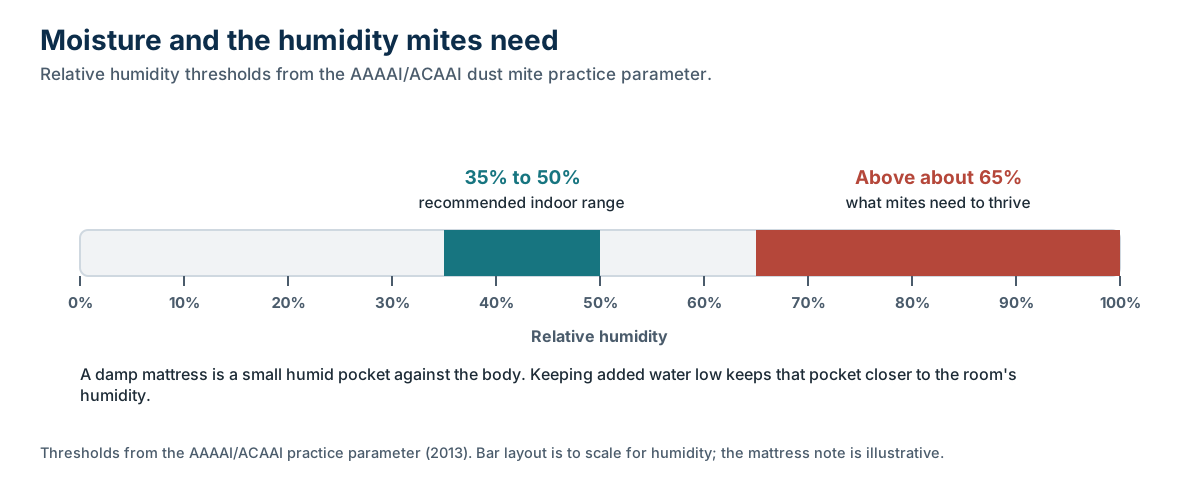
Low moisture isn't only about protecting foam. It also limits two side effects that wet sanitizing methods can create. The first is humidity: a damp mattress is a humid microclimate, and the AAAAI/ACAAI practice parameter notes that dust mites need relative humidity above about 65% to thrive. A sanitizing step that leaves the mattress wet for a day can work against mite control. The second is residue: whatever chemistry goes in with the water tends to stay in the fabric, close to your face for hours every night. Keeping the moisture load low avoids both, which is why it's worth accepting a more modest, honest claim about what a low-moisture process achieves.
Claims to be skeptical of
- "Kills 99.9% of germs" on a mattress. Ask which study, on what surface, with what organism. Hard-surface lab results don't transfer automatically.
- "EPA-approved device." The EPA says a device's establishment number does not indicate the EPA reviewed it for safety or efficacy.
- "Disinfects without chemicals." Disinfecting, in the CDC's sense, usually refers to a registered product used as labeled. A heat or UV device is a different claim.
What we don't know
- Germ reduction on mattresses. We haven't found a published study measuring microbial reduction on in-use mattresses after dry-vapor steam, UV-C or extraction.
- Surface temperature and dwell time. We haven't found measurements of how hot mattress fabric gets, or for how long, under a moving steam tool.
- UV-C on mattress fabric. We haven't found studies of UV-C mattress vacuums specifically.
Sources
- Cleaning and disinfecting your school (definitions) · CDC
- List N terms explained (contact time) · US EPA
- Pesticide devices: a guide for consumers · US EPA
- Tanner (2009), steam vapor inactivation of pathogens on test surfaces · American Journal of Infection Control
- Sexton et al. (2011), steam vapor in hospital rooms · American Journal of Infection Control
- Song, Wu & Xi (2012), steam against biofilms on hard surfaces · American Journal of Infection Control
- Tomás et al. (2022), UV-C inactivation of SARS-CoV-2 on porous and non-porous surfaces · Journal of Photochemistry and Photobiology B
- Dust mite practice parameter (Portnoy et al., 2013) · AAAAI-ACAAI
- What is a HEPA filter? · US EPA
- Htut et al. (2001), heat treatment of mattresses and asthma · Journal of Allergy and Clinical Immunology
- Caring for your TEMPUR mattress · Tempur UK
Last reviewed October 2, 2026. Manufacturer specifications and care instructions change; check the current version for your exact model. This page is general information, not medical advice. How we source and check pages: editorial standards.