
Short answer
Yes, by the most permissive manufacturer guidance we found: Purple's general guide says 'you can steam clean your innerspring or hybrid mattress,' and Saatva's blog suggests a garment steamer before vacuuming. Neither mentions dry-vapor steam, and the layers on top of the coils still matter: foam toppers inside the quilting carry foam cautions. Follow your label; our method is our own, not a manufacturer exemption, so check your warranty terms.
Key terms used on this page
- Innerspring mattress:
- A mattress whose support core is a unit of steel coils, with comparatively thin comfort layers and a quilted top. The coil core is open to airflow, which is one reason general cleaning guides treat innerspring beds as more tolerant of moisture than solid-foam beds.
- Pillow-top and Euro-top:
- An extra padded layer sewn onto the top of a mattress. On a pillow-top it is stitched on as a separate pillow-like layer; on a Euro-top it is sewn flush with the sides. The padding is usually fiber, foam or both, and it sits directly under the cleaning surface.
- Mattress layers (ticking, comfort layers, support core):
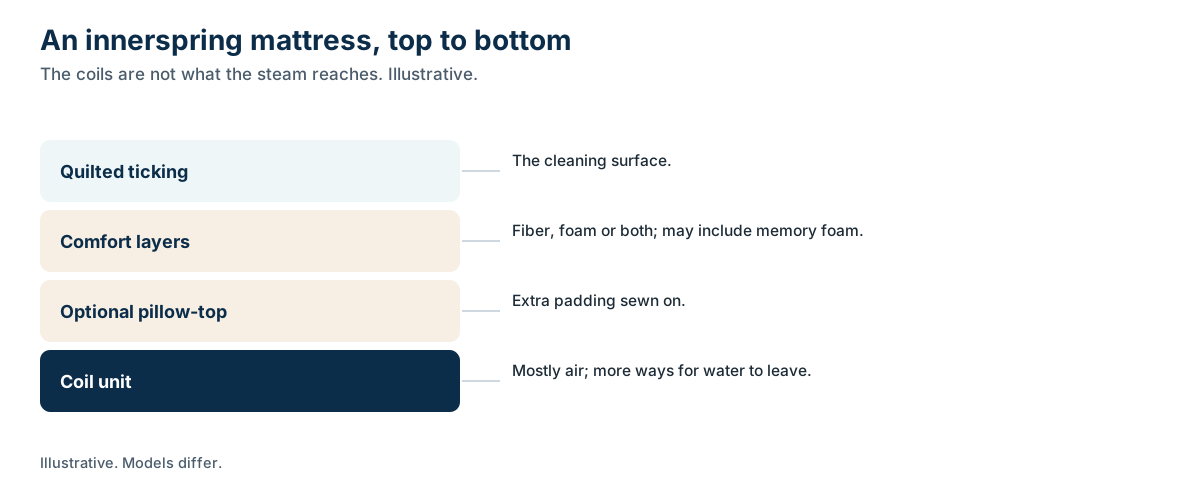
- Ticking is the outer fabric cover. Comfort layers are the foams, latex, fiber or wool directly under it. The support core is the coil unit or base foam underneath. Most mattresses also include a fire barrier between the ticking and the comfort layers.
- Dry-vapor steam:
- Steam made in a sealed, pressurized boiler and released through a hose and nozzle as hot vapor with a low liquid-water content. In the vendor specifications we reviewed, professional units are rated from 80 psi (Ladybug 2350) to 150 psi (Daimer), with stated boiler temperatures from about 345°F (Optima) to 360°F (Daimer); these are maker claims. Daimer describes its steam as about 5% water or less and Vapor Clean claims 'just 5-6% moisture'; that is a vendor claim, not an independent standard.
- Pass speed:
- How fast the steam tool moves across the fabric. A faster pass gives the fabric less time under the tool, so less heat and less condensed water reach any one spot. Purple's general guide makes the same point for home steamers: move 'without leaving it in one spot for too long.'
- Care instructions (manufacturer care guidance):
- What a manufacturer publishes about cleaning its product: a sewn-in label, a care web page, a help-center article or a brand blog post. They carry different weight. A sewn-in label or a product-care page speaks for a specific product; a blog post often gives general advice about many mattress types. On this hub we name the document type for every quote.
An innerspring mattress has a support core of steel coils under comparatively thin comfort layers and a quilted top. It is the one construction for which a manufacturer's page we checked describes steam cleaning as an option. This page sets out exactly what is said, what it doesn't cover, and why the layers above the coils still matter.
Not affiliated with or endorsed by any manufacturer listed. Brand names are used only to identify products and their published care instructions.
What manufacturers say about innerspring mattresses
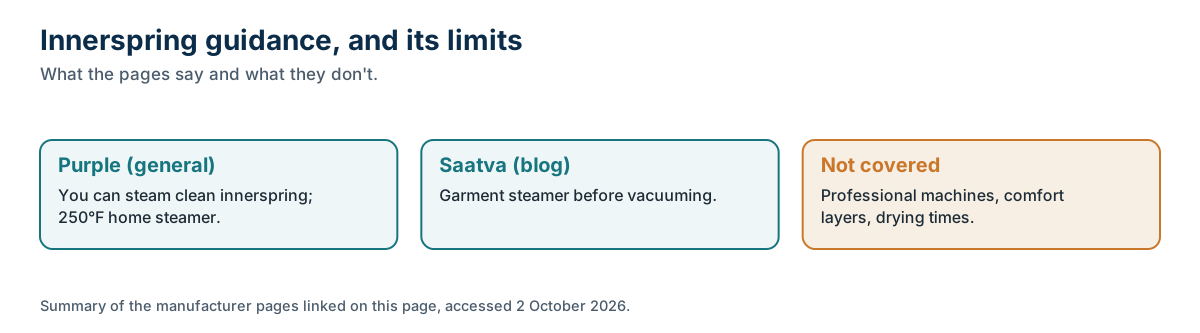
| Brand | Statement | Source |
|---|---|---|
| Purple (general guide) | "After vacuuming, you can steam clean your innerspring or hybrid mattress" | Purple |
| Purple (general guide) | "Set the steam cleaner to 250 degrees Fahrenheit to kill dust mites and other bacteria." | Purple |
| Purple (general guide) | "using a carpet cleaner to remove mattress dirt and grime can help clean an innerspring mattress, but could overly saturate a memory foam mattress" | Purple |
| Saatva (blog) | "If you have a garment steam cleaner, go over your mattress with that before vacuuming" | Saatva |
| Saatva (blog) | "You can find some innerspring and foam mattresses that can be flipped to extend the lifespan" | Saatva |
All accessed 2 October 2026. Neither page mentions dry-vapor steam.
Two cautions about this table. Purple's statements are general advice in a blog guide; Purple's own mattresses are covered by its separate line, "you should not steam clean a Purple mattress." Saatva's tip is also in a blog post, and it isn't limited to innerspring beds. Neither is a care label for a specific innerspring model.
Why coils change the moisture picture
A coil core is mostly air. Water that passes the quilting doesn't meet a sponge-like block of foam underneath, so it has more ways to leave. That is presumably why Purple's guide treats innerspring beds as tolerant of a carpet cleaner and a household steamer while warning that the same tools "could overly saturate a memory foam mattress." Hub 1's why moisture matters explains moisture load and drying in general.
That doesn't make the whole mattress coils. The quilted top usually contains fiber, foam or both, and it sits directly under the surface you clean. A pillow-top adds more. Saatva's own page describes the Saatva Classic as having "coil-on-coil construction" and "a layer of memory foam." So the comfort layers, not the coils, decide what care a given innerspring needs. Hub 1's glossary entry on mattress layers explains the parts.
What the permissive guidance doesn't say
- Professional equipment. Purple's directions describe a household steamer at 250°F. Saatva names a garment steamer. Neither addresses pressurized dry-vapor machines.
- Comfort-layer materials. Neither page tells you to check what is in the quilting first.
- Drying. Purple says "let the mattress completely dry before you put any bedding back on," but neither page gives a time.
- Chemicals for innerspring beds. No innerspring-specific chemical cautions appear; the bleach cautions on these pages are written about foam.
Sleep Sanitation's approach to innerspring mattresses
This section is our view, not any manufacturer's.
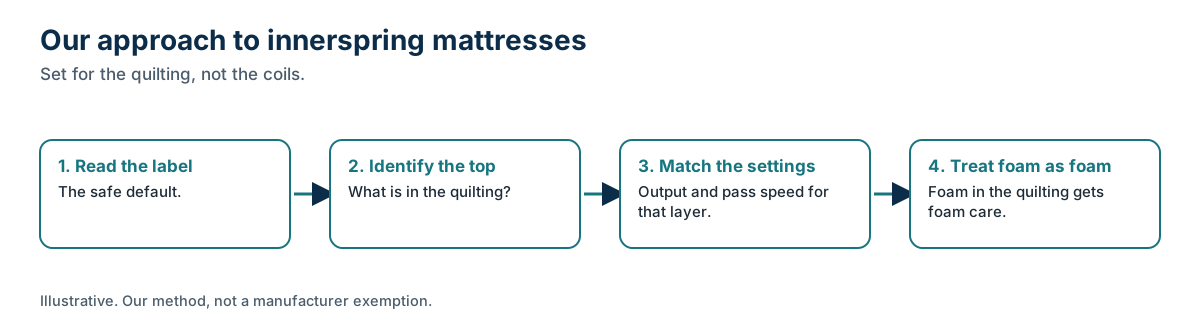
Your label is still the safe default, even for innerspring beds. Our position is that we can sanitize any mattress or topper. We use Vapor Clean dry-vapor equipment (we run the Magnum XP, ProV 350 and Pro6 Duo and match the machine to the job). On an innerspring mattress the steam meets the ticking and the quilted comfort layers, so our technician sets the steam output and pass speed for whatever is in the quilting, not for the coils. Where the quilting holds memory foam, we treat it as foam.
That is our method and reasoning, not an exemption from any manufacturer. Permission to use a household steamer, where a brand gives it, isn't permission for anything else. Check your warranty terms before booking and contact the manufacturer if you're unsure. This is not legal advice.
Day-to-day care for coil mattresses
The general guides give coil beds the same routine as other mattresses: vacuum, spot clean, deodorize, dry. Saatva's post leads with vacuuming, "If you're only going to do one thing to clean a mattress, make it this one," and suggests baking soda left "on for a full day if possible." Purple's guide adds seams and corners: "Go over the seams and corners several times to vacuum everything up."
Flipping is where innerspring beds differ. Saatva notes that "You can find some innerspring and foam mattresses that can be flipped to extend the lifespan," while "If your mattress has a pillow top, for example, you won't be able to flip it." Purple says "Most modern-day mattresses (including Purple mattresses) should not be flipped." Check your model; a flippable bed has two cleaning surfaces.
Questions to ask a provider about innerspring beds
- What's in my quilting? A careful provider asks, because the comfort layers decide the approach.
- Do you use an extractor? Purple's guide says one "can help clean an innerspring mattress," but extraction leaves far more water than dry vapor, and the quilting holds it.
- How long until I can make the bed? Purple says to let the mattress "completely dry" first.
- Do you clean both sides? Only relevant if your model is flippable.
Common misreadings
"Innerspring means no foam." Many innerspring mattresses have foam in the comfort layers; Saatva's Classic is described with "a layer of memory foam."
"Purple says innerspring beds can be steamed, so any steam is fine." Purple's directions describe a household steamer. They don't address pressurized dry-vapor equipment, and they aren't a care label for your model.
"Coils can't hold water, so moisture doesn't matter." The coils don't, but the quilted top does. Hub 1's drying-time article explains why surface-dry isn't the same as dry.
A worked example: a traditional innerspring with a quilted top
Imagine a ten-year-old innerspring mattress with a quilted top, no pillow-top, and a few old stains. Here is how we'd reason through it.
First, the label. Older mattresses often have a basic law tag listing fill materials, which tells you what is in the quilting: commonly polyester fiber, polyfoam, or both.
Second, the published guidance. Purple's general guide is the most permissive source: "you can steam clean your innerspring or hybrid mattress," and a carpet cleaner "can help clean an innerspring mattress." Saatva's blog suggests a garment steamer. Neither is your mattress's care label, and both describe household equipment.
Third, the quilting. The polyfoam or fiber in the quilting holds water. Old stains have often set into it. An extractor would put a lot of water into that layer; dry vapor puts in much less.
Fourth, drying. Purple says to let the mattress "completely dry" before making the bed. A thin quilted top dries faster than a thick pillow-top.
If you book us, our technician would set the output and pass speed for the quilting and spend extra time on the vacuum step. That is our method, not a manufacturer's ruling.
Why innerspring guidance is so permissive
Innerspring beds are the oldest common construction, and they have the least foam. Purple's guide reflects that when it contrasts innerspring beds with memory foam. The permissiveness, though, comes from general guides about every kind of mattress. We didn't find a dedicated care page from an innerspring manufacturer on the pages we checked that says the same thing about its own models, which is one reason we keep reminding owners that the label comes first.
Where this fits
See hybrid and pillow-top mattresses next. The Saatva page breaks down the garment-steamer tip; the compatibility guide and hub overview have the full picture. For costs, see pricing.
Related guidance and background
How other manufacturers word the same issue, for comparison:
- Casper. "Be careful not to saturate the mattress with too much water and/or detergent, as the foam in the mattress core will soak up water and detergent" (Casper).
Public guidance and reference sources behind this page:
- Clean, sanitize, disinfect. The CDC defines the three words differently: cleaning removes dirt and germs, sanitizing lowers germs to a safer level, and disinfecting kills germs, usually with a registered chemical used as labeled. We use "sanitize" in that sense and make no disinfection claim.
- Drying. The EPA's mold and moisture guide advises drying wet materials within 24 to 48 hours, and says that in most cases mold won't grow if you do. That is the public-health reason behind every manufacturer's drying instruction.
What we don't know
- Rust or corrosion. None of the pages we checked mentions coils and moisture.
- Model-specific labels. Innerspring care labels may be more specific than these blog posts.
- Drying times. No figures are published.
- Dry-vapor steam. No innerspring maker we checked addresses it.
Changelog
- 2 October 2026: First published. Purple and Saatva pages accessed on this date.
Sources
- How To Clean a Mattress in 9 Steps (last updated 16 Oct 2025, accessed 2026-10-02) · Purple
- How to Clean Your Mattress in 5 Simple Steps (blog, accessed 2026-10-02) · Saatva
- Magnum XP-Vac product page (maker's claims, accessed 2026-10-02) · Vapor Clean
- How to clean your mattress: a mattress care guide (accessed 2026-10-02) · Casper
- Cleaning and disinfecting your school (definitions) · CDC
- A brief guide to mold, moisture and your home · US EPA
Last reviewed October 2, 2026. Manufacturer specifications and care instructions change; check the current version for your exact model. This page is general information, not medical advice. How we source and check pages: editorial standards.