
Short answer
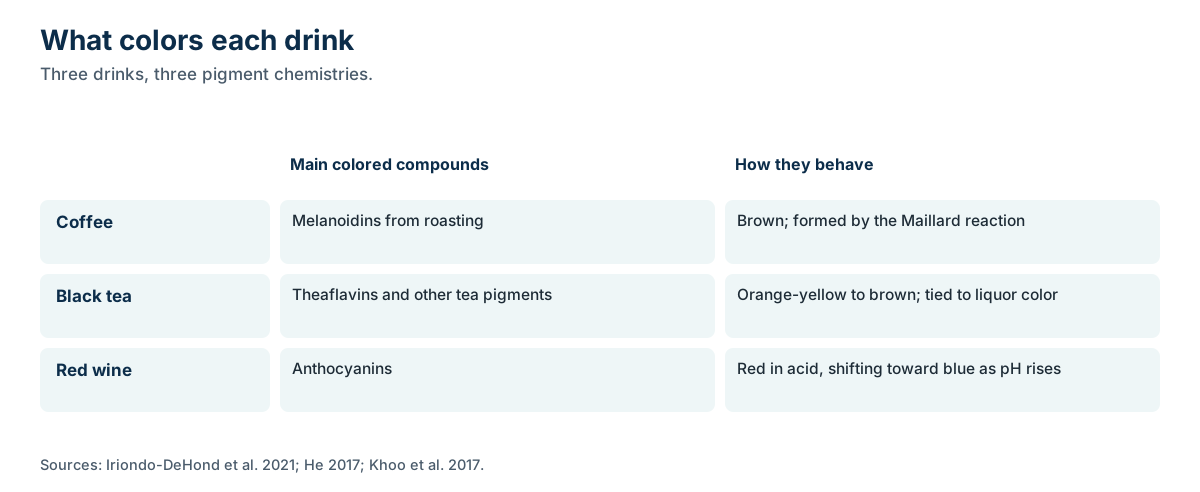
Because they carry plant pigments that cling to fiber. Extension guides call them tannin stains. Coffee gets its brown from melanoidins formed in roasting, black tea from theaflavins and related pigments, and red wine from anthocyanins whose color shifts with pH. They're not protein stains, but alkalis such as ammonia can set them, so blot fast, use cool water and mild detergent, and test before any oxidizer.
Key terms used on this page
- Tannin stain:
- A stain from plant drinks such as coffee, tea, wine, fruit juice and soft drinks. The colored compounds are plant polyphenols and, in coffee, brown roasting pigments. Old tannin stains may need an oxidizing bleach that's safe for the fabric.
- Anthocyanins:
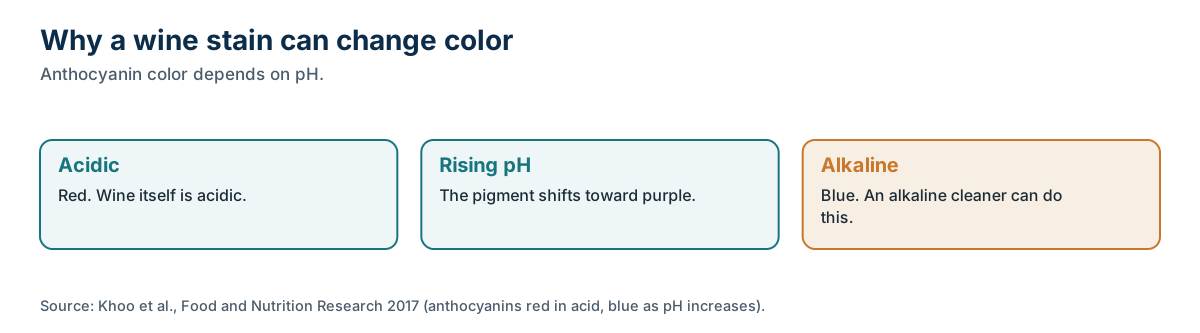
- Red, purple and blue plant pigments found in grapes, berries and other fruit. A review notes they appear red in acid and turn blue as pH rises, so an acid or alkaline cleaner can change how a wine stain looks.
- Melanoidins:
- Brown pigments formed by the Maillard reaction when coffee is roasted. They are part of what gives brewed coffee, and a coffee stain, its color.
- Coffee-ring effect:
- The way a drying drop carries dissolved and suspended material to its edge, leaving a dark ring. Deegan and colleagues explained it in Nature in 1997 as capillary flow toward a pinned edge.
- Hydrogen peroxide (3 percent):
- A mild oxidizing bleach sold as an antiseptic. Kentucky Extension says it is safe for all fibers but to test for colorfastness on dyed fabrics, and not to use the stronger solution sold for bleaching hair.
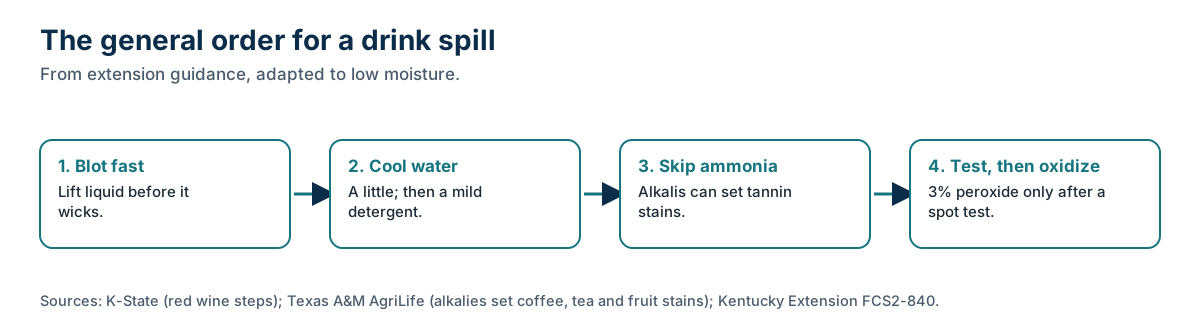
Coffee, wine and tea stain a mattress because they carry plant pigments that cling to fiber. Extension guides call them tannin stains. Coffee gets its brown from melanoidins formed when beans are roasted. Black tea gets its color from theaflavins and related tea pigments. Red wine is colored by anthocyanins, whose shade shifts with pH. They aren't protein stains, but alkalis such as ammonia can set them, so the safe order is blot fast, use cool water and a mild detergent, and test before any oxidizer.
General information about stain chemistry, not medical advice.
What makes a stain a tannin stain?
The name comes from tannins, a group of plant polyphenols that bind to proteins and fibers. University of Kentucky Extension groups a long list of drinks in its tannin family: alcoholic beverages, beer, coffee, tea, soft drinks, fruit juice and more. Its advice for washable fabrics is that "Fresh tannin stains are usually removed by laundering in detergent and hot water (as safe for fabric) without any special treatment," while "Old tannin stains may need bleaching for complete removal."
That hot-water advice is the opposite of the protein rule, and it's worth seeing why. Tannin pigments don't coagulate the way blood proteins do, so heat doesn't cook them into the fabric. But a mattress isn't a washable fabric. Hot water on a bed means more moisture going deeper and more heat on materials that may not tolerate it. K-State also warns that "For any unknown stains, never use hot water," and a coffee with milk is no longer purely a tannin stain.
What colors coffee?
Mostly the roast. Iriondo-DeHond and colleagues explain that coffee melanoidins "are generated by the Maillard reaction" during drying and roasting, and describe them as "the brown pigments formed as the end products of this reaction." Brewed coffee is one of the main dietary sources of them. Melanoidins are large, complex molecules, which helps explain why an old coffee stain can be stubborn.
Milk and cream change the picture. Milk adds protein and fat, so a latte spill is part tannin, part protein, part oil. In the stain families' own terms, that pushes it toward a mixed stain, and the protein part brings back the cool-water rule from the heat and blood article.
What colors tea and wine?
In black tea, the leaf's catechins oxidize during processing into new pigments. He's review of theaflavins describes them as "the smallest tea-pigments," positively correlated with the color of black tea liquor; isolated, they form an orange-yellow solid. Larger, browner tea pigments form alongside them.
Red wine's color comes from anthocyanins. Khoo and colleagues describe anthocyanins as red, purple and blue plant pigments whose color and stability "are influenced by pH, light, temperature, and structure," and write: "In acidic condition, anthocyanins appear as red but turn blue when the pH increases." Wine is acidic, so it spills red.
| Drink | Main colored compounds | Behavior that matters on fabric | Source |
|---|---|---|---|
| Coffee | Melanoidins | Brown, from roasting; large molecules | Iriondo-DeHond 2021 |
| Black tea | Theaflavins and other tea pigments | Orange-yellow to brown | He 2017 |
| Red wine | Anthocyanins | Red in acid, toward blue as pH rises | Khoo 2017 |
| All three | Tannin family | Can be set by alkalies such as ammonia | Texas A&M |
Why can an alkaline cleaner make things worse?
Two reasons. The first is that pH changes how anthocyanins look. Push a wine stain toward alkaline and the pigment can shift toward purple or blue. It looks different, but it hasn't gone anywhere, and a gray-blue patch can be harder to hide than a red one.
The second reason is the setting effect. Texas A&M AgriLife notes that "Some stains (for example coffee, tea, and fruits) are set by alkalies such as ammonia." That rules out ammonia-based cleaners on drink spills, and on wool-topped mattresses ammonia is out anyway: Georgia Extension warns that "Ammonia damages silk and wool," and the Woolwise scouring notes say too much alkali damages wool. The pH article covers what acids and alkalis do to each mattress material.
What do the guides suggest for red wine?
K-State's red wine routine is a good example of working from mild to strong: "Blot the stain with cold water followed by dishwashing liquid and rinse with more cold water. If the stain is still there, repeat the process with vinegar. If that still doesn't work, use 3 percent hydrogen peroxide, if it is safe for the fabric and the color." Vinegar is mildly acidic, which keeps anthocyanins on the red side and away from the alkaline setting problem. Peroxide is an oxidizer that can lighten the pigment, and the peroxide article explains why it can lighten colored ticking too.
On a mattress, every step uses less liquid than the guide imagines: a damp cloth, not a rinse. Kentucky's guide repeats the same caution throughout: check colorfastness on a hidden spot before using any bleach or solvent.
What other spills behave the same way?
Kentucky's tannin family is broader than coffee, tea and wine. It also lists beer, cologne, fruit juice (apple, grape, orange), soft drinks, tomato juice, washable felt-tip ink, and berries such as cranberries, raspberries and strawberries. The same rules apply: blot, cool water, a mild detergent, and no ammonia. Texas A&M AgriLife names fruits alongside coffee and tea among the stains alkalies can set.
Some of these share wine's color chemistry. Khoo and colleagues note that "Berries, currants, grapes, and some tropical fruits have high anthocyanins content," so grape juice and berry spills can shift toward blue under an alkaline cleaner, just as wine does. Kentucky places cherry and blueberry in a separate dye family, a reminder that the families are working categories, not strict chemistry. When a drink stain doesn't respond to the tannin approach, the dye approach is the next step: detergent, then a bleach that's safe for the fabric, after a spot test on a hidden area.
Why does a drink spill leave a ring?
Because of how drops dry. Deegan and colleagues showed in Nature that when a drop dries with its edge pinned, liquid flows outward to replace what evaporates at the rim, carrying dissolved and suspended material with it. Coffee is the classic example, which is why it's called the coffee-ring effect. On a mattress, the same flow pushes pigment to the edge of the wet patch, leaving a darker outline. Adding more water to a dried ring can move the outline outward. The article on stains that come back explains how to avoid that.
Sleep Sanitation's view
Here's how we look at drink spills. Whether one lifts depends on its age, its size and the fabric under it, so we can't promise any stain will come out. Organic cleaning methods are our default, and our Italian-made Vapor Clean machines let us adjust output and pass speed to the ticking. We make no health claim; our wording follows the CDC's cleaning and sanitizing terms. That approach is our own reasoning, not a manufacturer exemption. Your care label and warranty terms govern, so check your warranty terms before you book. The pricing page lists our prices, and the stain chemistry hub has the other families.
What we don't know
- How quickly coffee, tea and wine pigments bind to common ticking fibers. We found no study on mattress fabrics.
- Whether a set tannin stain on a mattress responds differently from one on cotton, given the foam and fiber below.
- How much milk or sugar in a drink changes how removable its stain is.
Changelog
- 5 October 2026: First published. Sources accessed on this date.
Sources
- Stain Removal for Washable Fabrics (FCS2-840) · University of Kentucky Cooperative Extension
- Removing Stains From Washable Fabric (2025) · Texas A&M AgriLife Extension
- Stain Removal (accessed 2026-10-05) · K-State Research and Extension, Greenwood County
- Anthocyanidins and anthocyanins: colored pigments as food, pharmaceutical ingredients, and the potential health benefits (Khoo et al., Food and Nutrition Research, 2017) · PubMed Central
- Research progress on theaflavins: efficacy, formation, and preparation (He, Food and Nutrition Research, 2017) · PubMed Central
- Interest of Coffee Melanoidins as Sustainable Healthier Food Ingredients (Iriondo-DeHond et al., Frontiers in Nutrition, 2021) · PubMed Central
- Capillary flow as the cause of ring stains from dried liquid drops (Deegan et al., Nature, 1997) · Nature
- Remove Stains from Blood (accessed 2026-10-05) · University of Georgia Extension, Textiles
- Aqueous Scouring and Detergents (Wool 482/582 lecture notes) · Australian Wool Education Trust / University of New England (Woolwise)
- Cleaning and disinfecting your school (definitions) · CDC
Last reviewed October 5, 2026. Manufacturer specifications and care instructions change; check the current version for your exact model. This page is general information, not medical advice. How we source and check pages: editorial standards.