
Short answer
Sometimes, with a test first. Three percent hydrogen peroxide is a mild oxidizing bleach that extension guides use on leftover blood and tannin stains. Kentucky Extension calls it safe for all fibers but says to test colorfastness on dyed fabrics, because it can lighten dye as well as stain. On colored or patterned ticking, a hidden spot test comes first, and the stronger hair-bleach strength never belongs on a mattress.
Key terms used on this page
- Hydrogen peroxide (3 percent):
- A mild oxidizing bleach sold as an antiseptic. Kentucky Extension says it is safe for all fibers but to test for colorfastness on dyed fabrics, and not to use the stronger solution sold for bleaching hair.
- Catalase:
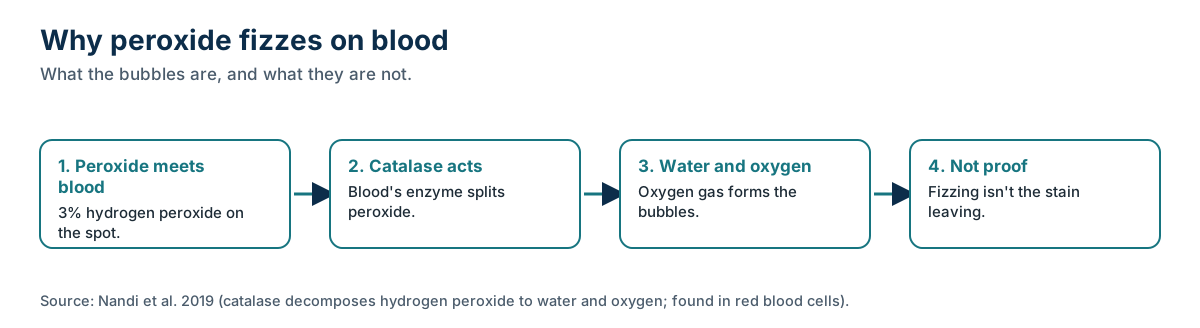
- An enzyme present in almost all aerobic organisms, including in red blood cells, that splits hydrogen peroxide into water and oxygen. The oxygen it releases is the fizz when peroxide meets blood.
- Colorfastness:
- How well a dyed fabric keeps its color when it meets water, cleaners or bleach. Extension guides tell you to pretest any cleaning agent on a hidden area first to check it.
- Spot test:
- Trying a cleaning agent on a hidden area first and checking for color change or damage before treating the stain. Georgia Extension tells readers to always pretest each cleaning agent this way.
- Protein stain:
- A stain whose main ingredient is protein, such as blood, vomit, feces, mucus or egg. Extension guides treat it with cold water first because heat makes the protein coagulate between the fibers.
Hydrogen peroxide can be used on a mattress stain, but only after a spot test. The 3 percent solution sold as a mild antiseptic, the strength Kentucky Extension specifies, is an oxidizing bleach. Extension guides use it as a late step on blood and tannin stains, after cool water and detergent or an enzyme have done what they can. Kentucky Extension calls it safe for all fibers but says to test colorfastness on dyed fabrics, because the same oxidizing action that lightens a stain can lighten a dye.
General information about cleaning chemistry, not medical advice.
What is hydrogen peroxide doing to a stain?
Hydrogen peroxide is an oxidizer. The Royal Society of Chemistry explains that the color in a stain comes from parts of molecules called chromophores, often chains of alternating double and single bonds, and that bleaches "oxidise coloured substances to colourless ones" by breaking bonds within the chromophore. The RSC adds that the fragments are "generally more soluble in washing water than the original stain." A mattress has no wash water, so a bleached spot may look gone before the residue is.
The extension guides reflect that by placing peroxide late. Georgia Extension's blood guide works through cool water, detergent and a lukewarm enzyme presoak first, then: "If stain still remains, put a few drops of 3 percent hydrogen peroxide on stain for 1-3 minutes. Rinse thoroughly." K-State suggests the same 3 percent strength for red wine that survives cold water, dish soap and vinegar, "if it is safe for the fabric and the color." In both, peroxide is a finishing tool, not a first move.
Why does it fizz on blood?
The bubbling is a second reaction. Blood contains catalase, an enzyme that Nandi and colleagues describe as decomposing hydrogen peroxide "to innocuous products such as water and oxygen"; their review discusses catalase levels in red blood cells. The oxygen gas is the foam. It tells you catalase is present. It doesn't tell you the stain is leaving.
The fizz has a practical side. Catalase uses up peroxide, so on a fresh, heavy blood spot a lot of the peroxide may be spent making bubbles. That's one reason the guides start with cool water and enzymes and keep peroxide for what's left.
Why can it lighten colored ticking?
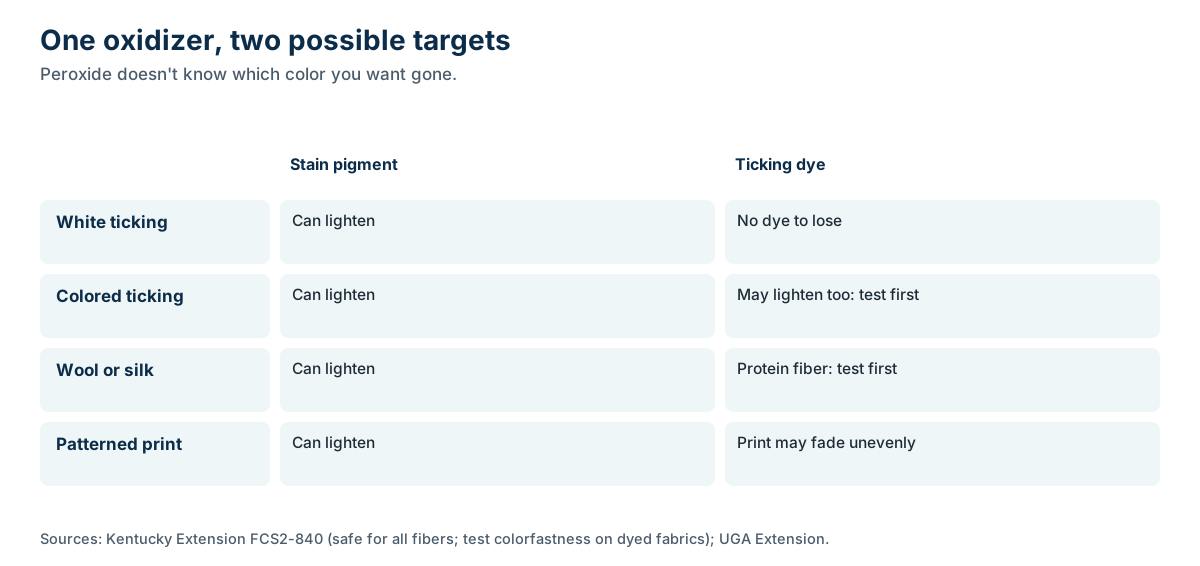
Because dyes are colored molecules too. An oxidizer doesn't know which color you want gone. Kentucky Extension writes that "Hydrogen peroxide is safe for all fibers, but test for colorfastness on dyed fabrics." That sentence covers two separate risks. By Kentucky's account the fiber itself tolerates the mild solution; the dye on that fiber may or may not hold up.
Mattress ticking ranges from plain white to tinted knits, printed patterns and dark side panels. White ticking has no dye to lose. On colored or printed ticking, a light patch where the stain used to be can look worse than the stain. A pattern can also fade unevenly, so one color in a print goes pale and another doesn't.
| Ticking | Peroxide on the stain | Peroxide on the fabric | Source |
|---|---|---|---|
| White | Can lighten | No dye to lose | UKY |
| Colored or dark | Can lighten | Test colorfastness first | UKY, UGA |
| Wool or silk content | Can lighten | Protein fiber: test first, use sparingly | UKY, UGA |
Wool and silk need extra care. Both are protein fibers: Kentucky warns that enzyme presoaks digest them, and Georgia's guide notes that "Ammonia damages silk and wool." Neither guide sets a peroxide rule for wool, so treat it like any dyed fabric and test first. The compatibility hub's wool page covers that material on a mattress.
What strength is right?
The guides we cite use 3 percent. Kentucky describes it as "a 3 percent solution of hydrogen peroxide sold as a mild antiseptic" and adds: "Do not use the stronger solution sold for bleaching hair." Stronger solutions oxidize faster and further, which raises the risk to dyes and to anything else they touch. There's no case in the extension guidance for using them on fabric, let alone on a bed you sleep on.
How do you test it first?
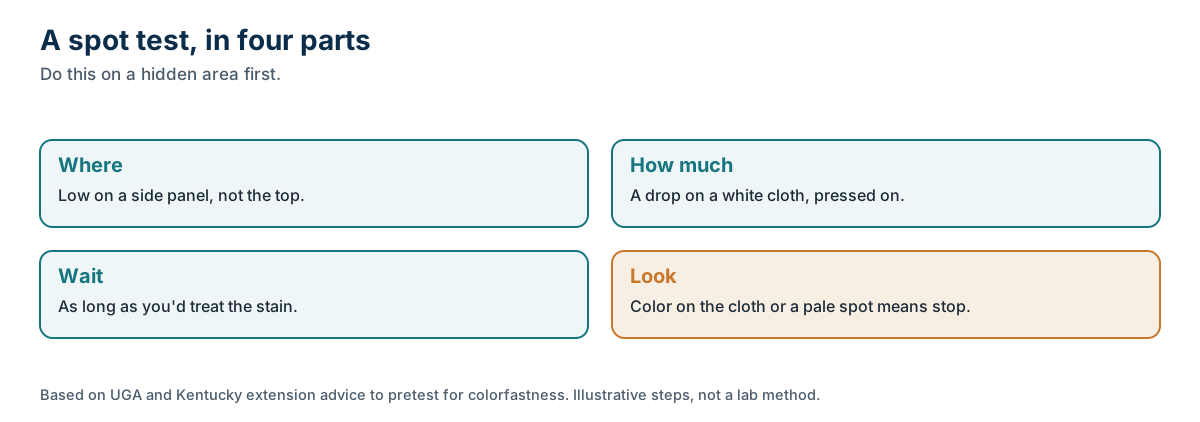
Georgia Extension gives the rule without exceptions: "Always pretest each cleaning agent on an inconspicuous area first to determine colorfastness." On a mattress, a low spot on a side panel is a reasonable place to test. Use the same strength you'd use on the stain, apply it with a white cloth, wait as long as you'd treat the stain, and look at both the cloth and the fabric. Color on the cloth or a paler patch on the ticking means stop.
How much liquid is too much?
Peroxide is mostly water. Kentucky notes that "Thorough rinsing is needed to remove bleach from fabrics," and on a shirt that means a sink. On a mattress it means a few drops of peroxide and then a cloth dampened with clean water, blotted, not poured. Liquid that goes deep has to dry back out, and it carries dissolved material to the edge as it goes. The article on stains that come back explains why that leaves rings, and the heat article explains why you shouldn't speed the drying with a hair dryer.
How does peroxide compare with other bleaches?
Kentucky's guide sorts household bleaches into three kinds, and the differences explain why peroxide is the one most often suggested for blood. Kentucky's 3 percent hydrogen peroxide comes with the colorfastness caveat quoted above. All-fabric oxygen bleach gets the same kind of test: "If there is a color change, do not use the all-fabric bleach."
Chlorine bleach is stronger and narrower. Kentucky Extension says "Chlorine bleach is more effective than oxygen bleach but might damage some fibers, dyes, and finishes," and rules it out on silk, wool, spandex, urethane and polyurethane foam. Most mattresses contain at least one of those, which is why chlorine bleach rarely belongs anywhere near one.
| Bleach type | What Kentucky says | Mattress takeaway |
|---|---|---|
| Hydrogen peroxide, 3 percent | Safe for all fibers; test dyed fabric; rinse thoroughly | Possible on a spot, after a test, with little liquid |
| All-fabric (oxygen) bleach | Test on a hidden area; stop if color changes | Same test-first rule; harder to rinse from a mattress |
| Chlorine bleach | More effective, but can damage fibers, dyes and finishes | Not on wool, spandex, urethane or polyurethane foam |
Where does peroxide fit with other stains?
It's a general oxidizer, so it shows up in guides for blood, wine and some dye stains. It's the wrong tool for oily stains, which need detergent or solvent first; the lotion and oil article covers those. On blood that hasn't been lifted, it's a weaker first step than cool water, and the fresh versus dried blood article explains why time matters. Iowa State also reminds readers to check colorfastness before any treatment, which applies here twice over.
Sleep Sanitation's view
This section is our view. Peroxide is a reasonable home step on white ticking after a spot test, and a risky one on colored fabric. For blood and other body fluids we stay with general chemistry here and don't publish our process; we assess each bed, and severe or biohazard jobs are quoted before we start. We make no disinfection claim; our terms follow the CDC's definitions. That's our own reasoning, not a manufacturer exemption. Your care label and warranty terms govern, so check your warranty terms before you book, and see the pricing page. The stain chemistry hub has the rest.
What we don't know
- How hydrogen peroxide affects the foam and adhesives below the ticking. The guides cover fabric, not mattress cores.
- Which common ticking dyes are most sensitive to 3 percent peroxide. We found no published list.
- How much catalase activity remains in an old, dried bloodstain, and so how much fizz to expect.
Changelog
- 5 October 2026: First published. Sources accessed on this date.
Sources
- Stain Removal for Washable Fabrics (FCS2-840) · University of Kentucky Cooperative Extension
- Remove Stains from Blood (accessed 2026-10-05) · University of Georgia Extension, Textiles
- Stain Removal (accessed 2026-10-05) · K-State Research and Extension, Greenwood County
- Role of Catalase in Oxidative Stress- and Age-Associated Degenerative Diseases (Nandi et al., Oxid Med Cell Longev, 2019) · PubMed Central
- Biphasic Oxidation of Oxy-Hemoglobin in Bloodstains (Bremmer et al., PLOS One, 2011) · PLOS One
- Holiday Stains (AnswerLine, 13 Dec 2022) · Iowa State University Extension and Outreach
- Cleaning and disinfecting your school (definitions) · CDC
- Chemistry in your cupboard: Vanish · Royal Society of Chemistry
Last reviewed October 5, 2026. Manufacturer specifications and care instructions change; check the current version for your exact model. This page is general information, not medical advice. How we source and check pages: editorial standards.