
Short answer
Dried blood has clotted, oxidized and wicked deeper. Fresh blood is a bright red liquid that cool water can still carry away. As it dries, fibrin forms a stiff mesh, and hemoglobin oxidizes from red to dark brown, quickly at first and then more slowly. That's why old stains need patience, a cool soak or an enzyme product, not force or heat. Severe or biohazard jobs are quoted before we start.
Key terms used on this page
- Fibrin clot:
- The mesh of fibrin protein that blood forms as it clots, which stabilizes the platelet plug. In a stain, it is part of what makes dried blood stiffer and harder to lift than fresh blood.
- Hemoglobin oxidation:
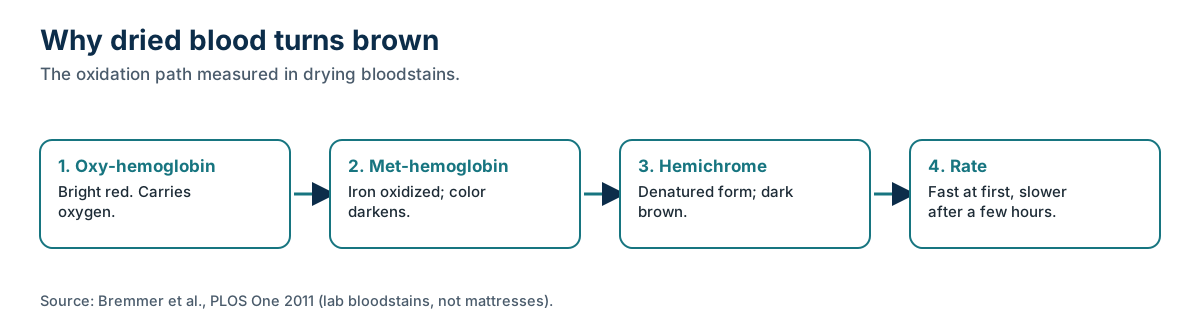
- The chemical change that turns a bloodstain from bright red to dark brown as oxygen-carrying hemoglobin converts to methemoglobin and then hemichrome. Bremmer and colleagues found the change is fast at first and slows after a few hours.
- Protein stain:
- A stain whose main ingredient is protein, such as blood, vomit, feces, mucus or egg. Extension guides treat it with cold water first because heat makes the protein coagulate between the fibers.
- Heat-set stain:
- A stain that has become harder to remove because heat fixed it in place. Kentucky Extension warns never to iron stained fabrics because heat sets stains, and Georgia Extension says stains set by heat will be difficult to remove.
- Detergent enzymes:
- Enzymes added to cleaners to break specific bonds in soil: proteases for protein, lipases for fats and oils, amylases for starch. Each targets its own kind of soil.
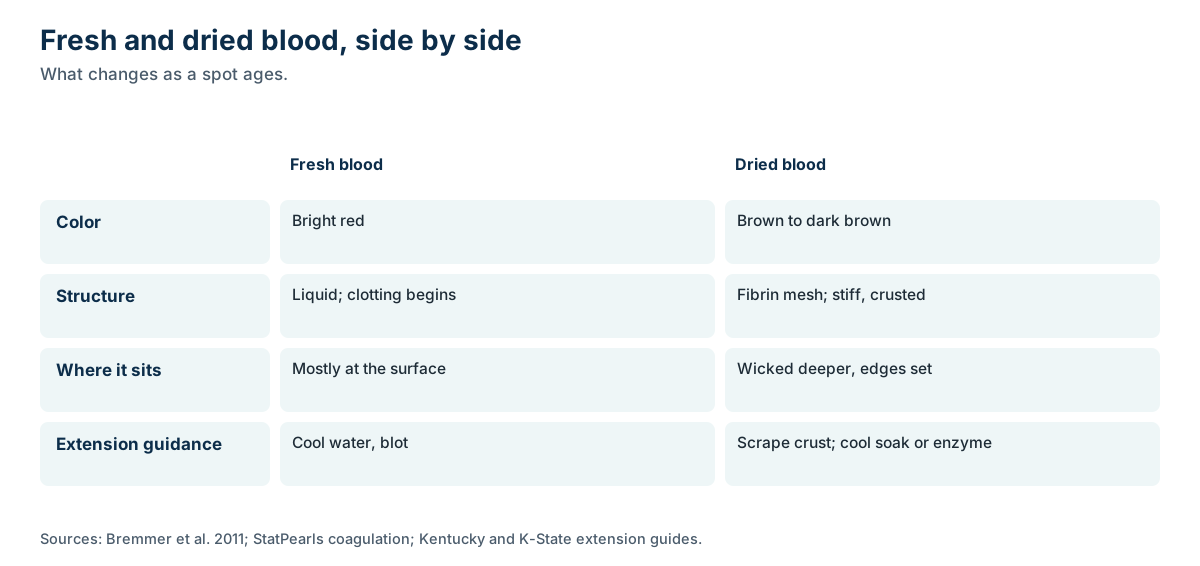
Dried blood differs from fresh blood in three ways: it has clotted, it has oxidized, and it has had time to wick deeper. Fresh blood is a bright red liquid sitting mostly at the surface, where cool water can still carry it away. As it dries, a fibrin mesh stiffens it, and hemoglobin oxidizes from red to brown, quickly at first and then more slowly. Old stains respond to patience, a cool soak or an enzyme product, not to force or heat.
General information about stain chemistry, not medical advice.
What happens to blood in the first minutes?
StatPearls' chapter on coagulation pathways describes clotting as a cascade in which two pathways converge on fibrin activation, a process that aims "to stabilize the platelet plug with a fibrin mesh." In the body, that mesh helps stop bleeding. We found no study of clotting inside fabric, but the same protein network is the likeliest reason a dried spot feels stiff and crusted rather than just colored.
At the same time, blood is spreading. Mattress ticking is usually quilted over fiber batting and foam, and liquid that isn't blotted moves both sideways and down. The longer it sits liquid, the more of it ends up below the surface, where a cloth can't reach. That's why Georgia Extension opens its blood guide with two words: "Treat immediately."
Why does blood turn brown?
The color change is chemistry, not dirt. Bremmer and colleagues, studying bloodstains for forensic dating, write that bloodstains "transit from bright red to dark brown," a change they attribute to oxy-hemoglobin oxidizing to met-hemoglobin and then to hemichrome. They found the first step biphasic: "At first, the oxidation of HbO2 is rapid, but slows down after a few hours." The rates were "strongly temperature dependent," and the later step to hemichrome depended strongly on humidity.
For a mattress owner, the takeaway is modest: the brown you see on an old spot is changed hemoglobin, not something that soaked in later.
Both studies measured stains under controlled conditions on lab surfaces. Neither tested blood in quilted ticking over foam, so we use them to explain the color, not to date a stain on your bed.
| Change | What drives it | What the source measured |
|---|---|---|
| Red to brown | Oxy-hemoglobin to met-hemoglobin to hemichrome | Bremmer 2011: rapid at first, slower after a few hours; strongly temperature dependent |
| Continued color drift | Ongoing oxidation and denaturation | Marrone 2021: color tracked hourly for a day, then daily for 60 days |
| Stiffening | Fibrin mesh from clotting | StatPearls: fibrin stabilizes the platelet plug |
Why is dried blood harder to lift?
Three things stack up. Clotted blood is no longer a free liquid, so it doesn't rinse out the way fresh blood does. The protein has had time to settle into the spaces between fibers. And the stain has usually spread below the top layer, so what you see is only part of it.
There's a fourth factor that people add themselves: heat. A dried stain that's been hit with a hair dryer, an iron or hot water has had its protein coagulated as well as oxidized. The article on why heat sets blood covers that. In the extension guides' terms, browning makes a stain harder; heat is what tends to make it permanent.
Can the color tell you how old a stain is?
Only roughly, and only under laboratory conditions. Forensic scientists have tried. Marrone and colleagues measured the color of eight bloodstains with a colorimeter, hourly for most of the first day and then daily for 60 days, and built models to estimate a stain's age from its color. They describe the work as "a small-scale study" and a starting point for forensic research. Because Bremmer's team found the oxidation rates depend strongly on temperature, the same stain darkens at different speeds in a warm room and a cool one, and Marrone's color coordinates kept shifting across the full 60 days.
Two lessons carry over to a mattress. The color change is real chemistry, regular enough that researchers can model it when everything else is held constant. And on a bed, nothing else is held constant: ticking color, lighting, the amount of blood and how far it soaked in all change what you see. A brown spot tells you the blood is no longer fresh. It doesn't tell you whether it's a day or a month old, or how hard it will be to lift.
| Stage | What you see | What's happening | Source |
|---|---|---|---|
| Minutes | Bright red liquid | Oxy-hemoglobin; clotting begins | Bremmer 2011; StatPearls |
| Hours | Darkening red | Rapid first oxidation step | Bremmer 2011 |
| Days to weeks | Red-brown to brown | Slower oxidation continues | Bremmer 2011; Marrone 2021 |
What do extension guides suggest for dried blood?
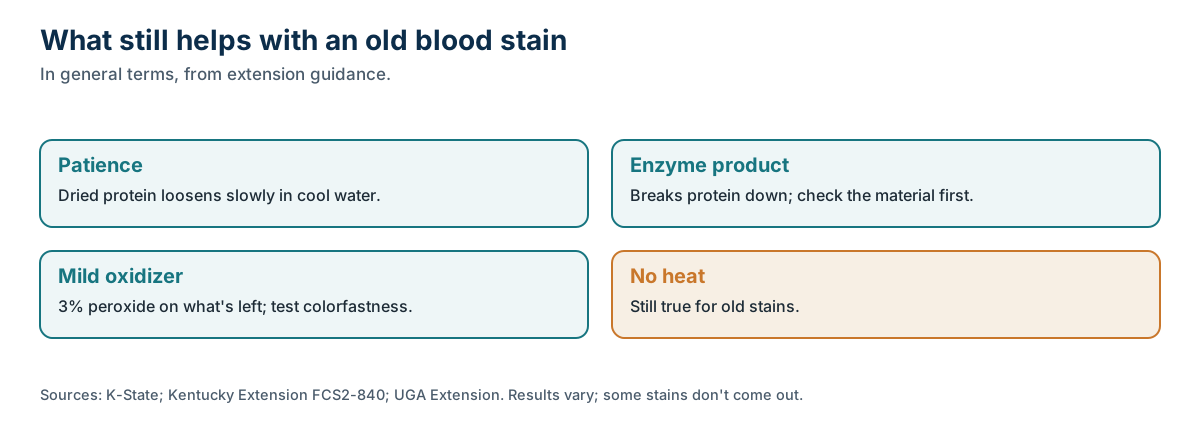
The guides adjust the approach rather than reversing it. Kentucky Extension says that if protein stains are dried or old, "scrape or brush off crusted matter (if any) then soak in cold water using a detergent or an enzyme presoak product." K-State suggests pretreating dried blood in warm water with a product containing enzymes, while saying of fresh blood: "do not use hot water as it will set blood stains." Warm, in that advice, is not hot.
On a mattress, soaking isn't an option, so the same chemistry has to work with far less water and more time. Enzymes need contact and moisture to work, which is the trade-off the enzyme article walks through. For what's left after that, hydrogen peroxide is the usual mild oxidizer, with a colorfastness test first. Wool and silk are exceptions for enzymes, as Kentucky warns, because both are protein fibers.
Does the edge of a dried blood stain matter?
Often it's the darkest part. As a liquid spot dries, flow toward its edge carries dissolved material outward, the effect Deegan and colleagues described for ring stains. A blood spot that dried undisturbed can have a darker rim and a lighter center. If you treat only the center with too much water, you can push a new ring out past the old one. The article on stains that come back explains how to avoid that.
When is an old blood stain not a cleaning question?
When it's large, soaked through to the core, or part of a bigger event. Volume and depth change the job, and Hub 6 covers when a mattress is too contaminated to clean. Some stains simply won't come out, and Kentucky is frank that some stains are "impossible to remove." A stain that's faded but visible may be the realistic best case.
Sleep Sanitation's view
This section is our view. Age changes a blood stain, so we assess every bed before we treat it, and severe or biohazard jobs are quoted before we start. We don't publish a step-by-step process for blood or other body fluids, and we don't promise a stain will come out. Our cleaning language follows the CDC's distinction between cleaning, sanitizing and disinfecting; we make no disinfection claim. That's our own reasoning, not a manufacturer exemption. Your care label and warranty terms govern, so check your warranty terms before you book. See the pricing page for costs, and the stain chemistry hub for other stains.
What we don't know
- How quickly blood oxidizes inside mattress ticking and batting, as opposed to the lab surfaces in the forensic studies.
- Whether a stain's color tells you how removable it is. The studies link color to age, not to removal.
- How deep a typical blood spot wicks into a quilted top before it dries.
Changelog
- 5 October 2026: First published. Sources accessed on this date.
Sources
- Biphasic Oxidation of Oxy-Hemoglobin in Bloodstains (Bremmer et al., PLOS One, 2011) · PLOS One
- Short and Long Time Bloodstains Age Determination by Colorimetric Analysis: A Pilot Study (Marrone et al., Molecules, 2021) · PubMed Central
- Physiology, Coagulation Pathways (Chaudhry, Killeen and Babiker, StatPearls) · PubMed / NCBI Bookshelf
- Stain Removal for Washable Fabrics (FCS2-840) · University of Kentucky Cooperative Extension
- Remove Stains from Blood (accessed 2026-10-05) · University of Georgia Extension, Textiles
- Stain Removal (accessed 2026-10-05) · K-State Research and Extension, Greenwood County
- Holiday Stains (AnswerLine, 13 Dec 2022) · Iowa State University Extension and Outreach
- Capillary flow as the cause of ring stains from dried liquid drops (Deegan et al., Nature, 1997) · Nature
- Cleaning and disinfecting your school (definitions) · CDC
Last reviewed October 5, 2026. Manufacturer specifications and care instructions change; check the current version for your exact model. This page is general information, not medical advice. How we source and check pages: editorial standards.