
Short answer
Mostly because of body oils rather than the salts in sweat. Chi and Obendorf's textile review attributes fabric yellowing mainly to residual oily soils, and their squalene study found that aging oil forms colored compounds. Sebum, the skin's oil, contains squalene and wax esters, Picardo's team reports. The review also ties aging to harder removal, which is why old yellowing resists cleaning.
Key terms used on this page
- Sebum:
- The oily film made by the skin's sebaceous glands. Picardo and colleagues describe squalene and wax esters as lipids unique to human sebum.
- Lipid autoxidation:
- The slow reaction of unsaturated fats and oils with oxygen in air. On fabric, Chi and Obendorf's review links it to the yellowing of aged oily soils.
- Oil-based stain:
- A stain from fats, oils or waxes, including hand lotion, face cream, hair oil and the greasy rings that body oils leave on collars. It needs detergent or a solvent rather than plain water.
- Lipase:
- An enzyme that cuts the ester bonds in fats and oils. In cleaners it targets body oils, lotions and greasy food soil.
- Stain family:
- A group of stains that share chemistry and so share a first treatment. University of Kentucky Extension sorts stains into protein, tannin, oil-based, dye and combination families, plus a group that needs special methods.
Textile research points to body oils, not the salts in sweat, as the main cause of yellowing on fabric like mattress ticking. Chi and Obendorf's review attributes fabric yellowing mainly to residual oily soils, and their squalene study found aged oil forms colored compounds. Sebum, the skin's oil, contains squalene and wax esters, according to Picardo's team. The same review ties aging to harder removal, which is why old yellowing resists cleaning.
General information about stain chemistry, not medical advice.
What does a sleeper actually leave on a mattress?
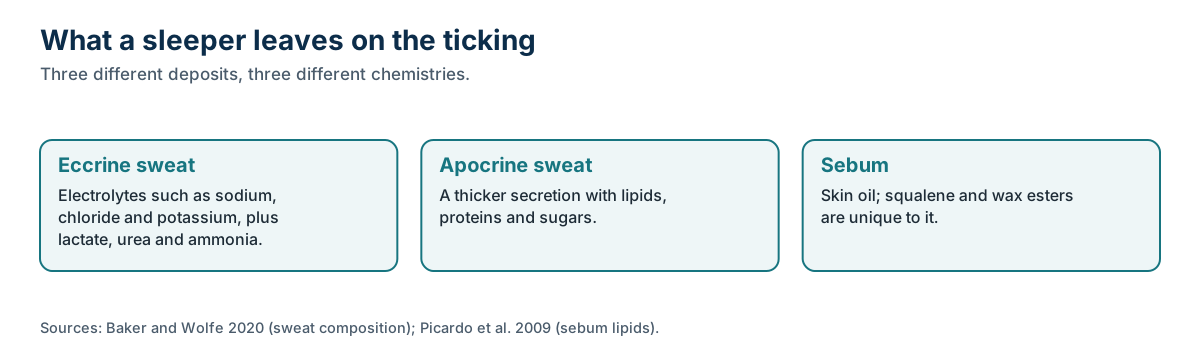
Three things, each with its own chemistry. The first is eccrine sweat, the watery kind that cools you. Baker and Wolfe's review of sweat composition lists its major electrolytes as sodium, chloride and potassium, along with metabolites such as lactate, ammonia and urea. When it dries, the water leaves and a faint salt residue stays.
The second is apocrine sweat, from glands in places like the armpits. The same review describes it as a more viscous secretion "containing lipids, proteins, sugars, and ammonia." The third is sebum, the skin's own oil. Picardo and colleagues write that human sebum contains unique lipids, "such as squalene and wax esters not found anywhere else in the body." Add hair products and lotions, covered in the lotion and oil article, and the top of a mattress collects a thin, mixed film night after night.
Why do the oils yellow and the salts don't?
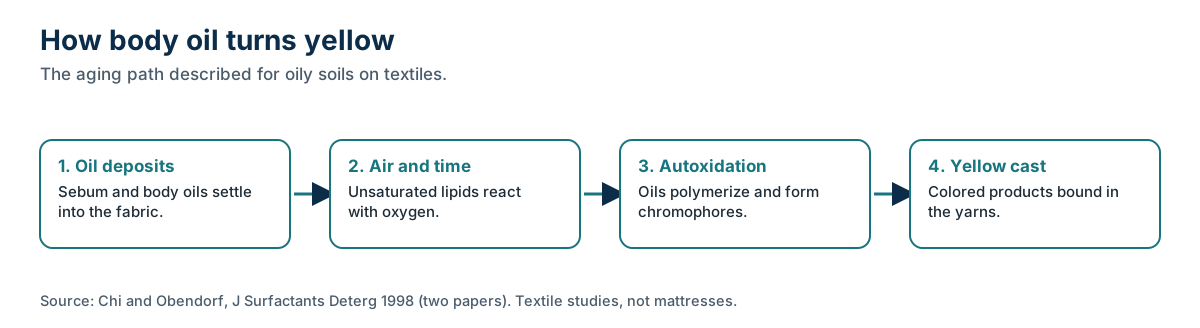
Salt residue isn't what the textile researchers blame. Chi and Obendorf's review of oily soil on textiles states that "Yellowing of fabrics is attributed mainly to residual oily soils although there are other causes," and says "Oxidation of unsaturated oils was suggested as the cause of problems related to aging of oily soils."
Their companion study on squalene-soiled cotton explains the color: "oily soils undergo autoxidation, which results in polymerization and formation of chromophores." A chromophore is the part of a molecule that absorbs visible light and so looks colored. In plain terms, oil that was nearly colorless becomes a yellowish, partly hardened film.
Why does old yellowing resist cleaning?
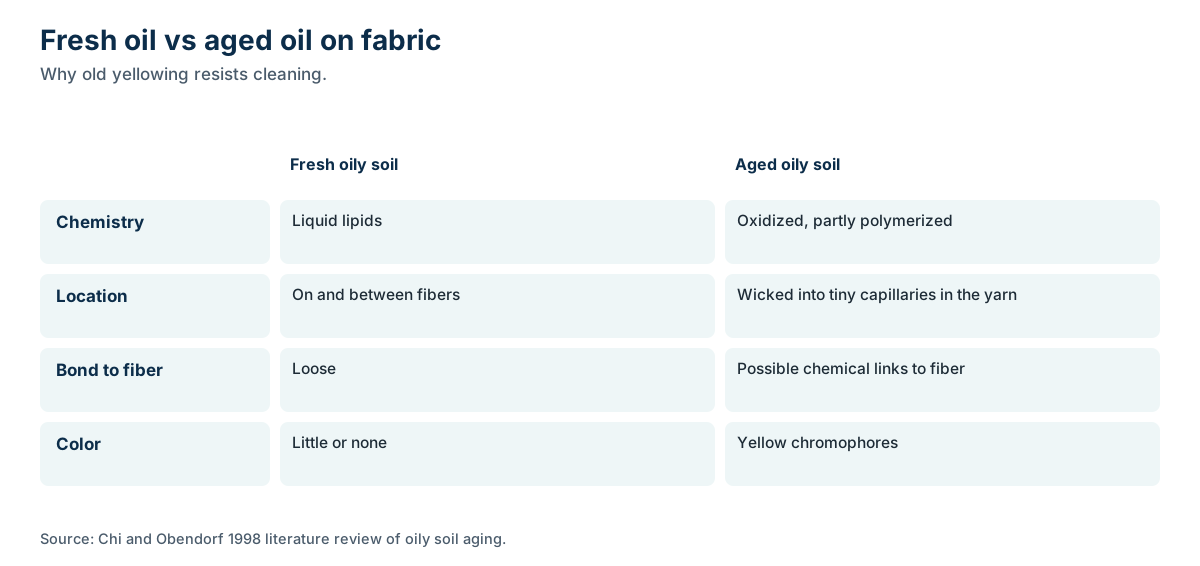
Because the oil isn't the oil it was. Chi and Obendorf attribute the effect of aging on oily soil removal to three things: "this oxidation of unsaturated oils, wicking of oils into small capillaries within the yarn structure, and possible chemical linkages of aged oils with fibers." Each one makes the soil harder to wash out.
| What aging does | Why it matters for removal | Source |
|---|---|---|
| Oxidizes unsaturated oils | Polymerized, colored products don't behave like fresh oil | Chi and Obendorf, review |
| Wicks oil into tiny capillaries in the yarn | Harder for cleaner to reach | Chi and Obendorf, review |
| May link aged oil to fibers | Soil may be partly bound, not just sitting there | Chi and Obendorf, review |
| Forms chromophores | The yellow can survive even when oil is reduced | Chi and Obendorf, squalene study |
The squalene study adds a caution about quick fixes. A reducing bleach restored whiteness on the test fabric without removing much oil, and the authors warned "the color will probably reverse by oxidation over time." A treatment that hides yellowing isn't the same as one that removes its cause.
What do extension guides suggest for perspiration?
The guides handle perspiration with a mix of approaches. Kentucky Extension suggests a prewash stain remover or bar soap, and then: "If perspiration has changed the color of the fabric, apply ammonia to fresh stains or white vinegar to old stains." Its oil-based family includes "collar/cuff greasy rings," the textbook example of body-oil soil. Texas A&M AgriLife lists perspiration among the stains that enzyme products help with, and NMSU recommends an enzyme presoak for blood and perspiration.
Two adjustments apply on a mattress. Ammonia is alkaline, and Georgia Extension warns that "Ammonia damages silk and wool," while the Woolwise scouring notes say "too much alkali can damage wool." So ammonia is out on wool-topped beds; the pH article explains why. And because a mattress can't be laundered, any product has to be used with very little water and blotted out.
Which enzyme matches body soil?
Body soil is mixed, so it takes more than one. As the enzyme article explains, lipases break the ester bonds in fats and oils, and proteases break down protein, such as the proteins in apocrine sweat. The enzyme article sets out which enzyme matches which stain. Enzymes need moisture and contact time to work, which on a mattress means a careful trade-off with drying. Hub 5 covers surface moisture versus saturation.
Can yellowing be slowed?
In a laboratory, yes; on a mattress, the evidence is thin. In their squalene study, Chi and Obendorf tested three antioxidants on cotton and reported that "they were found to be effective antioxidants for this purpose by preventing the discoloration of squalene upon aging." That was a finish applied to test fabric, and we don't know of any mattress ticking sold with one.
The practical levers are simpler. A washable layer between you and the mattress catches body oil before it reaches the ticking, and it can be laundered while the oil is still fresh, which is when Kentucky Extension says oil stains respond to a heavy-duty liquid detergent. Hub 6 weighs whether cleaning is still worth it with a protector. Time matters too, because the review ties the hardest problems to aged oily soil, so body oil is best dealt with before it has years to oxidize.
Is yellow foam the same problem?
Usually not. Yellowing on the cover fabric is most likely oxidized body oil. Foam inside a mattress can yellow on its own. A foam maker's discoloration information sheet explains that polyurethane foam made with an aromatic isocyanate yellows under UV light through oxidation of the polymer itself, and that "the yellow color cannot be extracted." No body soil is involved, and cleaning doesn't reverse it. If you see yellow on foam through an opened cover, don't assume it's sweat. And don't unzip a cover that isn't meant to come off; check the maker's instructions first.
Sleep Sanitation's view
This section is our view. Yellowing builds over years and is one of the stains we're most careful not to overpromise on; we can't say any stain will come out. Organic cleaning methods are our default, and our Italian-made Vapor Clean machines let us set output and pass speed to the ticking and fill in front of us. We use "sanitize" in the sense of the CDC's cleaning and sanitizing terms and make no health claim. That method is our own reasoning, not a manufacturer exemption; your care label and warranty terms govern, so check your warranty terms before you book. Prices are on the pricing page, and the stain chemistry hub covers the other families. A washable protector is the simplest prevention.
What we don't know
- How fast body oils yellow in mattress ticking specifically. The aging studies used test fabrics such as cotton.
- How much of a typical yellow patch is oxidized oil versus other causes, such as dyes, light or the fabric's own aging.
- Whether low-moisture methods can reach oil that has wicked into yarn capillaries. We found no study on mattresses.
Changelog
- 5 October 2026: First published. Sources accessed on this date.
Sources
- Physiological mechanisms determining eccrine sweat composition (Baker and Wolfe, Eur J Appl Physiol, 2020) · PubMed Central
- Sebaceous gland lipids (Picardo et al., Dermato-Endocrinology, 2009) · PubMed Central
- Aging of oily soils on textile materials: a literature review (Chi and Obendorf, J Surfactants Deterg, 1998) · Journal of Surfactants and Detergents (DOI)
- Preventing discoloration of squalene-soiled cotton fabrics with antioxidants (Chi and Obendorf, J Surfactants Deterg, 1998) · Journal of Surfactants and Detergents (DOI)
- Stain Removal for Washable Fabrics (FCS2-840) · University of Kentucky Cooperative Extension
- Removing Clothing Stains (Guide C-502) · New Mexico State University Cooperative Extension
- Removing Stains From Washable Fabric (2025) · Texas A&M AgriLife Extension
- Aqueous Scouring and Detergents (Wool 482/582 lecture notes) · Australian Wool Education Trust / University of New England (Woolwise)
- Remove Stains from Blood (accessed 2026-10-05) · University of Georgia Extension, Textiles
- Discoloration of Polyurethane Foam (information sheet) · Foamex (foam manufacturer)
- Cleaning and disinfecting your school (definitions) · CDC
Last reviewed October 5, 2026. Manufacturer specifications and care instructions change; check the current version for your exact model. This page is general information, not medical advice. How we source and check pages: editorial standards.