
Short answer
Mattress coils come in three common designs: open Bonnell coils, continuous coils formed from long strands of wire, and pocketed coils wrapped individually in fabric. A spring manufacturer describes pocketed coils as flexing independently. Coils are steel, and general chemistry says iron rusts when exposed to oxygen and water, faster with salts. A study of used mattresses found center springs weakened most.
Key terms used on this page
- Bonnell coil:
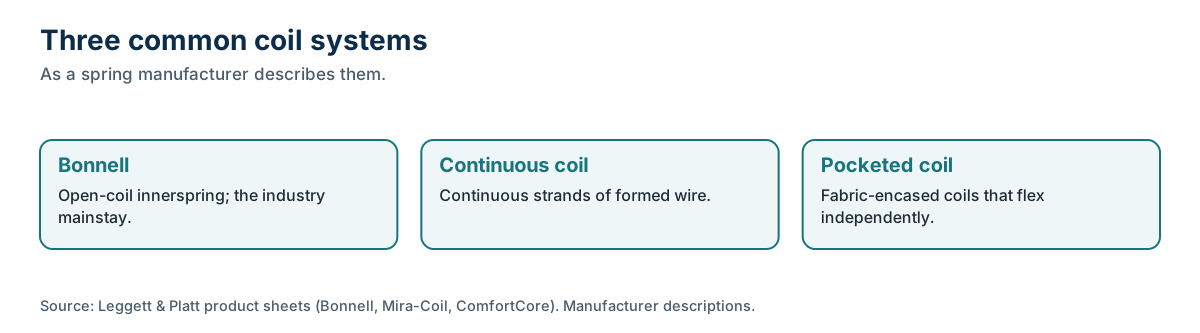
- An open-coil innerspring design. Spring maker Leggett & Platt calls Bonnell systems the mainstay of the industry.
- Continuous coil:
- A spring unit formed from long strands of wire rather than separate springs. Leggett & Platt describes its Mira-Coil system as continuous strands of specially formed wire.
- Pocketed coil:
- A spring sewn into its own fabric pocket. Leggett & Platt says its fabric-encased coils isolate motion transfer and that each coil flexes and moves independently.
- Tempered coil:
- A spring treated with heat or electricity to set its properties. Leggett & Platt says tempering gives its coils resilience and a uniform amount of resistance.
- Rust:
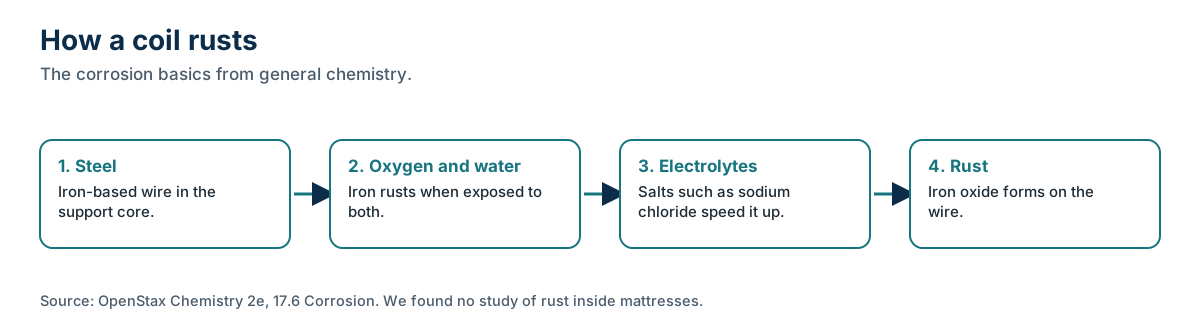
- Hydrated iron(III) oxide. OpenStax explains that iron rusts when exposed to oxygen and water, and that electrolytes such as sodium chloride speed the reaction.
- Innerspring mattress:
- A mattress whose support core is a unit of steel coils, with comparatively thin comfort layers and a quilted top. The coil core is open to airflow, which is one reason general cleaning guides treat innerspring beds as more tolerant of moisture than solid-foam beds.
- Hybrid mattress:
- A mattress that combines a coil support core with substantial comfort layers of foam, latex or another material on top. What applies to a hybrid depends on what sits under the cover: the coils below or the foam or latex above.
- Coil failure:
- Broken, bent or noisy springs in an innerspring or hybrid unit. Sleep Foundation notes that noisy springs are common in old innerspring mattresses and lists more noise than usual as a sign to replace. It is a mechanical problem, not a cleaning one.
Mattress coils come in three common designs. Bonnell coils are an open-coil design, continuous coils are formed from long strands of wire, and pocketed coils are individually wrapped in fabric. A spring manufacturer describes pocketed coils as flexing independently. Coils are steel, and general chemistry says iron rusts when exposed to oxygen and water, faster when salts are present. A study of used mattresses found the springs under the body weakened most.
General information about mattress materials, not medical advice.
Where do coils sit in a mattress?
In the core. Federal flammability rules define the core as "the main support system that may be present in a mattress, such as springs, foam, water bladder, air bladder, or resilient filling," as the law tag article explains. In an innerspring mattress the coil unit is the core, with comfort layers above. The compatibility hub describes an innerspring as a steel coil core with comparatively thin comfort layers and a quilted top, and a hybrid as a coil core with substantial comfort layers of foam, latex or another material.
Leggett & Platt, a manufacturer of mattress springs, publishes descriptions of its coil systems. We use them below because they're detailed and specific. They're manufacturer descriptions, so we attribute them rather than present them as independent findings.
What is a Bonnell coil?
The traditional design. Leggett & Platt's product sheet calls "Bonnell innerspring systems, the mainstay of the industry," and describes them as "Bonnell open-coil innersprings" that "make a versatile, supportive, and highly resilient sleep surface." The sheet also notes "Stress-Relieved Wire" that "Holds its shape and creates a more durable and consistent innerspring," and says the company "draws its own wire to ensure quality-controlled steel in every coil."
Unlike the fabric-encased coils described below, Bonnell coils aren't individually wrapped. The sheet says they're "manufactured using high-speed computer-controlled technology" and come in a wide range of heights and sizes.
What is a continuous coil?
A spring unit formed from long runs of wire rather than separate springs. Leggett & Platt's Mira-Coil sheet says the system "is made up of continuous strands of specially formed wire." The company claims the "continuous-coil design" maximizes surface coverage and creates a stable surface "supportive all the way to the edge." It also says the design offers "minimised partner disturbance, as well as no roll-together or roll-off." Those are the maker's performance claims; we found no independent test comparing them.
What is a pocketed coil?
A spring sewn into its own fabric pocket. Leggett & Platt's ComfortCore page describes "fabric-encased innersprings" and says "Our individually wrapped coils isolate motion transfer to minimize partner disturbance. Additionally, each coil flexes and moves independently to deliver support where it's needed most."
The fabric pockets add another material inside the core. Our own reasoning is that fabric holds liquid longer than bare wire, which is one more reason to keep water from reaching the core of any coil mattress.
What does "tempered" mean?
A heat or electrical treatment that sets the spring's properties. Leggett & Platt says "Our core unit coils feature added strength through heat- or electricity-tempering, giving the coil resilience and a uniform amount of resistance." The Bonnell and Mira-Coil sheets mention stress-relieved wire for a similar purpose: a spring that holds its shape.
Can mattress coils rust?
In principle, yes. Leggett & Platt's sheets describe steel coils, steel is an iron-based alloy, and OpenStax Chemistry states the basic rule: "Iron will rust when it is exposed to oxygen and water." Salt makes it worse: "The speed of the spontaneous reaction is increased in the presence of electrolytes, such as the sodium chloride used on roads to melt ice and snow or in salt water." OpenStax also explains that "What we call rust is hydrated iron(III) oxide."
Manufacturers protect steel in several ways, according to OpenStax. Paint protects iron "As long as the paint remains intact." Alloying works too: "stainless steel is mostly iron with a bit of chromium. The chromium tends to collect near the surface, where it forms an oxide layer that protects the iron." Galvanizing uses zinc, which oxidizes first, so "even if the zinc coating is scratched, the zinc will still oxidize before the iron." We don't know which, if any, of these a given mattress maker uses.
We found no study of rust inside mattresses. The practical point is simple: rust needs water, so the less water reaches the core, the less chance there is. Hub 5 explains how hybrid mattresses react differently from solid foam and how to tell if moisture reached the core.
Do springs wear out?
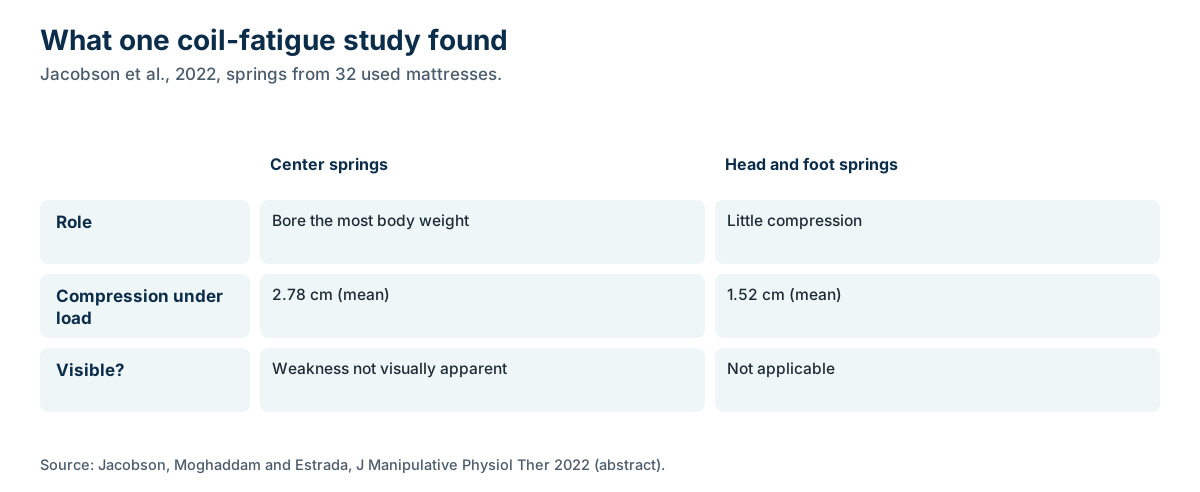
They do, and not evenly. Jacobson and colleagues (2022) compared springs taken from the center of 32 used mattresses with springs from the head and foot of the same mattresses. Unloaded, the two groups didn't differ: the study found "no significant group differences in weight or height in unloaded coils." Under a 1,296-gram weight, though, the center springs compressed further, 2.78 cm on average versus 1.52 cm. The study's force gauge told the same story: compressing the center springs 2 cm took about 1,091 grams of force, against about 1,213 grams for the head and foot springs. The authors concluded that weight-bearing springs "were weaker when compressed than the NWBS from used mattresses, and such characteristics may not be visually apparent in a mattress when not in use."
So a coil unit can lose support where you lie while looking fine. That's a mechanical change, and cleaning can't restore it. Hub 6 lists problems professional cleaning can't fix, including sagging and broken or noisy coils.
Do coils change how a mattress handles moisture?
The compatibility hub covers this in its innerspring page, which explains why coils change the moisture picture. Its glossary notes that a coil core is open to airflow, one reason general cleaning guides treat innerspring beds as more tolerant of moisture than solid foam. Tolerant isn't the same as immune. Everything above the coils, the quilting, comfort layers and any fire barrier, is foam or fabric, and the coils themselves are steel that can rust if water reaches them.
That's why we treat a coil mattress much like a foam one at the surface. The fire barrier article explains what sits just under the cover.
Sleep Sanitation's view
This section is our view. With a coil mattress, our aim is to keep water out of the core entirely, since steel and fabric pockets both sit below the comfort layers. So we work through the cover with low moisture and don't try to reach the springs. The care label and warranty terms govern; ours is our own reasoning and not a manufacturer exemption, so check your warranty terms before you book. The word "sanitize" follows the CDC's terms, and we make no disinfection claim. Leave the bed unmade until it's dry to the touch; our moisture check confirms it. The first mattress is $249 (see pricing). The ticking article covers what sits above the coils, and the mattress materials hub shows the whole stack.
What we don't know
- Whether rust forms inside mattresses in normal use, and how often. We found no study.
- What corrosion protection, if any, a given coil unit has. Spring makers' sheets don't say.
- How independent tests compare Bonnell, continuous and pocketed coils on durability. The descriptions we cite are the manufacturer's own.
Changelog
- 5 October 2026: First published. Sources accessed on this date.
Sources
- Bonnell innerspring product sheet · Leggett & Platt Bedding Components
- Mira-Coil innerspring product sheet · Leggett & Platt Bedding Components
- ComfortCore fabric-encased coils · Leggett & Platt Bedding Group
- Chemistry 2e, 17.6 Corrosion · OpenStax (Rice University)
- Mattress Coil Spring Fatigue and Weight-Bearing Support (Jacobson, Moghaddam and Estrada, J Manipulative Physiol Ther, 2022) · PubMed
- Cleaning and disinfecting your school (definitions) · CDC
Last reviewed October 5, 2026. Manufacturer specifications and care instructions change; check the current version for your exact model. This page is general information, not medical advice. How we source and check pages: editorial standards.