
Short answer
Flexible polyurethane foam is made by mixing two key chemicals, a polyol and an isocyanate, with water, according to the Polyurethane Foam Association. The reaction starts almost at once, gas bubbles expand the mix, and within minutes it sets into a solid foam. Most bedding foam is poured as a long slab, then cut and cured, and additives tune softness, firmness and fire performance.
Key terms used on this page
- Polyol:
- One of the two main ingredients of polyurethane. Gama and colleagues' review explains that polyurethanes form when the hydroxyl groups of a polyol react with the isocyanate groups of an isocyanate; the polyol forms the foam's soft segments.
- Isocyanate:
- The second main ingredient of polyurethane, carrying reactive NCO groups that link with a polyol. Gama and colleagues' review names MDI and TDI as the most commonly used isocyanates.
- Slabstock foam:
- Foam made in a continuous block: the liquid mix rises on a conveyor and is later cut into sheets and shapes. It's the method behind most furniture and bedding foam, according to the Polyurethane Foam Association.
- Blowing agent:
- Whatever produces the gas that expands foam. Gama and colleagues' review explains that the isocyanate reacts with water to yield urea groups and carbon dioxide, and the PFA calls carbon dioxide the primary blowing agent.
- Foam fillers and additives:
- Materials added to foam that aren't part of the polymer. The PFA says large amounts can make foam more likely to tear and reduce durability, which is why it recommends judging foam by polymer density.
- Polyfoam (polyurethane foam):
- Conventional polyurethane foam, used for comfort, transition and base layers. Like memory foam it has cells that liquid can enter; Casper warns that 'the foam in the mattress core will soak up water and detergent.'
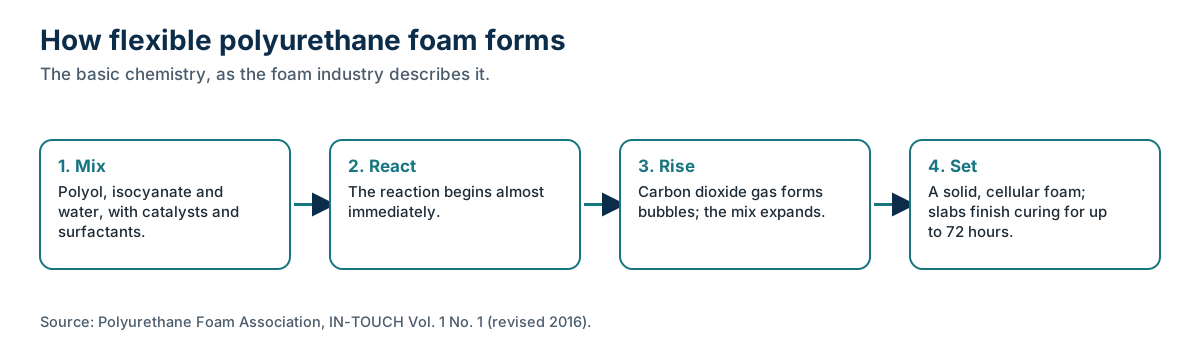
Polyurethane mattress foam is made by mixing two key chemicals, a polyol and an isocyanate, with water. The Polyurethane Foam Association (PFA) describes the reaction as starting almost immediately: gas bubbles form, the mixture expands, and in a matter of minutes it becomes a solid foam. Most bedding foam is poured onto a conveyor as one long slab, then cut and left to finish reacting. Additives such as catalysts, surfactants, flame retardants and fillers tune how the finished foam feels and performs.
General information about mattress materials, not medical advice.
What goes into polyurethane foam?
Two main ingredients and a handful of helpers. The PFA's foam primer puts it plainly: "Flexible polyurethane foam is produced from a reaction of two key chemicals, a polyol and an isocyanate with water." Gama and colleagues' review explains that polyurethanes form when the hydroxyl (OH) groups of a polyol react with the isocyanate (NCO) groups of an isocyanate, and that the name comes from the resulting urethane linkage. A foam maker's discoloration sheet notes that the isocyanate in flexible foam is "typically toluene diisocyanate," and that it reacts with the polyol to form the urethane polymer.
The chemistry has a long history. The same review traces polyurethanes back to 1937, when Otto Bayer made them from a polyester diol and a diisocyanate. The review also explains how the parts divide the work. The polyol forms the soft, flexible segments of the polymer. The urethane and urea groups formed in the reaction make up the hard segments. Formulators tune that balance, and the review notes it's common to adjust "the type and content of the polyol, isocyanate, catalyst, surfactant, blowing agent, and additives in order to control the properties of the ensuing foams."
Why does the mix turn into bubbles?
Because water is one of the reactants. In Gama's account, the isocyanate reacts with the polyol to make urethane groups and with water to make urea groups and carbon dioxide. That gas is what inflates the foam. The PFA calls carbon dioxide "the primary blowing agent" and adds that auxiliary blowing agents "can be used to make foam softer or lighter."
Two reactions run at once: the polymer building up and the gas forming. Gama's review says "a proper expansion is obtained through the balance between the polymerization (gelling) and the gas generation (blowing)." Catalysts manage that timing, and Gama's review names amines and tin compounds as the most common ones. The PFA lists surfactants as the additive that helps "in the formation of foam cells."
The PFA offers a kitchen comparison: "It's been compared to bread rising." Unlike bread dough, though, the mix heats itself. The foam maker's sheet says "The foam making process is exothermic, that is, the reaction produces heat," and warns that if a high temperature is sustained, "the foam can scorch in the center." Scorch is one of the causes of discolored foam that the yellowing article covers.
Slabstock or molded: how is bedding foam shaped?
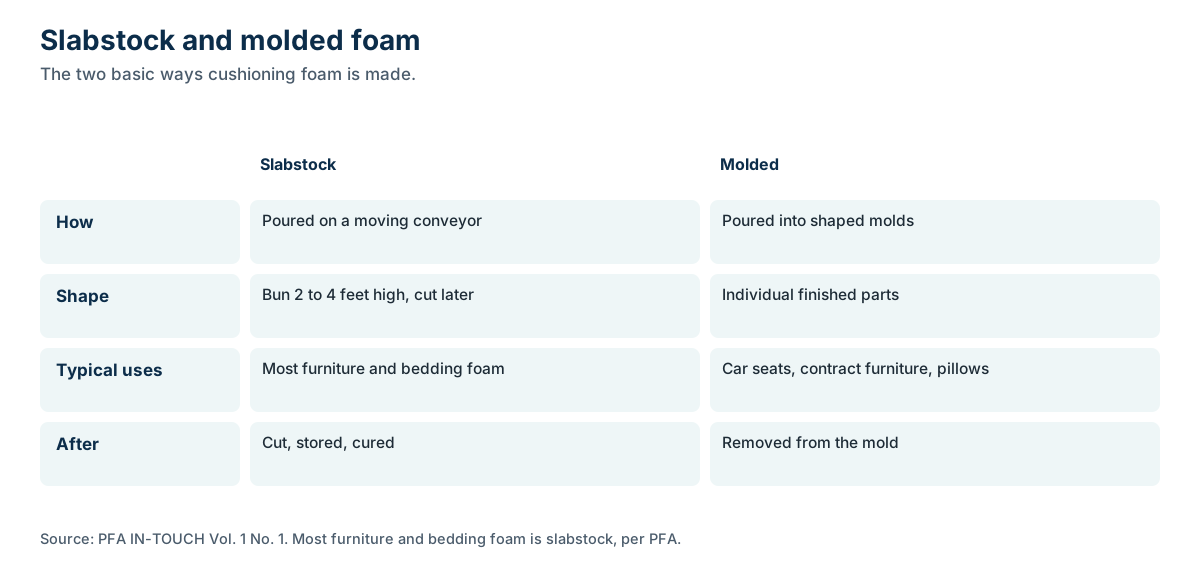
The PFA describes two basic methods. In the slabstock process, the liquid mix is poured onto a moving conveyor with sides, where it rises "into a bun or slab anywhere from two to four feet high." The PFA says the slab is then cut and stored for up to 72 hours while it finishes curing chemically, before it's fabricated into useful shapes. "Most foams for use in furniture and bedding are produced this way."
The second method pours the chemicals into shaped molds, where each part foams to its final form. The PFA's examples are automotive seating, contract furniture and pillows. Molded parts come out close to their final shape, while slab foam is cut into sheets afterward. How a mattress's layers are then joined is a construction question, and Hub 5 explains why construction matters for cleaning.
What do additives change?
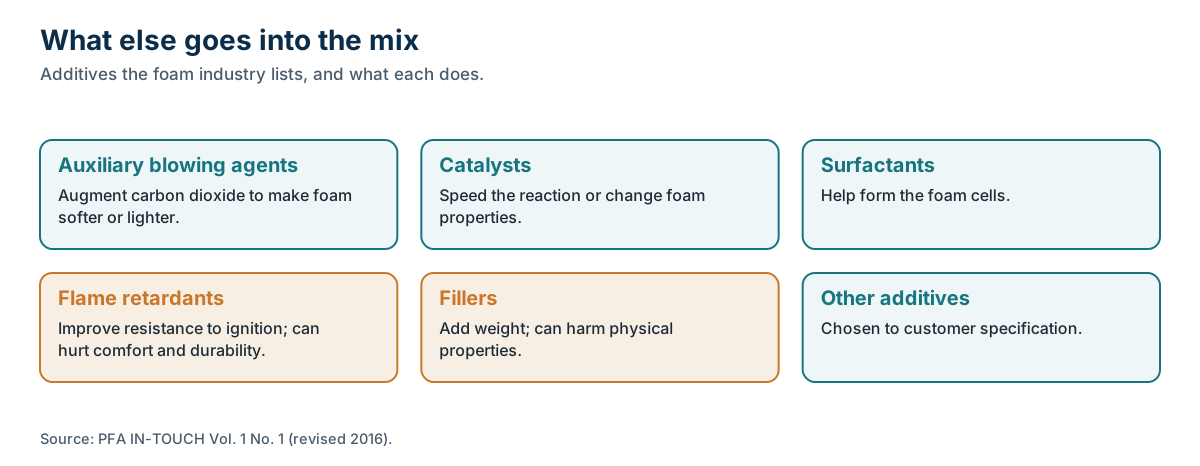
A great deal. The PFA says producers can make "literally hundreds of different types of foam" by adjusting the chemical mix. Its list of additives includes catalysts that speed the reaction, surfactants that shape the cells, and flame retardant additives "used to improve a foam's resistance to ignition or burning." It's candid about the trade-off: flame retardants "tend to have a negative influence on the comfort, support, and durability of the foam."
Fillers are the other caution. The PFA describes them as additives that increase the weight of the foam, "but can possibly have a negative influence on the physical properties of the foam." That's why its density bulletin recommends judging foam by polymer density, the density of the foam chemistry alone, rather than the overall weight. The density and firmness article explains that distinction and the numbers on a spec sheet.
Open cells, closed cells and airflow
Flexible foam is meant to breathe. When the bubbles grow, their thin walls are supposed to open so air can move from cell to cell. The PFA uses air flow as a diagnostic: high air flow "indicates that cells are open and as flexible as they should be," and "A good rule of thumb for air flow in flexible polyurethane foams is a minimum of 2.0 cubic feet per minute (cfm)." Gama's review notes that open-cell foams generally suit sound insulation, while closed-cell foams suit thermal insulation.
Memory foam is part of this same family. The PFA's viscoelastic bulletin calls it an "open-cell variety of flexible polyurethane foam" that's formulated for slow recovery. Its temperature behavior gets its own article, why memory foam softens with body heat. Our reasoning for mattresses: if air can move through open cells, so can liquid. Hub 5's article on what happens when memory foam gets wet covers what follows.
Why does the recipe matter for an owner?
Because two foams that look alike can behave differently. Firmness, recovery speed, airflow and resistance to yellowing all trace back to the formulation, and the PFA notes that physical properties are measured under controlled humidity and temperature for a reason. A research team testing bio-based viscoelastic foams found that swapping part of the polyol changed foam behavior, though the glass transition stayed in its typical range near 10 °C. Hub 5's article on what temperature foam can tolerate covers the heat side of that.
Foam also isn't the only thing in a mattress. Most have a cover fabric, a fire barrier and a support core, each with its own chemistry. The mattress materials hub maps those layers, and the compatibility hub's memory foam page covers what cleaning methods suit foam beds.
Sleep Sanitation's view
This section is our view. Foam's open, cellular structure is the main reason we keep moisture as low as we can. Our Italian-made Vapor Clean machines let us set output and pass speed for the layer in front of us. Organic cleaning methods are our default, and enzyme treatment handles urine and organic odor. None of this is a manufacturer exemption; it's our own reasoning, and your care label and warranty terms govern, so check your warranty terms before you book. "Sanitize" here means what the CDC's terms say it means, and we make no disinfection claim. Our process page walks through a visit.
What we don't know
- The exact formulation of any particular mattress foam. Makers don't publish recipes, and two foams with the same label can differ.
- How much a given additive, such as a flame retardant or filler, changes a finished mattress layer over years of use. The PFA describes general trends, not product data.
- How fully the cells in a given mattress layer are open. Air flow is measured on samples at the factory, not on beds in homes.
Changelog
- 5 October 2026: First published. Sources accessed on this date.
Sources
- IN-TOUCH Vol. 1 No. 1: Flexible polyurethane foam, an introduction · Polyurethane Foam Association
- IN-TOUCH Vol. 1 No. 2: Foam density · Polyurethane Foam Association
- IN-TOUCH Vol. 11 No. 1: Viscoelastic (memory) foam (revised 2016) · Polyurethane Foam Association
- Polyurethane Foams: Past, Present, and Future (Gama, Ferreira and Barros-Timmons, Materials, 2018) · PubMed Central
- Discoloration of Polyurethane Foam (information sheet) · Foamex (foam manufacturer)
- Bio-Based Viscoelastic Polyurethane Foams: Functional Behavior Across Application Temperatures (Malewska et al., Polymers, 2026) · PubMed Central
- Cleaning and disinfecting your school (definitions) · CDC
Last reviewed October 5, 2026. Manufacturer specifications and care instructions change; check the current version for your exact model. This page is general information, not medical advice. How we source and check pages: editorial standards.