
Short answer
Off-gassing is the release of volatile organic compounds (VOCs) as gases from solid materials, including new mattress foam. A crib-mattress study found every sample emitted VOCs, more when new and when warm. CertiPUR-US certifies flexible polyurethane foam only, testing for low VOC and formaldehyde emissions and excluding certain substances; it doesn't certify whole mattresses or latex. The EPA's consistent advice is ventilation.
Key terms used on this page
- Volatile organic compounds (VOCs):
- Chemicals emitted as gases from certain solids or liquids. The EPA lists furnishings among sources and says many VOCs are consistently higher indoors than outdoors.
- Off-gassing:
- The release of VOCs from a product into the air. The PFA says off-gassing naturally occurs with any product and advises ventilating memory foam before final assembly.
- CertiPUR-US:
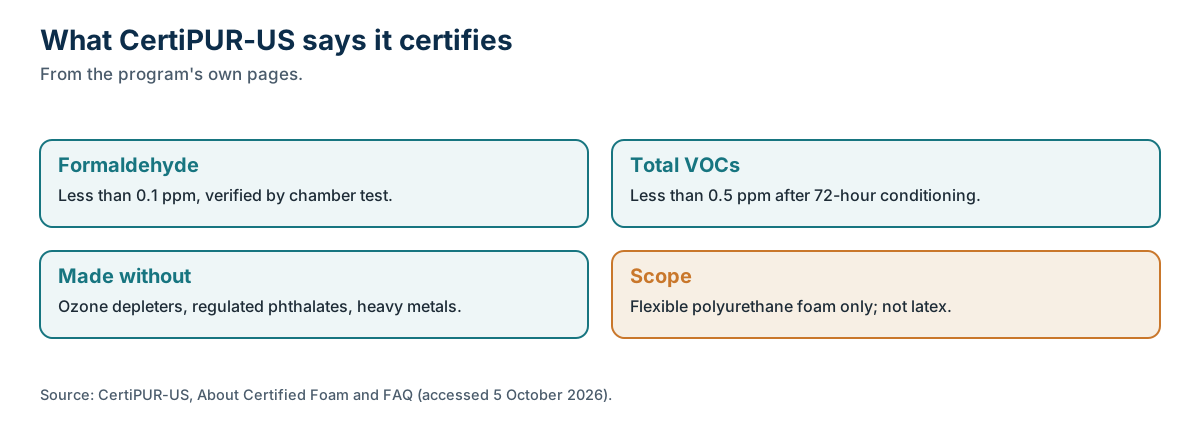
- A certification for flexible polyurethane foam only. The program says certified foam is tested for formaldehyde below 0.1 ppm and total VOCs below 0.5 ppm; it doesn't certify whole mattresses or latex.
- Memory foam (viscoelastic foam):
- An open-cell, slow-recovery polyurethane foam that softens with body heat and conforms to pressure. Because its cells are open, liquid can travel into it, and because it is dense and insulating, it is slow to dry.
- Polyfoam (polyurethane foam):
- Conventional polyurethane foam, used for comfort, transition and base layers. Like memory foam it has cells that liquid can enter; Casper warns that 'the foam in the mattress core will soak up water and detergent.'
Off-gassing is the release of volatile organic compounds (VOCs) as gases from solid materials, and new mattress foam is one source. A study of crib mattresses found every sample emitted VOCs, and emissions were higher when the mattress was new and when it was warm. CertiPUR-US certifies flexible polyurethane foam, testing for low VOC and formaldehyde emissions and excluding certain substances, but it doesn't certify whole mattresses or latex. Ventilation is the consistent advice.
General information about mattress materials, not medical advice.
What is off-gassing?
The EPA's page on VOCs gives the basic definition: "Volatile organic compounds (VOCs) are emitted as gases from certain solids or liquids." Its list of household sources includes "building materials and furnishings," alongside paints, cleaners and air fresheners. It also notes that "Concentrations of many VOCs are consistently higher indoors (up to ten times higher) than outdoors."
CertiPUR-US makes the same point more casually: "There are few things on this planet that do not 'off-gas' to some extent, including your own body!" The question isn't whether a new mattress releases anything, but what, how much and for how long.
Does memory foam off-gas more?
It can. The PFA's viscoelastic bulletin says "As with any product, off-gassing naturally occurs," and that memory foam formulations "sometimes create the potential for more noticeable aromatic emissions than typically found in conventionally manufactured foam products." The PFA describes these as "not known to be harmful," while acknowledging "residual odor may be bothersome to some consumers," and says "it is advisable to thoroughly ventilate viscoelastic foam products prior to final product assembly."
That's the foam industry's view. The memory foam article explains what makes memory foam chemically different, and the how foam is made article covers the ingredients.
What did the crib-mattress study measure?
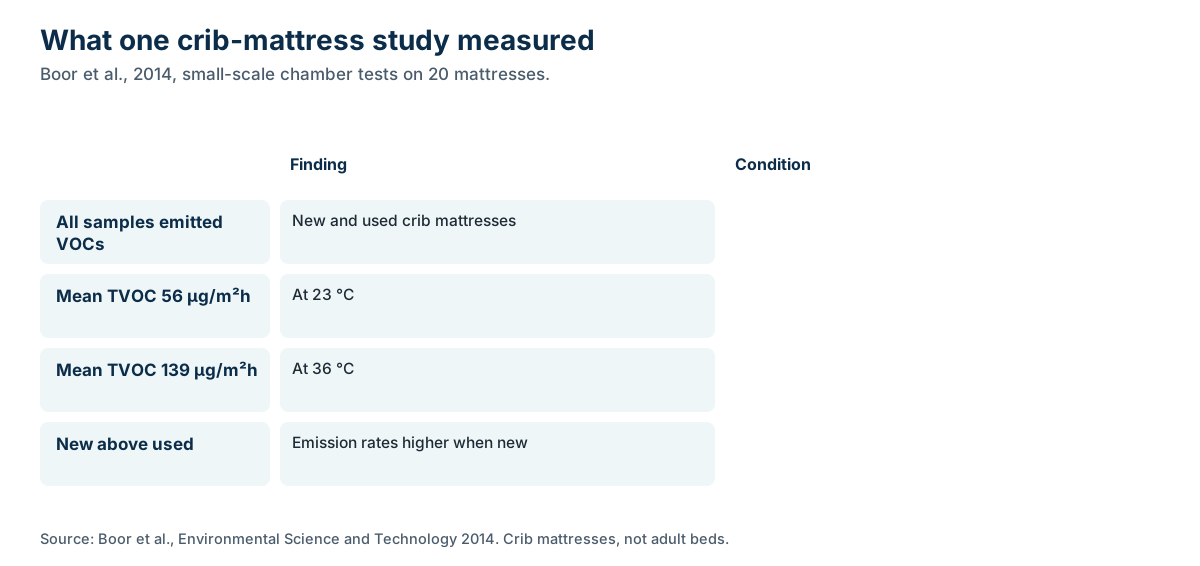
Boor and colleagues (2014) tested "a collection of twenty new and used crib mattresses" in small-scale chambers. "All mattress samples were found to emit VOCs and the mean values of total VOC (TVOC) SERs were 56 μg/m2h at 23 °C and 139 μg/m2h at 36 °C." SER means area-specific emission rate. In larger chamber tests, the authors also used a heated infant manikin set to the "approximate skin surface temperature of a sleeping infant."
Three findings stand out. "TVOC SERs were greater for new mattresses compared to used ones and were influenced by the type of foam material and the presence of mattress cover layer." The foam type mattered: "polyurethane foam releasing a greater diversity of VOCs compared to polyester foam." And concentrations close to the mattress were higher than in the room: in the breathing zone and inside the foam's pores, levels exceeded bulk room air by factors of 1.8 to 2.4 and 7.5 to 21, respectively.
The authors concluded "that crib mattresses are an important source of VOCs and infant exposure to VOCs are possibly elevated in their sleep microenvironments." These were crib mattresses, not adult beds, so we cite the direction of the findings rather than the numbers.
What does CertiPUR-US certify?
Foam, and only foam. The program's FAQ says "We do not certify furniture, product lines or companies. We only certify flexible polyurethane foam." It adds that "Latex foam is outside the scope of our certification," and notes a mattress can include a latex layer alongside certified polyurethane foam.
For the foam it covers, the program's overview describes emission tests. "The detection of less than 0.1 parts per million of formaldehyde in foam is verified in CertiPUR-US certified foam by a small chamber emission test." For VOCs, "foam samples are conditioned for 72 hours after which emissions of total volatile organic compounds are measured," and certified foams have "low emissions for indoor air quality (less than 0.5 parts per million)."
The FAQ lists what the foam is made without: formaldehyde, ozone depleters, phthalates regulated by the U.S. Consumer Product Safety Commission, and "mercury, lead and other heavy metals." On flame retardants, the FAQ says "There are hundreds of flame retardants (FRs) that are used in various consumer products. We identify those FRs that could be used in upholstered furniture or mattresses," and the prohibited list is in the program's Technical Guidelines.
How often is certified foam tested?
The overview says "Certified foams are tested and analyzed twice in the first year, and recertified annually thereafter," and that "certified foams are subject to random verification testing." Testing is done by "independent, accredited testing laboratories," per the program.
What about the logo?
It's optional. CertiPUR-US says companies using certified foam "may use our name and logo, but are not required to label their products or packaging. Lack of our name or logo is not an indication the flexible polyurethane foam inside is not certified." It also says "Some companies only offer products that contain certified foams, other companies offer certified foams in certain products or certain product lines. Ask the manufacturer to be sure."
The certification doesn't extend to the cover. The California public health study discussed in the ticking article noted "The apparent non-inclusion of mattress covers in chemical-free certifications."
What reduces exposure?
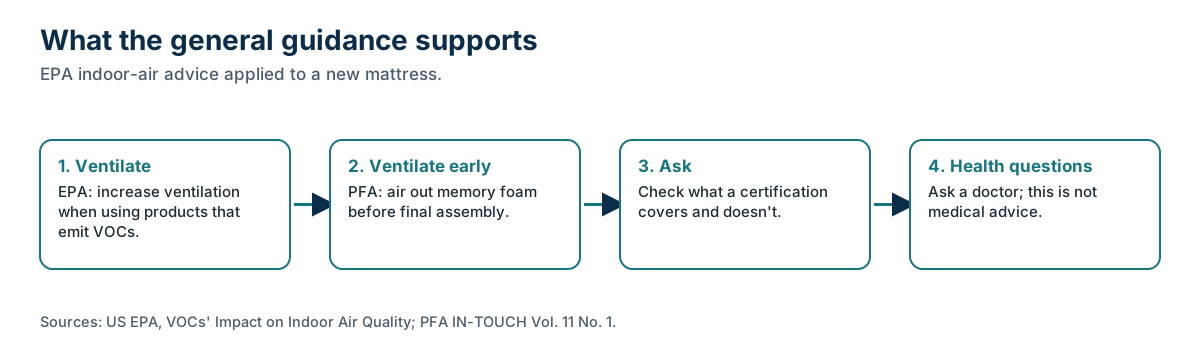
Ventilation, according to every source we checked. The EPA's first step is "Increase ventilation when using products that emit VOCs." The PFA advises makers to ventilate memory foam before assembly. The Boor study's finding that new mattresses emitted more than used ones suggests airing a new mattress is reasonable, though it didn't test how long that takes. On health effects, the EPA says "VOCs include a variety of chemicals, some of which may have short- and long-term adverse health effects," and that effects vary "from those that are highly toxic, to those with no known health effect." If you have concerns, ask your doctor.
Can cleaning products add VOCs of their own?
Yes, and the EPA says so directly. Its VOC page notes that "Paints, varnishes and wax all contain organic solvents, as do many cleaning, disinfecting, cosmetic, degreasing and hobby products," and that these products "can release organic compounds while you are using them, and, to some degree, when they are stored." Its advice for household products is practical: "Use household products according to manufacturer's directions," "Make sure you provide plenty of fresh air when using these products," and "Never mix household care products unless directed on the label."
For a mattress, our own reasoning is that adding strongly scented sprays to cover a new-foam smell trades one set of VOCs for another. Our process page explains how a visit works.
Sleep Sanitation's view
This section is our view. A sanitation visit is not an off-gassing fix, and we don't claim it lowers VOCs. If a new mattress smells, ventilation is the advice the sources support. What we do is surface cleaning of the cover with low moisture, which is a separate job from airing out a new bed. That is our own reasoning, not a manufacturer exemption. Your care label and warranty terms govern, so check your warranty terms before you book. We use "sanitize" in the CDC's terms, with no disinfection claim. To tell where an odor sits, Hub 6 covers the cover or the foam. See also the mattress materials hub and how we're different.
What we don't know
- How long a new adult mattress keeps emitting VOCs at a noticeable level. We found no published figure.
- Which VOCs a particular mattress releases, since that depends on its foams, adhesives and cover.
- How closely the crib study's findings apply to adult mattresses, which are larger and built differently.
Changelog
- 5 October 2026: First published. Sources accessed on this date.
Sources
- Volatile Organic Compounds' Impact on Indoor Air Quality · US EPA
- Infant Exposure to Emissions of Volatile Organic Compounds from Crib Mattresses (Boor et al., Environmental Science and Technology, 2014) · Environmental Science and Technology (DOI)
- About Certified Foam (accessed 2026-10-05) · CertiPUR-US
- Frequently Asked Questions (accessed 2026-10-05) · CertiPUR-US
- IN-TOUCH Vol. 11 No. 1: Viscoelastic (memory) foam (revised 2016) · Polyurethane Foam Association
- Cleaning and disinfecting your school (definitions) · CDC
Last reviewed October 5, 2026. Manufacturer specifications and care instructions change; check the current version for your exact model. This page is general information, not medical advice. How we source and check pages: editorial standards.