
Short answer
Memory foam softens with body heat because it's viscoelastic: the Polyurethane Foam Association says its pliability and recovery rate rise as it warms, and it stiffens in the cold. Makers tune the formula so the softening happens near room-plus-body temperature. The foam also reacts to humidity and to how fast weight is applied.
Key terms used on this page
- Memory foam (viscoelastic foam):
- An open-cell, slow-recovery polyurethane foam that softens with body heat and conforms to pressure. Because its cells are open, liquid can travel into it, and because it is dense and insulating, it is slow to dry.
- Viscoelastic foam:
- The foam sold as memory foam. The Polyurethane Foam Association describes it as a type of open cell, flexible polyurethane foam with slow recovery after compression, and says its firmness, support and recovery rate are affected by temperature and humidity.
- Ball rebound resilience:
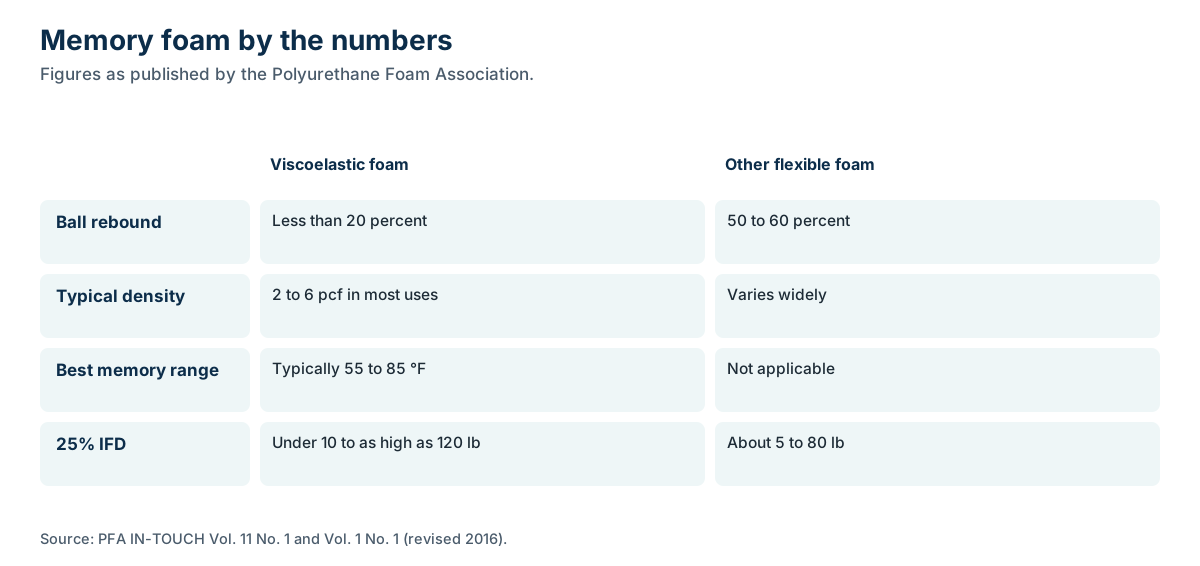
- A measure of foam springiness: how high a dropped steel ball bounces. The PFA says flexible foams range from about 20 to 80 percent, and memory foam is below 20 percent.
- Glass transition temperature:
- The temperature range where a polymer shifts between a stiff, glassy state and a soft, rubbery one. In one 2026 study of lab-made viscoelastic foams with up to 20 percent bio-based polyols, the glass transition stayed around 10°C. It explains why memory foam stiffens in the cold.
- Indentation force deflection (IFD):
- A standard firmness test that measures the force needed to compress a foam sample by a set amount. The PFA notes that warmer, more humid conditions in the test room may contribute to temporary softer readings, so samples are conditioned first.
- Open-cell foam:
- Foam whose cells connect, so air can move through it. The PFA primer says foam performance is optimized when air flow is maximized, which indicates the cells are open. The same open structure that lets air through also lets liquid water in.
Memory foam softens with body heat because it's a viscoelastic material, part springy solid and part slow-flowing. The Polyurethane Foam Association (PFA) says its pliability and recovery rate increase as the foam warms, while cold makes it firmer or even stiff. Manufacturers adjust the formula so the softening happens around room temperature plus body heat. Humidity and loading speed shift its behavior too.
General information about mattress materials, not medical advice.
What makes memory foam different from other foam?
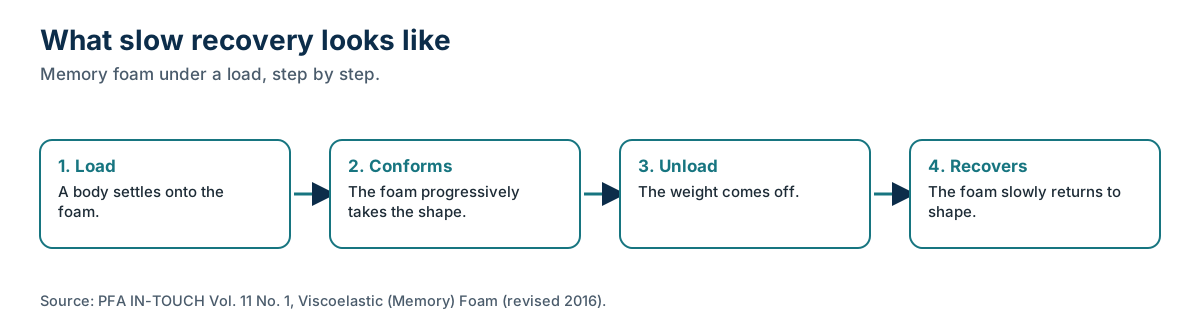
It's chemically a polyurethane foam, made the way the how foam is made article describes, but formulated for slow recovery. The PFA's viscoelastic bulletin calls it "a type of open cell, flexible polyurethane foam" and says it "is typified by its slow recovery after compression." When a body lies on it, "the foam progressively conforms to the shape of the object, and after the weight is removed, the foam slowly reassumes its initial shape."
The bulletin gives a short history too. Viscoelastic foam, "also known as memory or temper foam, was first commercialized during the mid 60's as a result of NASA's AMES Research technology transfer program." The PFA ties that contouring to how the foam spreads weight: "Its ability to closely contour to shapes allows surface pressure to be distributed over a wide area." It also cautions that if firmness is very low and "there is not sufficient foam density or thickness to provide support, the product may 'bottom out,' negating the benefits of pressure reduction."
The name stuck, though a 2026 paper by Malewska and colleagues points out that the slow recovery "originates from viscoelasticity rather than a real shape memory mechanism."
How is slow recovery measured?
With a bouncing ball. The PFA primer describes resilience as "an indicator of the surface elasticity or 'springiness' of foam," measured by dropping a steel ball onto a sample and recording how high it rebounds. Across flexible foams it ranges "from about 20 percent ball rebound to as high as 80 percent rebound," and the primer adds that "Viscoelastic products typically exhibit very low resilience."
The viscoelastic bulletin puts numbers on it: ball rebound of "less than 20% (compared to 50% – 60% with other varieties of FPF)." The Malewska study measured time instead, reporting that "Viscoelastic foams show a significantly longer post-load recovery time (~1–20 s) than standard flexible PUFs." That's the familiar handprint that fades over a few seconds.
Why does warmth make it softer?
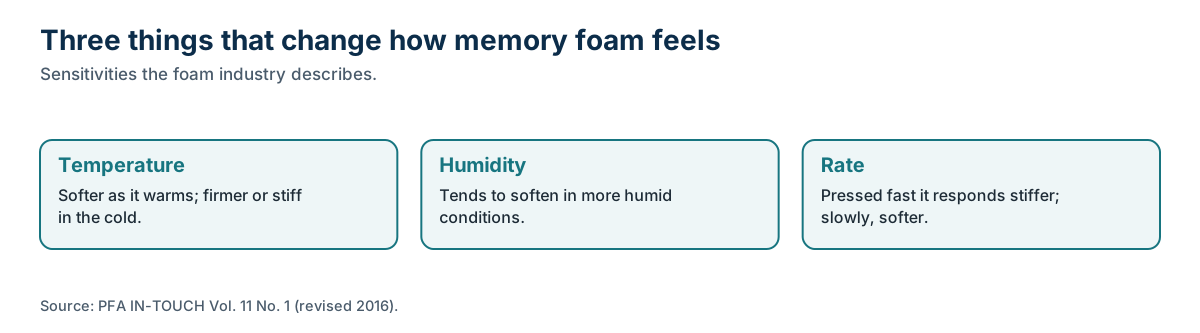
The PFA describes the temperature dependence directly. "Even slight changes in room temperature can affect measured firmness and recovery rates," the viscoelastic bulletin says, and "Recovery rate has been positively correlated to heat, so that as the foam increases in temperature, pliability and compression and recovery rates increase." The opposite holds as it cools: "In colder conditions, viscoelastic products tend to become firmer or even stiff."
Body heat is enough to do it. "Heat (even body heat) can soften viscoelastic materials and, in extreme situations, affect the foam's ability to provide support," the bulletin says, calling this "a phase change or relaxation." The cold-side mechanism, the glass transition, is covered in Hub 5's article on what temperature mattress foam can tolerate, so we won't repeat it here. The Malewska paper, for its part, found that bio-based viscoelastic foams kept a glass transition "around 10 °C" and noted their use below that "may be limited by increased stiffness."
How do makers tune where it softens?
By narrowing the window rather than widening it. The PFA explains that "foam formulation can be adjusted to narrow the temperature span at which phase change occurs, anticipating the influence of room temperature combined with body temperature." Getting it wrong cuts both ways, per the bulletin. If the change happens too low, body heat "could lessen its firmness to the point where support is lost." If it happens too high, "added body heat would not be enough to soften the foam."
The PFA's typical figures: some formulations keep memory performance "as low as 30°F," but "the optimum range for best 'memory' action is typically between 55°F and 85°F." It notes that research continues on broader temperature ranges, especially for uses like vehicle seats where the temperature can't be controlled.
What does humidity do?
It softens the foam too. "Viscoelastic products tend to soften in more humid conditions," the PFA bulletin says. "For example, very pliant foam may feel slick or 'buttery' as opposed to coarse, depending on the humidity." The PFA doesn't treat this as a big deal for finished products, because "the foam is enclosed inside a covering material that provides its own surface feel."
For cleaning, our own reasoning is that a foam already sensitive to humid air is a good reason to keep added moisture low. The effects of water on memory foam are covered in Hub 5, and the memory foam compatibility page sets out what manufacturers say about cleaning it.
Why does loading speed matter?
Because viscoelastic materials resist fast deformation more than slow deformation. The PFA calls this rate sensitivity. In a firmness test, "if the indentation plate used in the test descends quickly, the foam may respond with stiffness, whereas slower speeds may result in different IFD measurements." The bulletin says IFD reports for memory foam should note the test speed so comparisons are fair.
Testing also has to control the room. The PFA's testing bulletin notes that temperature and humidity can affect firmness readings in general, and the viscoelastic bulletin says "Conditioning the foam sample prior to testing is extremely important." ASTM's D3574 Test M was developed for viscoelastic foam, per the PFA, with an indentor that moves up much faster than in normal foam testing. The density and firmness article explains IFD itself.
Does slow recovery show up anywhere else?
Even in the factory. The PFA says memory foam "must be cut at a much slower rate than conventional foam due to its slow recovery characteristic," and that convoluted, egg-crate style cuts come out shallower because "Viscoelastic foam usually does not recover before it hits the blade." It's a small detail, but it shows how the same property you feel in bed shapes how the foam is made.
On the chemistry side, Gama and colleagues' review notes that in polyurethane foams the polyol forms the flexible "soft segments" while urethane and urea groups form hard segments. We found no source that ties a specific ratio to memory foam's feel, so we leave that question open.
Sleep Sanitation's view
This section is our view. Because memory foam reacts to warmth and humid air, we favor quick passes and very little added moisture on it. The tools are Italian-made Vapor Clean machines; the default is organic methods, plus enzyme treatment when urine or organic odor is the problem. Your care label and warranty terms come first. Our method is our own reasoning rather than any manufacturer exemption, so check your warranty terms before you book. On wording, we describe sanitizing in the CDC's terms and make no disinfection claim. After we leave, keep the bed unmade until it's dry to the touch; our moisture check confirms it. The process page explains the visit, and the mattress materials hub shows where memory foam sits.
What we don't know
- The phase-change temperature of the memory foam in any given mattress. Makers rarely publish it, and the PFA says formulations differ.
- How much a humid bedroom changes the feel of a covered memory foam layer in real use, as opposed to a bare test sample.
- Whether repeated warming and cooling over years changes a foam's recovery. We found no long-term study on mattress layers.
Changelog
- 5 October 2026: First published. Sources accessed on this date.
Sources
- IN-TOUCH Vol. 11 No. 1: Viscoelastic (memory) foam (revised 2016) · Polyurethane Foam Association
- IN-TOUCH Vol. 1 No. 1: Flexible polyurethane foam, an introduction · Polyurethane Foam Association
- IN-TOUCH Vol. 4 No. 2: Foam testing and performance, part 1 · Polyurethane Foam Association
- Bio-Based Viscoelastic Polyurethane Foams: Functional Behavior Across Application Temperatures (Malewska et al., Polymers, 2026) · PubMed Central
- Polyurethane Foams: Past, Present, and Future (Gama, Ferreira and Barros-Timmons, Materials, 2018) · PubMed Central
- Cleaning and disinfecting your school (definitions) · CDC
Last reviewed October 5, 2026. Manufacturer specifications and care instructions change; check the current version for your exact model. This page is general information, not medical advice. How we source and check pages: editorial standards.