
Short answer
A fire barrier is a layer inside a mattress that helps it pass federal flammability tests. Federal rules require mattresses to resist a lighted cigarette and to limit the size of an open-flame fire. Makers choose how to comply, and CertiPUR-US says some wrap the foam core in fiberglass barrier fabric. A California public health study found fiberglass could reach adjacent layers, so don't open a cover not meant to come off.
Key terms used on this page
- Fire barrier fabric:
- A layer that helps a mattress meet federal flammability standards. CertiPUR-US says some makers surround the foam core with barrier fabrics made from fiberglass; others use flame-resistant fibers.
- Open-flame standard (16 CFR 1633):
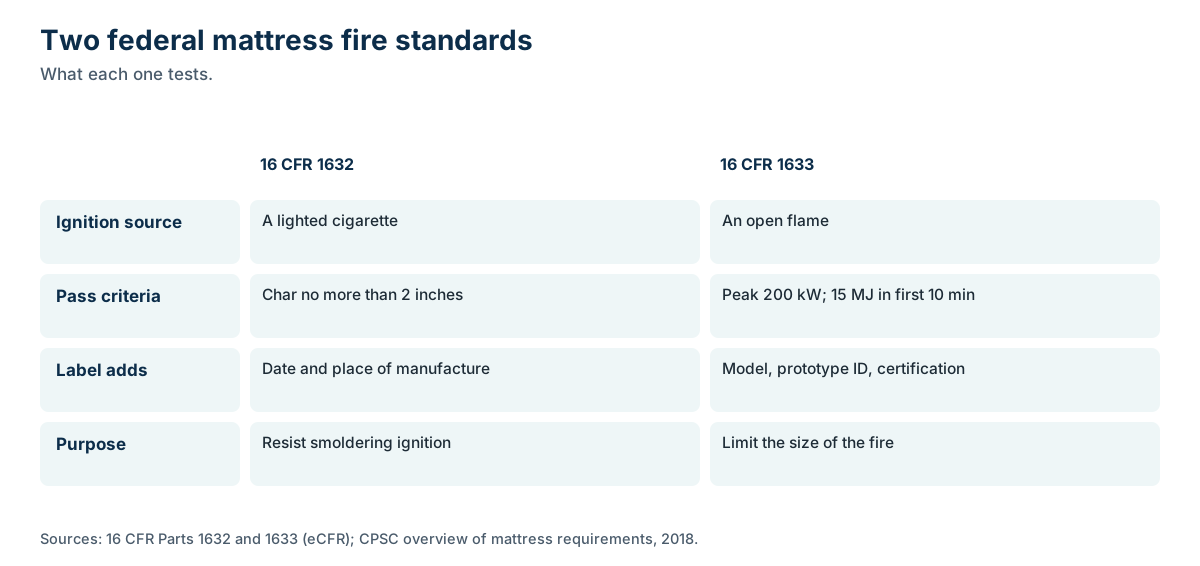
- The federal rule limiting the size of a mattress fire. A mattress set's peak heat release may not exceed 200 kW in a 30 minute test, and total heat release may not exceed 15 MJ in the first 10 minutes.
- Cigarette ignition standard (16 CFR 1632):
- The federal test of whether a lighted cigarette can ignite a mattress or mattress pad. Each test location passes if the char length is no more than 2 inches.
- Ticking:
- The outer fabric cover of a mattress, often quilted to the comfort layers beneath. Avocado tells owners: 'Do not attempt to remove the mattress ticking to access the internal materials or support unit.'
- Upholstery material:
- Under 16 CFR 1633, all material, loose or attached, between the mattress ticking and the core. Quilting, comfort layers and barriers fall in this zone.
- Mattress core:
- Under 16 CFR 1633, the main support system that may be present in a mattress, such as springs, foam, water bladder, air bladder or resilient filling.
A mattress fire barrier is a layer, usually just under the cover, that helps the mattress pass federal flammability tests. Federal rules require mattresses to resist ignition from a lighted cigarette and to limit the size of the fire when exposed to an open flame. Makers choose how to comply. CertiPUR-US says some surround the foam core with barrier fabric made from fiberglass. A California public health study found fiberglass could reach adjacent layers, which is one reason not to open a cover that isn't meant to come off.
General information about mattress materials, not medical advice.
Why do mattresses need fire protection?
Because foam burns. The PFA's primer notes that flexible polyurethane foam, like all organic materials, is combustible, and the how foam is made article covers what it's made of. Federal law addresses the risk with two standards, each built around a different kind of fire.
The older one, 16 CFR Part 1632, dates from 1973 according to the CPSC's overview, and its purpose is "To improve ignition resistance of mattresses and mattress pads to smoldering cigarettes." The newer one, 16 CFR Part 1633, addresses open flames. Its stated purpose is "to reduce deaths and injuries associated with mattress fires by limiting the size of the fire generated by a mattress set during a thirty minute test."
What does the cigarette test check?
Whether a smoldering cigarette can start the mattress burning. The regulation says it "prescribes a test to determine the ignition resistance of a mattress or a mattress pad when exposed to a lighted cigarette." Cigarettes are burned on each kind of surface the mattress has, which the rule lists as "smooth surface, tape edge, quilted, or tufted areas," and each test location passes "if the char length is not more than 2 inches."
The CPSC overview says the rule uses a prototype testing scheme, testing designs that match production units "with respect to materials, components, design, and method of assembly." For mattress pads treated with a flame retardant, the overview says the label is marked with the letter T, and it notes "there may be additional state requirements for labeling."
What does the open-flame test check?
How big a fire the mattress set produces. Under 16 CFR 1633, a pair of propane burners is applied to the mattress, and the specimen must meet both criteria: "The peak rate of heat release shall not exceed 200 kilowatts ('kW') at any time within the 30 minute test," and "The total heat release shall not exceed 15 megajoules ('MJ') for the first 10 minutes of the test."
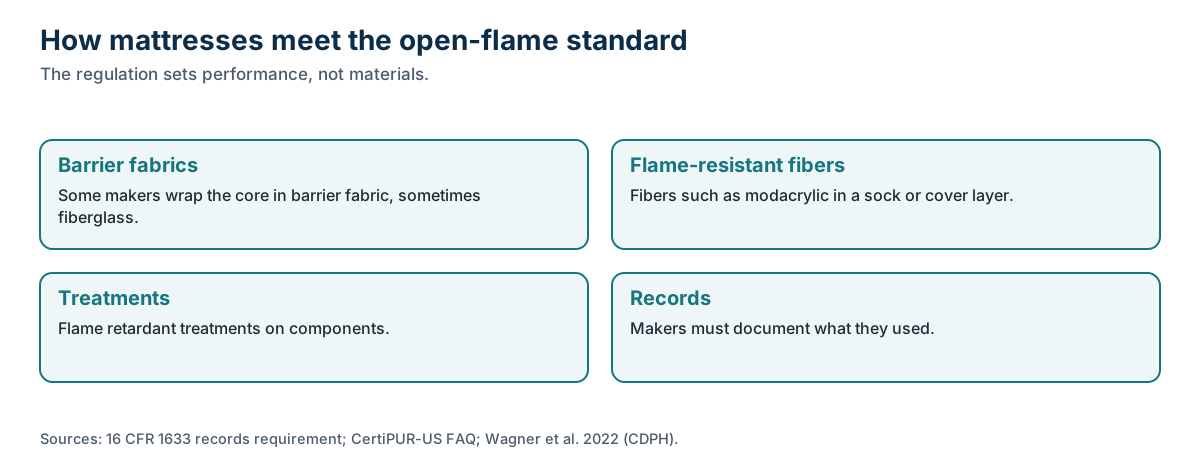
The rule tests performance, not ingredients. It doesn't tell makers which materials to use. Instead, it requires them to document their choices, including "Identification, composition, and details of the application of any flame retardant treatments and/or inherently flame resistant fibers or other materials employed in mattress components."
How do makers meet the open-flame rule?
In several ways, which is why mattresses differ. The PFA's viscoelastic bulletin notes that memory foam "can be combined with barrier materials in mattresses designed to comply with CPSC 16 CFR Part 1633." CertiPUR-US explains that "some mattress manufacturers surround a mattress's foam core with barrier fabrics made from fiberglass to help meet government standards for mattress flammability," and adds, "There would not be fiberglass in the certified foam used for mattresses, pillows or upholstered furniture."
Other approaches use flame-resistant fibers. In the California study discussed below, sock layers in some covers contained synthetic fibers "consistent with flame resistant modacrylic containing vinyl chloride and antimony." Which approach a particular mattress uses isn't something you can see from outside. The California authors note that the use of flame retardants and flame-resistant fibers in mattresses "is primarily driven by California and US flammability regulations," and that changes in California's furniture flammability testing rules "have shifted emphasis from the foam to their covers." That's one reason the cover system, not just the foam, matters.
What did the California fiberglass study find?
The 2022 study by Wagner and colleagues at the California Department of Public Health examined four new mattresses. It found that "Two of the mattress covers contained over 50% fiberglass in their inner sock layers," and that "Up to 1% of the fiberglass had migrated to adjacent fabric layers, representing a potential risk of consumer exposure if the zipper on the outer cover is opened."
Just as important is what it didn't find: "No fiberglass was observed on the brand new mattresses' outer surfaces." The fragments it measured were 30 to 50 µm in aerodynamic diameter, which the authors said were "potentially inhalable into the nose, mouth, and throat, but are likely too large to penetrate deeper into the lungs."
The study also describes why it matters. Fiberglass "is a known respiratory, skin and eye irritant and an asthmagen," the authors write, and the International Agency for Research on Cancer classed it in 2001 as Group 3, "unclassifiable as to human carcinogenicity." They report that a search of the CPSC website found 128 complaints during 2020 linked to fiberglass exposure from mattresses, and they describe a 2021 case in which fiberglass suspected to have leaked from a mattress led to a home clean-up that included disposing of the mattress, carpet and clothing. They conclude that "further improvements are needed in mattress labeling and education of consumers."
Why shouldn't you unzip a mattress cover?
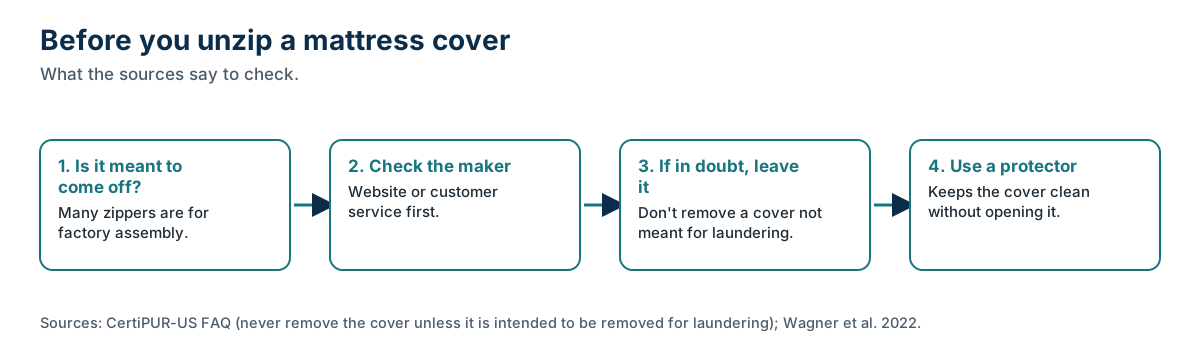
Because the zipper usually isn't for you. CertiPUR-US says "A mattress zipper is usually there for easy assembly at the factory and not for the customer to use." Its advice is direct: "never remove the cover of your mattress, even if it has a zipper, unless the mattress cover is specifically intended to be removed for laundering." The California study's finding about migration "if the zipper on the outer cover is opened" points the same way.
If you want to keep the cover clean without opening it, CertiPUR-US says "The best way to protect your mattress from getting soiled is to use a mattress pad or mattress protector on top of the mattress." Hub 6 discusses whether cleaning is worth it with a protector.
What does the law label say about fire safety?
It certifies the result, not the method. Under 16 CFR 1633, the label carries a statement such as "This mattress meets the requirements of 16 CFR part 1633 (federal flammability (open flame) standard for mattresses) when used without a foundation." It also carries the maker, the month and year of manufacture, and a prototype identification number. The law tag article explains each field and who may remove the label.
Sleep Sanitation's view
This section is our view. We never open a mattress cover, zipper or not, and we'd ask you not to either. Everything we do happens through the ticking, with low moisture, Italian-made Vapor Clean machines and organic methods as the default; enzyme treatment covers urine and organic odor. That reflects our own reasoning, not a manufacturer exemption. The care label and warranty terms govern, so check your warranty terms before you book. Our sanitizing language follows the CDC's terms, and we make no disinfection claim. If you think fiberglass has escaped a cover, contact the manufacturer before booking any cleaning. The process page explains a visit, and the mattress materials hub shows the other layers.
What we don't know
- How common fiberglass barriers are across the market. The California study examined four mattresses, and makers aren't required to put barrier materials on the label.
- Whether years of use change how much fiberglass can migrate within a closed cover. The study tested new mattresses.
- How cleaning methods affect different barrier fabrics. We found no study and act cautiously.
Changelog
- 5 October 2026: First published. Sources accessed on this date.
Sources
- 16 CFR Part 1633: Standard for the Flammability (Open Flame) of Mattress Sets · Electronic Code of Federal Regulations (eCFR)
- 16 CFR Part 1632: Standard for the Flammability of Mattresses and Mattress Pads (FF 4-72) · Electronic Code of Federal Regulations (eCFR)
- Overview of U.S. Mattress Requirements (Campbell, March 2018) · U.S. Consumer Product Safety Commission
- Fiberglass and Other Flame-Resistant Fibers in Mattress Covers (Wagner, Fowles and Barreau, Int J Environ Res Public Health, 2022) · PubMed Central
- Frequently Asked Questions (accessed 2026-10-05) · CertiPUR-US
- IN-TOUCH Vol. 11 No. 1: Viscoelastic (memory) foam (revised 2016) · Polyurethane Foam Association
- Cleaning and disinfecting your school (definitions) · CDC
Last reviewed October 5, 2026. Manufacturer specifications and care instructions change; check the current version for your exact model. This page is general information, not medical advice. How we source and check pages: editorial standards.