
Short answer
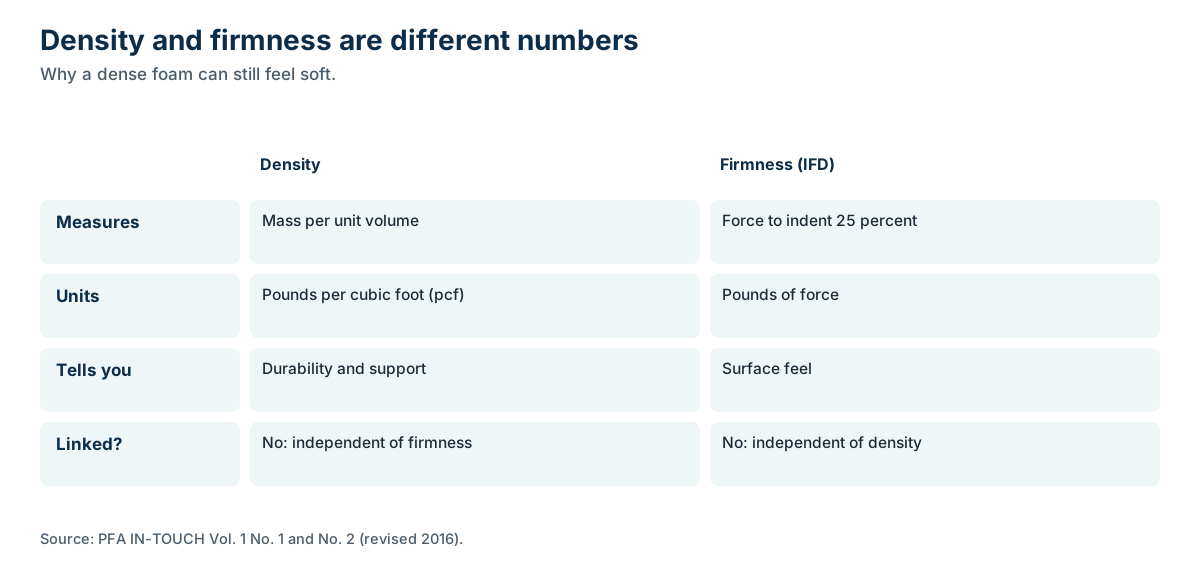
Density measures how much foam material is packed into a cubic foot, while firmness, measured as indentation force deflection (IFD), is the force needed to compress the foam. The Polyurethane Foam Association says the two are independent: a dense foam can be soft and a light foam can be firm. Density relates more to durability and support; IFD describes surface feel.
Key terms used on this page
- Foam density:
- Mass per unit volume, given in pounds per cubic foot in the US. The PFA says flexible foam ranges from about 0.5 to 6 pcf and that density is independent of firmness.
- Polymer density:
- Density counted from the fully reacted foam polymer only. The Polyurethane Foam Association says it, not overall density, is the way to gauge performance, since added fillers can make a foam heavier.
- Indentation force deflection (IFD):
- A standard firmness test that measures the force needed to compress a foam sample by a set amount. The PFA notes that warmer, more humid conditions in the test room may contribute to temporary softer readings, so samples are conditioned first.
- Support factor:
- A ratio comparing deep firmness with surface firmness: foam is tested at 65 and 25 percent indentation and the first reading is divided by the second. Per the PFA, values run from roughly 1.5 to 2.6.
- Compression set (height loss):
- Foam's tendency to lose thickness after being compressed. The PFA's density bulletin says height loss decreases as density increases, so body impressions may be less noticeable.
Foam density and firmness are two separate measurements. Density is the mass of foam in a given volume, usually pounds per cubic foot. Firmness is measured as indentation force deflection (IFD), the force needed to press a foam sample down by a set amount. The Polyurethane Foam Association (PFA) is emphatic that the two are independent: high-density foam can be soft and low-density foam can be firm. Density says more about durability and support, and IFD describes surface feel.
General information about mattress materials, not medical advice.
What is foam density?
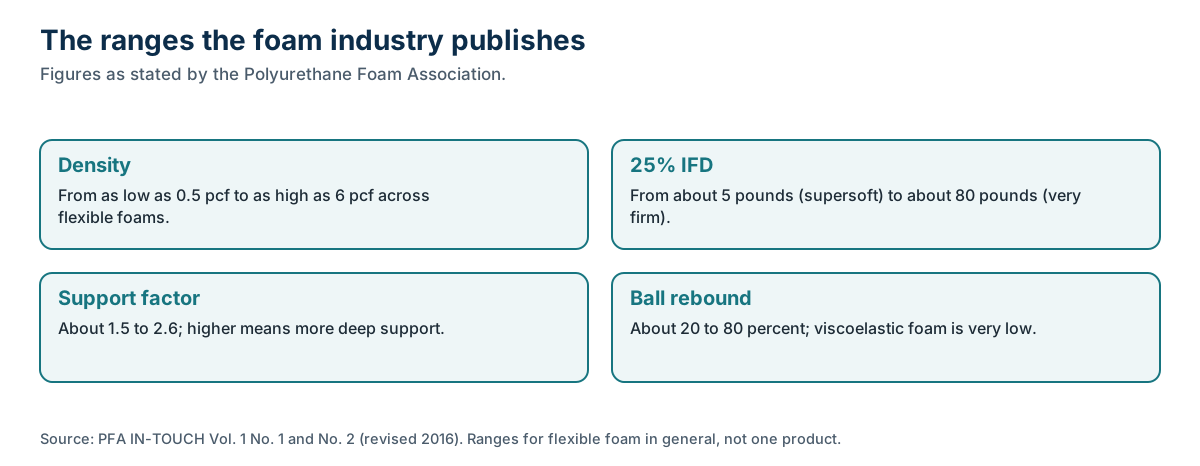
The PFA's density bulletin starts by correcting a common assumption: "Foam density is not weight. It's actually a measurement of mass per unit volume." In the US it's given in pounds per cubic foot (pcf) and elsewhere in kilograms per cubic meter. The bulletin says flexible polyurethane foam is available in densities "ranging from as low as 0.5 pcf to as high as 6 pcf."
Measuring it sounds simple: weigh a block and divide by its volume. The PFA's testing bulletin adds the details that make it reliable. The sample has to be uniformly rectangular, rulers and scales must be calibrated, and density "can vary slightly within a foam block." Its example spec is 1.8 pcf with a tolerance of plus or minus 0.1 pcf, so a shipment can be checked against a range rather than a single number.
Why does "polymer density" matter?
Because not everything in a foam is foam. The PFA primer advises using "the polymer density of the foam, or the density of the material made up strictly by the foam chemistry without fillers or reinforcements included." Fillers raise overall density, and the density bulletin warns that "Large amounts of additives can make foams more likely to tear and can reduce foam durability." It explains why: additives that aren't part of the polymer "can act as abrasives that break down foam cell walls."
So two foams labeled with the same density may not be equal. One may reach that number with polymer, the other partly with filler. The PFA's summary puts it in one line: "To truly gauge foam performance, the unfilled, or polymer density of the foam must be evaluated." The how foam is made article covers where fillers fit in the recipe.
What is IFD, and how is it measured?
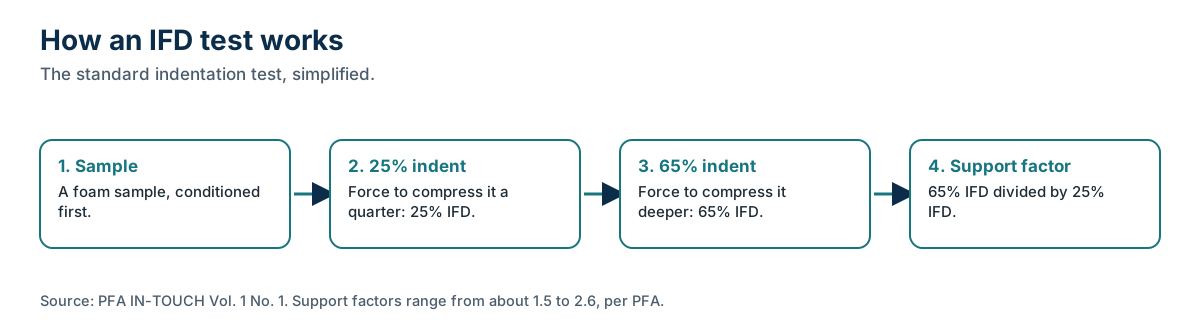
IFD is a force, not a material property you can see. The PFA primer says it's measured "by indenting (compressing) a foam sample 25 percent of its original height," and the force in pounds needed to do that is the 25 percent IFD. "The more force required, the firmer the foam." The testing bulletin notes the older name, indentation load deflection (ILD), and describes the setup: a platen of 50 square inches and a preferred sample of 20 by 20 by 4 inches, with 15 by 15 by 4 inches as the minimum.
Conditions matter as much as equipment. The PFA's testing bulletin, part 1 warns that "Ambient temperature and humidity within the testing environment can also affect IFD." It also stresses accurate sample thickness, careful pre-flexing and precisely timed readings. A number quoted without those controls is hard to compare with another.
The primer gives the range for flexible foam: from about 5 pounds, which it calls supersoft, to about 80 pounds, very firm. Those figures describe foam samples, not finished mattresses, which stack several layers with different IFDs under a quilted cover.
Why are density and firmness independent?
Because firmness depends on the formulation as well as the amount of material. The PFA primer says "Firmness is independent of foam density, although it is often thought that higher density foams are firmer." The density bulletin goes further: "there is no such thing as 'hard' or 'firm' density." Producers can make a dense foam that feels soft or a light foam that feels firm by changing the chemistry.
What density does affect, in the PFA's account, is how much material is there to carry weight and how well the foam holds up. "The denser the foam, the more material used to produce it, and the more material there is in the cushion to provide weight support." The bulletin also defines the difference between firmness and support: firmness is the surface feel, while support is the foam's ability "to 'push back' against weight and prevent the foam from 'bottoming out.'"
What is support factor?
It's a ratio that captures deep support. The primer explains that a second IFD reading is sometimes taken at 65 percent indentation, and "The ratio of the 65 percent IFD divided by the 25 percent IFD is called the foam's support factor." Support factors range "from about 1.5 to 2.6," per the PFA, and "The higher the number, the better the ability of the foam to provide support."
That's how a foam can feel soft on top and still hold up a body. The PFA notes it's possible to specify "a low 25 percent IFD on a foam with a high support factor to create extra surface softness without causing the foam to 'bottom out' when weight is applied." The primer adds that "Typically, the higher the foam density, the better the support factor," and the density bulletin notes that some "high performance" grades are formulated to reach higher support factors even at lower densities.
How does density relate to durability?
Here the PFA's language is consistent. The density bulletin reports that "as polymer density increases, firmness loss is usually lessened," and that "As density increases, height loss decreases dramatically." Height loss is measured as compression set, the tendency of foam to lose thickness with use. The bulletin connects this to mattresses directly: less height loss means "mattresses body impressions may be less noticeable," and some manufacturers use higher-density quilting foam for that reason.
A PFA industry committee approved a related statement about furniture: foams "with polymer densities of 1.8 PCF or higher perform better in seating applications than foams with lower polymer density." That was written for seating, not mattresses, so we don't apply the number to beds. The general direction, more polymer and better retention, is what carries over.
Does memory foam follow the same rules?
Mostly, with complications. The PFA's viscoelastic bulletin says memory foam in most household uses ranges from 2 to 6 pcf, and that density "enhances durability and the ability of viscoelastic foam to maintain its physical performance." Its firmness can range from under 10 pounds to as high as 120 pounds at 25 percent IFD. But the same bulletin warns that standard IFD testing "may not accurately evaluate viscoelastic foam firmness because the foam relaxes during the one-minute hold period." The memory foam article explains why temperature, humidity and loading speed all shift its readings.
What do these numbers mean for cleaning?
Less than for buying, but they're not irrelevant. Body impressions and soft spots are a change in the foam itself, which cleaning can't reverse; Hub 6 lists other problems professional cleaning can't fix. Our own reasoning is that a heavier, denser foam layer holds more material for water to wet, so we keep moisture low regardless of the spec. The mattress materials hub puts foam in context with the other layers.
Sleep Sanitation's view
This section is our view. Density and IFD are buying questions, and we don't measure either in your home or rate mattresses. A heavier foam layer simply holds more material for water to reach, in our reasoning, so the spec doesn't change how gently we work. We clean at the surface, through the cover. Check your warranty terms before you book: that's our own approach, not a manufacturer exemption, and the care label and warranty govern. We follow the CDC's cleaning terms for "sanitize" and make no disinfection claim. The first mattress is $249, and the pricing page has the rest.
What we don't know
- The density and IFD of the layers in any particular mattress. Makers often publish neither, and a finished bed combines several layers.
- How the PFA's seating benchmark of 1.8 pcf translates to mattress comfort layers, which carry load differently from seat cushions.
- How much a filler-heavy foam's performance differs from a pure-polymer foam of the same density over a mattress's life. The PFA describes the direction, not the size, of the effect.
Changelog
- 5 October 2026: First published. Sources accessed on this date.
Sources
- IN-TOUCH Vol. 1 No. 1: Flexible polyurethane foam, an introduction · Polyurethane Foam Association
- IN-TOUCH Vol. 1 No. 2: Foam density · Polyurethane Foam Association
- IN-TOUCH Vol. 4 No. 2: Foam testing and performance, part 1 · Polyurethane Foam Association
- IN-TOUCH Vol. 4 No. 2: Foam testing and performance, part 2 · Polyurethane Foam Association
- IN-TOUCH Vol. 11 No. 1: Viscoelastic (memory) foam (revised 2016) · Polyurethane Foam Association
- Cleaning and disinfecting your school (definitions) · CDC
Last reviewed October 5, 2026. Manufacturer specifications and care instructions change; check the current version for your exact model. This page is general information, not medical advice. How we source and check pages: editorial standards.