
Short answer
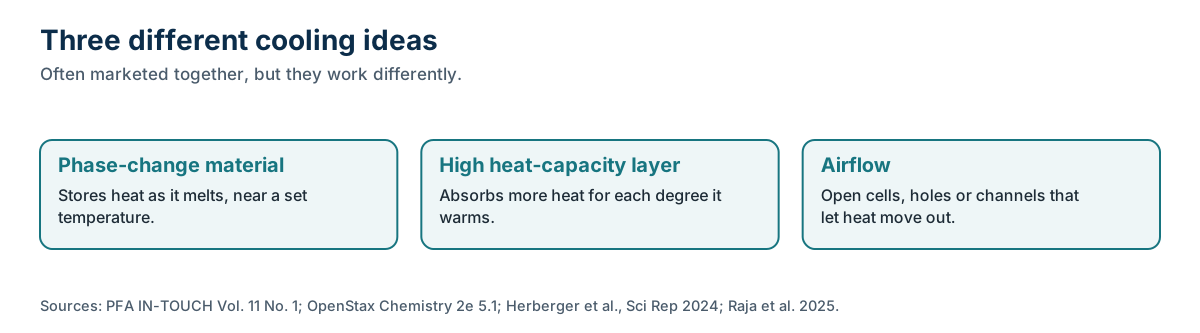
Cooling foams use one or more of three ideas. A phase-change material absorbs heat as it melts near a set temperature until it's used up. A high heat-capacity layer takes in more heat per degree of warming. Open cells, holes or channels let warm air move out. Published tests are narrow, so read cooling claims as describing how a surface feels at first.
Key terms used on this page
- Phase-change material (PCM):
- A substance that stores and releases large amounts of energy as it melts and solidifies at a set temperature. The PFA says PCM in foam holds temperature near its melting point until its capacity is used up.
- Heat capacity:
- How much heat an object takes in or gives off per degree of temperature change. In OpenStax's explanation, a larger pan of the same metal has a proportionally larger heat capacity, because the amount of material counts as well as its type.
- Gel-infused (cooling gel) foam:
- Memory foam or polyurethane foam with gel beads, swirls or a gel layer added, marketed for cooling. It is still foam, so the cautions makers give for foam generally apply. We found no manufacturer care page that gives gel foam its own cleaning rule.
- Thermal conductivity:
- How readily a material passes heat. Engineering ToolBox lists polyurethane foam at 0.03 W/(m K) and liquid water at 0.606 W/(m K). Foam is an insulator, which is one reason surface heat does not travel far into a thick foam layer.
- Memory foam (viscoelastic foam):
- An open-cell, slow-recovery polyurethane foam that softens with body heat and conforms to pressure. Because its cells are open, liquid can travel into it, and because it is dense and insulating, it is slow to dry.
- Open-cell foam:
- Foam whose cells connect, so air can move through it. The PFA primer says foam performance is optimized when air flow is maximized, which indicates the cells are open. The same open structure that lets air through also lets liquid water in.
Gel and cooling mattress foams rely on one or more of three ideas. A phase-change material (PCM) absorbs heat as it melts near a set temperature, until its capacity runs out. A high heat-capacity layer takes in more heat for each degree it warms. Open cells, holes or channels let warm air move out of the foam. The published tests behind these ideas are narrow, so cooling claims are best read as describing how a surface feels, not a whole night's sleep.
General information about mattress materials, not medical advice.
Why does foam feel warm in the first place?
Polyurethane foam is an insulator, a point Hub 5 makes in explaining why foam mattresses are slow to dry. Our reading is that the same property slows body heat leaving through the layer you lie on. Memory foam adds a second effect: as the memory foam article explains, it softens with warmth and contours closely to the body.
The three cooling ideas attack that problem from different angles. One stores heat, one soaks it up by mass, and one moves it away.
How does a phase-change material store heat?
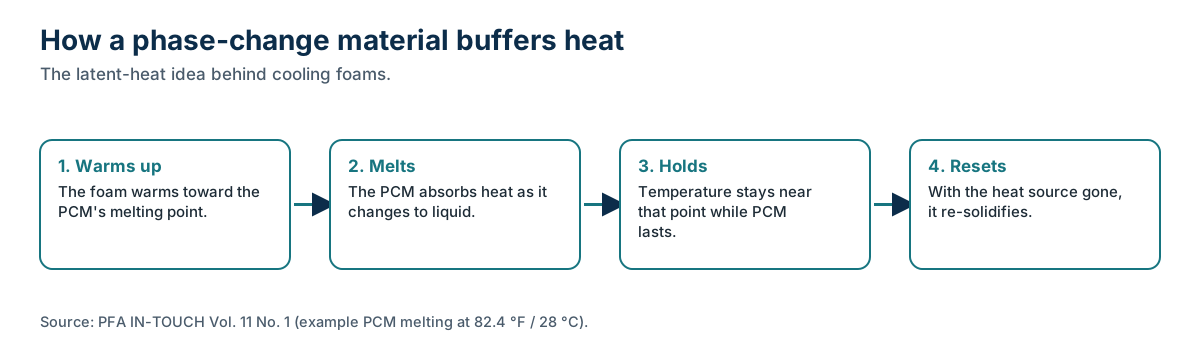
By melting. The PFA's viscoelastic bulletin describes a PCM as "a substance with a high heat of fusion which, melting and solidifying at a certain temperature, is capable of storing and releasing large amounts of energy." The energy goes into changing the material's state rather than raising its temperature: "Heat is absorbed or released when the material changes from solid to liquid and vice versa."
In foam, that works as a buffer. "PCM, as used in viscoelastic foam, absorbs heat when the temperature of the foam reaches the melting point of the PCM," the bulletin says. Its example is a PCM melting at 82.4°F (28°C), which it describes as suited to foam bedding. "By absorbing the heat, PCM helps to maintain the temperature of the foam bedding products around 82.4°F until all the PCM potential is consumed." When the person gets up, "the PCM recovers back to the solid state, and is ready to absorb the heat again."
What are PCMs made of?
Several things. The PFA lists "roughly three kinds of PCM: eutectics, salt hydrates, and organic materials," and says "Organic PCMs, such as waxes, oils, fatty acids and polyglycols, are most commonly used in viscoelastic foam." Because they melt, "PCM may be microencapsulated to assist processing in viscoelastic foam formulations." Adding them isn't free: "Modified formulations are needed to obtain the desired heat absorption while maintaining physical properties of the foam."
PCMs aren't only a bedding idea. A 2025 study of knitted fabrics by Cheng and colleagues describes PCMs as "a class of latent heat storage materials," and explains that "When the ambient temperature rises, PCMs absorb and store substantial latent heat through phase transition, and when the temperature drops, they release heat to maintain a stable surface temperature."
What did a mattress PCM test find?
One recent bench study gives a sense of scale. Raja and colleagues (2025) placed 100 g pouches of a salt hydrate PCM on layers of low-density (18 kg/m³) and high-density (32 kg/m³) polyurethane foam in an insulated timber chamber, then heated the stack with incandescent bulbs producing about 114 W, which they chose to approximate a resting person's heat output. They measured temperatures in each layer.
Their best result came from the low-density foam with PCM, "achieving a temperature difference (ΔT) of 7.310 °C between the ambient and top layer." In their setup, ambient meant the air warmed by the bulb heater. Holes punched in the foam did much less: "Ventilation alone provides minimal thermal benefits, as seen in HDF with Holes (ΔT = 1.905 °C)." In the same test, high-density foam without PCM had a ΔT of 1.148 °C.
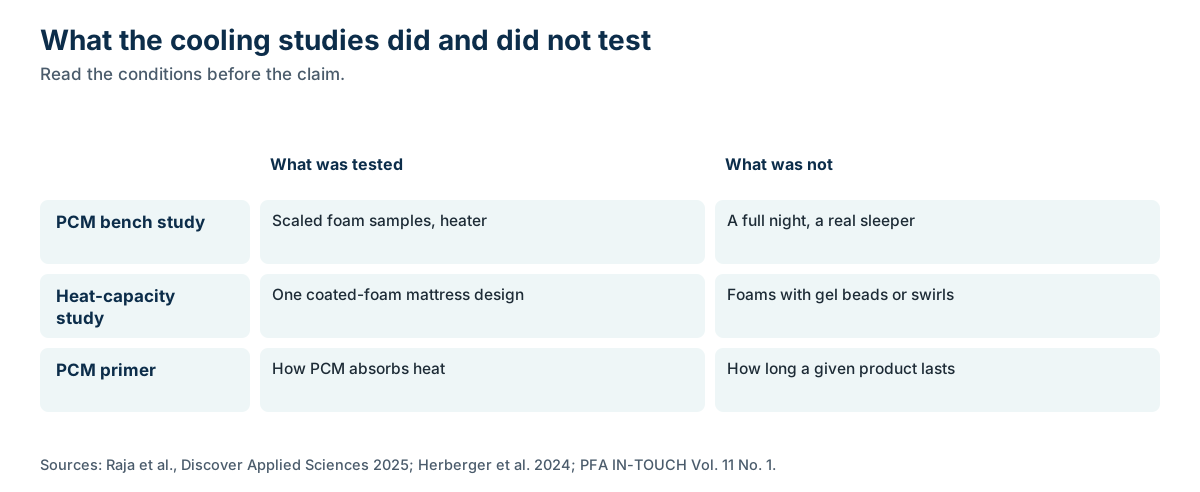
The authors are frank about limits. "The experimental study was conducted using a scaled-down mattress sample size in controlled environment, whereas real-world mattresses are significantly larger and varying environmental conditions." They add that "no direct airflow measurements were taken between the mattress layers," and that "Long-duration testing on actual mattresses would provide insights into how PCM responds to extended heat exposure over an entire night of sleep."
What is a high heat-capacity layer?
A layer that absorbs a lot of heat before it warms up. OpenStax Chemistry defines heat capacity as "the quantity of heat (q) it absorbs or releases when it experiences a temperature change (ΔT) of 1 degree Celsius," and notes that "Heat capacity is determined by both the type and amount of substance that absorbs or releases heat." More material, or a material with a higher specific heat, takes more energy to warm.
Sleep researchers have used this idea. A 2024 study in Scientific Reports by Herberger and colleagues, involving 72 people at three centers, used "a high-heat capacity mattress as a reproducible, non-disturbing way of body cooling." The paper says the mattress "consisted of a foam core coated in polyurethane material," made by Technogel Italia, and it lists an author affiliated with Technogel Italia. We cite it for the material idea only and make no claim about sleep from it.
Where does gel fit?
Gel is a material, not a mechanism, so a gel layer could in principle work through any of the three ideas. The compatibility hub defines gel-infused foam as foam with gel beads, swirls or a layer added. Raja's team mentions "gel infusions and open-cell structures" among recent changes aimed at heat retention, but their study didn't test gel. We found no independent study that measures how gel beads or swirls in mattress foam affect temperature, so we don't rank gel against PCM.
Does airflow matter?
It helps, though the evidence is mixed. The PFA primer uses air flow to check that foam cells are open, with "a minimum of 2.0 cubic feet per minute (cfm)" as a rule of thumb for flexible polyurethane foam. Open cells let air, and with it some heat, move through. Raja's bench test found that holes in the foam alone gave a small benefit, and that holes combined with PCM in low-density foam reached a ΔT of 4.993 °C, below the PCM-only result. The finding that lower-density foam did better came from one setup with two foams, so we don't generalize it; the density and firmness article explains what foam density does and doesn't measure.
Sleep Sanitation's view
This section is our view. Without knowing what a cooling layer contains, we treat it as memory foam: short passes, minimal moisture. We haven't found any study of cleaning heat and microencapsulated PCMs, which is one more reason for caution. The approach is ours, not a manufacturer exemption, so the care label and warranty terms govern and you should check your warranty terms before you book. "Sanitize" follows the CDC's terms; we make no disinfection claim. See the mattress materials hub for where cooling layers sit and our process page for what a visit involves.
What we don't know
- What's actually in a branded "cooling" layer. Makers rarely publish whether it's a PCM, a high heat-capacity material, gel for feel or a mix.
- How long a mattress PCM keeps buffering on a real night. The only mattress test we found used scaled samples and a bulb heater.
- Whether cleaning heat affects microencapsulated PCMs. We found no study, which is one reason we keep passes short.
Changelog
- 5 October 2026: First published. Sources accessed on this date.
Sources
- IN-TOUCH Vol. 11 No. 1: Viscoelastic (memory) foam (revised 2016) · Polyurethane Foam Association
- Chemistry 2e, 5.1 Energy Basics · OpenStax (Rice University)
- Experimental investigation on thermal performance of polyurethane foam mattresses with PCM (Raja et al., Discover Applied Sciences, 2025) · Springer Nature (open access)
- Enhanced conductive body heat loss during sleep increases slow-wave sleep and calms the heart (Herberger et al., Scientific Reports, 2024) · PubMed Central
- Thermoregulatory Performance and Thermal Comfort Analysis of Phase-Change Fiber Seamless Knitted Fabrics (Cheng et al., Materials, 2025) · PubMed Central
- IN-TOUCH Vol. 1 No. 1: Flexible polyurethane foam, an introduction · Polyurethane Foam Association
- Cleaning and disinfecting your school (definitions) · CDC
Last reviewed October 5, 2026. Manufacturer specifications and care instructions change; check the current version for your exact model. This page is general information, not medical advice. How we source and check pages: editorial standards.