
Short answer
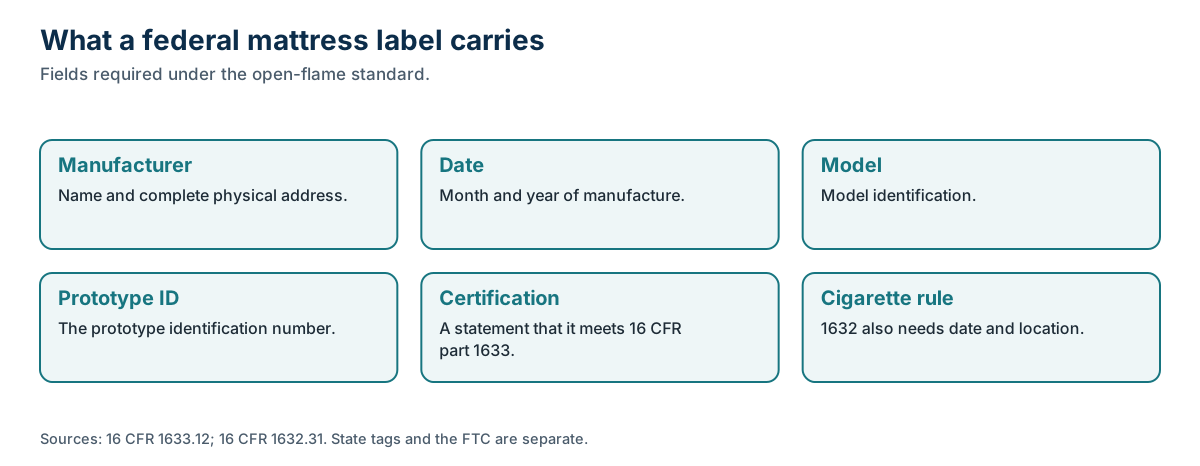
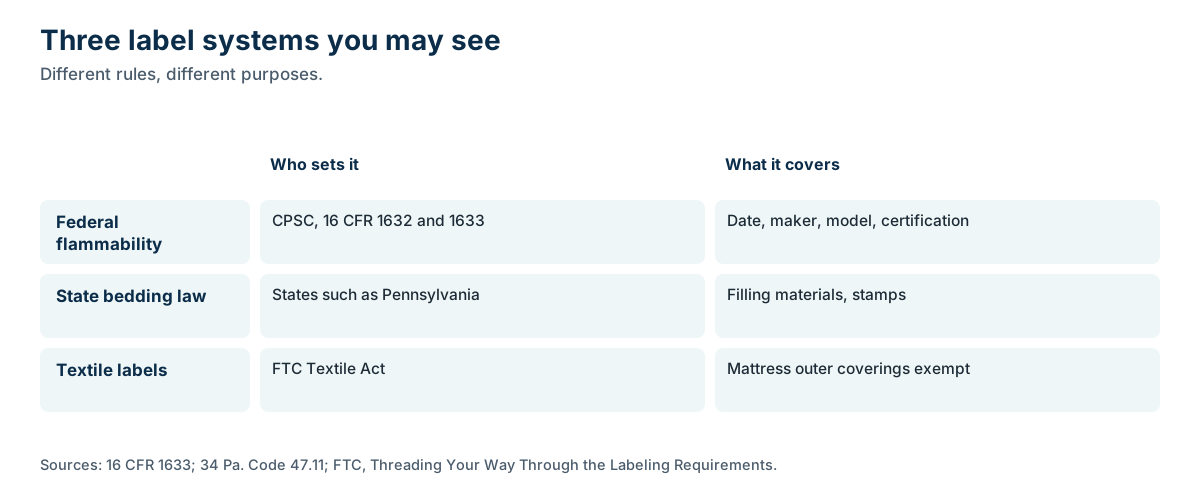
A mattress law tag is really up to three labels. The federal flammability label gives the maker, address, month and year of manufacture, model, prototype ID and a 16 CFR 1633 certification. State bedding tags, like Pennsylvania's, list filling materials. Federal rules bar anyone but the ultimate consumer from removing the label, but keeping it is wise: it holds your mattress's date and model.
Key terms used on this page
- Law tag:
- The required labels on a mattress. The federal 1633 label lists the maker, address, month and year of manufacture, model, prototype ID and certification; state bedding tags such as Pennsylvania's add filling materials.
- Open-flame standard (16 CFR 1633):
- The federal rule limiting the size of a mattress fire. A mattress set's peak heat release may not exceed 200 kW in a 30 minute test, and total heat release may not exceed 15 MJ in the first 10 minutes.
- Cigarette ignition standard (16 CFR 1632):
- The federal test of whether a lighted cigarette can ignite a mattress or mattress pad. Each test location passes if the char length is no more than 2 inches.
- Care label:
- The care instructions sewn into a mattress, topper or cover. Tempur UK notes that 'A label stitched inside the cover will give you specific care instructions for the item you have purchased.' A care label outranks general web guidance.
- Ticking:
- The outer fabric cover of a mattress, often quilted to the comfort layers beneath. Avocado tells owners: 'Do not attempt to remove the mattress ticking to access the internal materials or support unit.'
A mattress law tag is usually more than one label. The federal flammability label lists the maker and address, the month and year of manufacture, the model, a prototype identification number and a certification under 16 CFR 1633. State bedding tags, such as Pennsylvania's, add a statement of filling materials. Under the federal rule, anyone other than the ultimate consumer is barred from removing the label, but keeping it is wise, because it records your mattress's date and model.
General information about mattress materials, not medical advice.
What does the federal label have to say?
Exactly what the rule lists, and nothing else. 16 CFR 1633.12 requires each mattress set to carry "a permanent, conspicuous, and legible label(s) containing the following information (and no other information) in English." The list is short: the manufacturer's name (and the importer's, for imports), the "complete physical address of the manufacturer," the "Month and year of manufacture," the "Model identification," the "Prototype identification number for the mattress set," and a certification.
The certification wording is fixed. For a mattress sold on its own, it reads: "This mattress meets the requirements of 16 CFR part 1633 (federal flammability (open flame) standard for mattresses) when used without a foundation." Mattresses meant to go on a specific foundation name it instead. The label also has to say, in capitals, whether the mattress is intended to be used with or without a foundation. The rule even sets the format: "The label must be white with black text."
What do the prototype ID and import lines mean?
The prototype number ties your mattress to a tested design. The CPSC overview explains that the rules use a prototype testing scheme, where a prototype is "A design that is the same as production units with respect to materials, components, design, and method of assembly." The point, it says, is to "Lower testing burden by using a qualified prototype on which confirmed or subordinate prototypes can be based, also called prototype pooling." The ID on your label points back to that tested design in the maker's records.
Imported mattresses carry extra address lines. The rule requires "the complete address of the foreign manufacturer, including country, and the complete physical address of the importer or the United States location where the required records are maintained if different from the importer." If you ever need to reach whoever holds the records, that's where to look.
What about the cigarette standard?
It adds its own requirement. Under 16 CFR 1632, "Each mattress or mattress pad subject to the Standard shall bear a permanent, accessible, and legible label containing the month and year of manufacture and the location of the manufacturer." The CPSC's overview summarizes the same points and adds that, for treated mattress pads, the label is marked with the letter T.
So the two federal rules overlap on the date and maker. The fire barrier article explains what each test measures.
Who's allowed to remove the label?
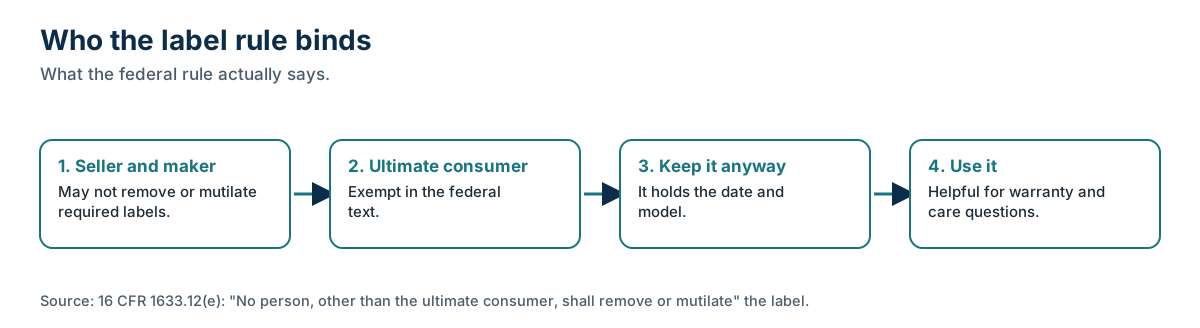
Under the federal rule, the familiar do-not-remove warning is aimed at businesses. The federal open-flame rule is precise: "No person, other than the ultimate consumer, shall remove or mutilate, or cause or participate in the removal or mutilation of, any label required by this section to be affixed to any item." In other words, the rule binds makers, importers and sellers, and exempts the person who bought the mattress for their own use.
That doesn't make removing it a good idea. The label is often the only place the month and year of manufacture and the model are recorded, which matter for warranty questions and for knowing how old your mattress is. We'd leave it on. State rules can add their own requirements, as the CPSC overview notes, so check yours.
What do state bedding tags add?
Filling information, in states with bedding laws. Pennsylvania is an example. Its regulation says "Each new and secondhand article of upholstered furniture and each mattress, pillow, bolster, feather bed, comfortable, cushion and bulk filling material shall be tagged and stamped." Tags "shall be so located that the information contained on them is visible," and "When possible, they shall be securely sewed onto the pillows, mattresses or other material."
The state tag carries a statement of filling materials and a stamp: "On each tag shall be affixed an adhesive stamp issued by the Department," placed so it doesn't "interfere with the statement of filling materials." Each manufacturer, upholsterer, secondhand dealer, renovator and auctioneer must furnish its own labels. Requirements differ by state, and we haven't surveyed them all, so don't expect every mattress to carry this kind of tag.
Does the tag list the fabric?
Often not. The FTC enforces fiber labeling under the Textile Act, but its labeling guide lists items "not covered by the Textile Act labeling requirements," including "Upholstery or mattress stuffing that is not reused" and "Outer coverings of upholstered furniture, mattresses and box springs." It adds a condition for stuffing: "If the stuffing is reused, the label must say so."
That's why you may find no fiber content for the cover anywhere on the mattress. The ticking article covers what cover fabrics are made of and how to find out. For wool, the FTC's separate Wool Act rules apply to most products containing wool, as the wool article explains.
What does the tag tell you about the layers?
Indirectly, quite a bit. The federal rule defines the vocabulary. "Ticking means the outermost layer of fabric or related material of a mattress or foundation." "Upholstery material means all material, either loose or attached, between the mattress ticking and the core of a mattress." And "Core means the main support system that may be present in a mattress, such as springs, foam, water bladder, air bladder, or resilient filling." A state tag's filling statement describes what's in those layers.
What the label won't tell you is how to clean the mattress, or what barrier materials it uses. The federal label can't carry extra information, and makers keep records of flame retardant treatments and flame-resistant fibers rather than printing them. For care, look for the manufacturer's care label or instructions.
How to read a tag, step by step
Start with the federal label. Find the month and year of manufacture and note the model; that's your mattress's age and identity. Read the certification line to see whether it's certified alone or with a specific foundation, and keep that foundation if it's named. Then look for any state tag and its filling statement. Finally, check the manufacturer's website or paperwork for care instructions, since none of the law labels are care guides.
Sleep Sanitation's view
This section is our view. We leave law labels where they are. For cleaning, the tag isn't the guide; your care label and the maker's instructions are, so look those out before a visit. On the day, we clean through the cover, never under it. Our method rests on our own reasoning and is not a manufacturer exemption: the care label and warranty terms govern, and it's worth checking your warranty terms before you book. We mean "sanitize" as the CDC's terms define it and make no disinfection claim. When you're ready, you can schedule a visit, or start with the mattress materials hub.
What we don't know
- Which states currently require bedding tags and what each requires. We cite Pennsylvania as one example and haven't surveyed every state.
- How the FTC's Wool Act coverage applies to every wool mattress layer; its guide doesn't address mattresses directly.
- What barrier materials a given mattress uses, since that information sits in the maker's records rather than on the label.
Changelog
- 5 October 2026: First published. Sources accessed on this date.
Sources
- 16 CFR Part 1633: Standard for the Flammability (Open Flame) of Mattress Sets · Electronic Code of Federal Regulations (eCFR)
- 16 CFR Part 1632: Standard for the Flammability of Mattresses and Mattress Pads (FF 4-72) · Electronic Code of Federal Regulations (eCFR)
- 34 Pa. Code § 47.11. Tags and stamps · Pennsylvania Code and Bulletin
- Threading Your Way Through the Labeling Requirements Under the Textile and Wool Acts · Federal Trade Commission
- Overview of U.S. Mattress Requirements (Campbell, March 2018) · U.S. Consumer Product Safety Commission
- Cleaning and disinfecting your school (definitions) · CDC
Last reviewed October 5, 2026. Manufacturer specifications and care instructions change; check the current version for your exact model. This page is general information, not medical advice. How we source and check pages: editorial standards.