
Short answer
There's no single normal level. Outdoor air is about 428 ppm, and Health Canada found median home readings of 418 to 729 ppm, with 95th percentiles up to 1,483 ppm. A closed bedroom with two sleepers often climbs past 1,000 ppm by morning. Health Canada's guideline is 1,000 ppm as a 24-hour average, so a brief overnight peak isn't the same thing.
Key terms used on this page
- Parts per million (ppm):
- The unit for CO2 in air: molecules of CO2 per million molecules of air. Health Canada gives the conversions 1 ppm = 1.8 mg/m3 and 0.1% = 1,000 ppm.
- Outdoor CO2 baseline:
- The CO2 level of outdoor air, the floor an indoor reading falls back toward when a room is well aired. NOAA's Mauna Loa record averaged 427.55 ppm in August 2026; ASHRAE notes it passed 400 ppmv in 2013.
- Long-term exposure limit (Health Canada):
- Health Canada's residential guideline for CO2: 1,000 ppm based on a 24-hour average. Health Canada says sampling for comparison should last at least 24 hours under normal conditions.
- Steady-state CO2:
- The level where CO2 stops rising because outdoor air removes it as fast as people add it. Persily and de Jonge's model puts two sleeping adults in a 65 m3 bedroom at 1,988 ppm above outdoors at 0.2 air changes per hour.
- Air changes per hour (ACH):
- How many times an hour a room's volume of air is replaced by outdoor air. An ASHRAE-cited review of bedroom studies found mean bedroom rates from 0.2 to 4.9 per hour, lower in heating seasons.
There's no single normal CO2 level for a bedroom. Outdoor air is about 428 ppm. Health Canada's survey of Canadian homes found median hourly readings between 418 and 729 ppm, with 95th percentiles as high as 1,483 ppm. A closed bedroom with two people asleep often climbs past 1,000 ppm by morning. Whether that matters depends on what the number is being compared with, and most comparisons online mix up averages, peaks and limits written for other settings.
General information about bedroom air and ventilation, not medical advice.
What is the starting point?
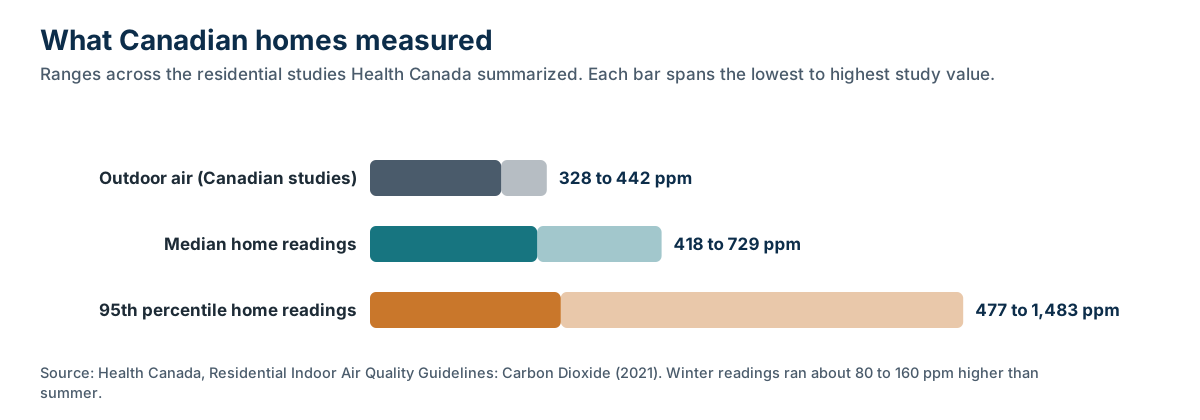
Outdoor air. Every indoor reading starts there and falls back toward it when a room is well aired. NOAA's Mauna Loa record averaged 427.55 ppm in August 2026, up from 425.48 ppm a year earlier. ASHRAE's position document on indoor CO2 notes that outdoor levels passed 400 ppmv in 2013 and keep rising. Health Canada reports that published outdoor ground-level values have ranged from 328 to 442 ppm.
So an indoor reading of 430 means the room is about as fresh as outside. Anything above that is CO2 added indoors, overwhelmingly by people breathing. Health Canada's residential guideline says "the main source of CO2 indoors is from the respiration of occupants."
What do typical homes measure?
Health Canada pulled together home studies from Ottawa, Edmonton, Halifax, Montreal, Quebec City and the Annapolis Valley. Median hourly averages ranged from 418 to 729 ppm, and measured 95th percentiles ranged from 477 to 1,483 ppm. In the cities measured in two seasons, winter medians ran about 80 to 160 ppm higher than summer.
Those are whole-home figures, and they include daytime hours when windows may be open and people are out. A bedroom at night is a different situation: the door is often closed, the people inside are there for hours, and nobody is opening and closing exterior doors. That's why bedroom numbers can look much higher than these medians.
What do bedrooms measure?
Higher, and over a wider range. An ASHRAE committee issue brief summarizing a review by Sekhar and colleagues reported "mean bedroom CO2 concentrations ranging between approximately 430 ppm and 2600 ppm," with mean bedroom air change rates from 0.2 to 4.9 per hour. The review found ventilation rates were lower during heating seasons.
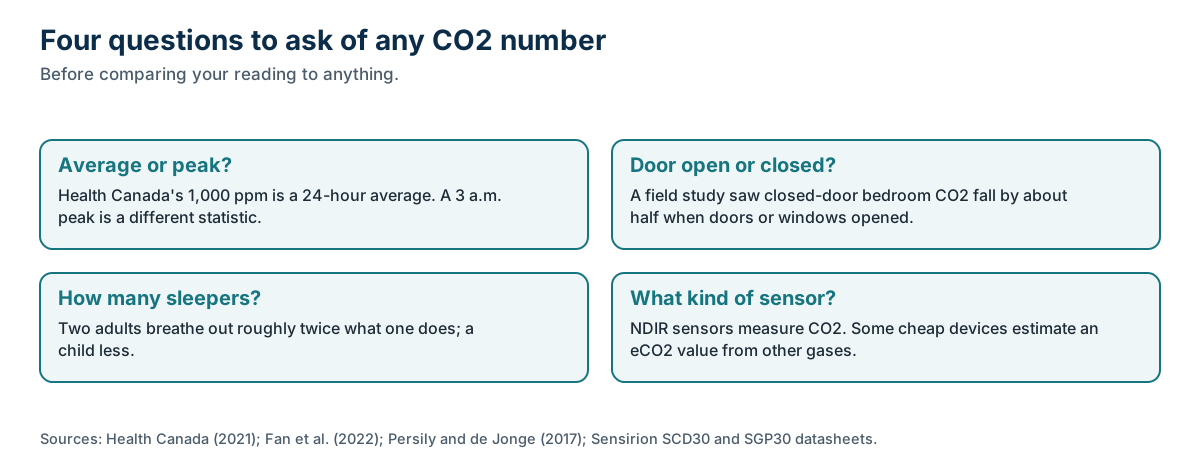
A Danish field study gives a sense of real winter nights. In Fan et al. (2022), bedrooms with doors and windows closed had a mean 95th-percentile CO2 during sleep of 2,916 ppm in one group and 2,310 ppm in another. Opening the doors or windows cut those to 1,415 and 904 ppm. Model values tell a similar story: Persily and de Jonge calculate that two sleeping adults in a 65 m3 bedroom would level off 795 ppm above outdoors at 0.5 air changes per hour and 1,988 ppm above outdoors at 0.2. Why CO2 builds up overnight explains that math.
Which numbers get quoted, and what do they mean?
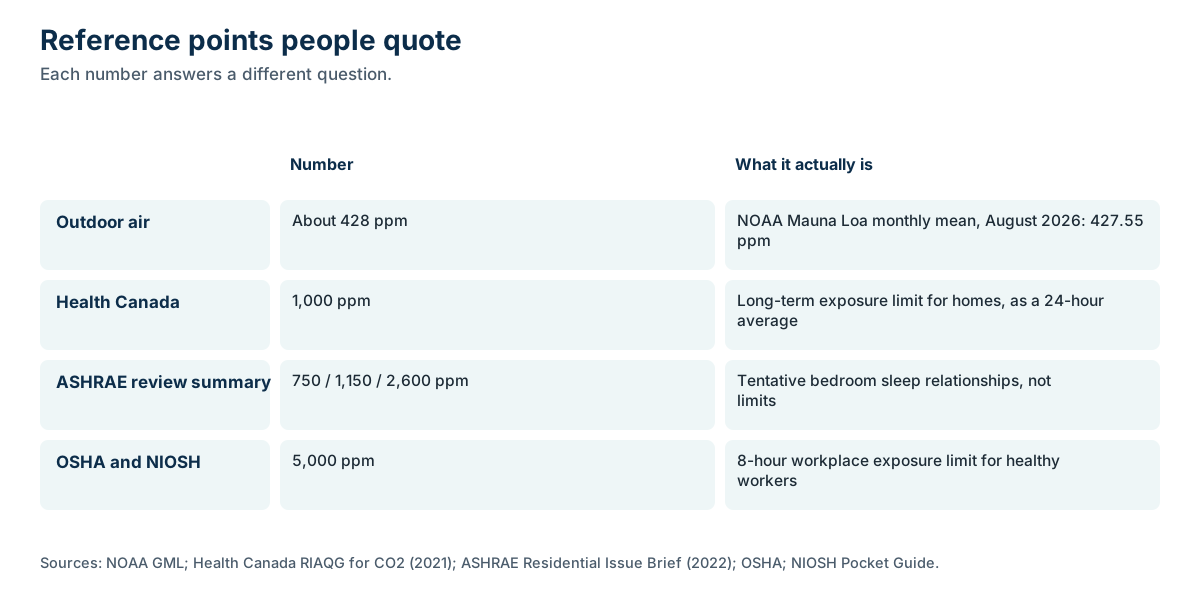
Four numbers come up again and again, and each answers a different question.
- About 428 ppm is outdoor air, the floor.
- 1,000 ppm is Health Canada's long-term exposure limit for homes, "based on a 24-hour average." It also has a long history as a ventilation marker, covered in where the 1,000 ppm number comes from.
- 750, 1,150 and 2,600 ppm are the tentative sleep relationships in the ASHRAE brief: sleep "will not be negatively affected" below 750 ppm, ventilation letting CO2 reach about 1,150 ppm "can disturb sleep quality," and above 2,600 ppm next-day performance may suffer. What research says about bedroom CO2 and sleep examines the studies behind them.
- 5,000 ppm is the 8-hour workplace limit, which is not a bedroom target.
Is an overnight peak the same as an average?
No, and this is the most common mix-up. Health Canada says that when comparing a measurement with its guideline, "the sampling time should be at least 24 hours, taken under normal conditions." A bedroom that climbs to 1,300 ppm at 5 a.m. and falls to 500 ppm once the door opens may average well under 1,000 ppm across the day.
That doesn't make the peak meaningless. The bedroom studies looked at conditions during sleep, not 24-hour averages, so the overnight pattern is what matters for that question. It just means a single overnight high isn't a breach of a 24-hour guideline. How to read a night of bedroom CO2 readings shows how to look at the whole curve.
Why do two bedrooms read so differently?
Because the level depends on a few things that vary a lot from home to home:
- How many people are breathing. Two adults add roughly twice what one does. Shared bedrooms, kids' rooms and pets has the numbers.
- How much outdoor air reaches the room. Door open or shut, window cracked or not, mechanical ventilation running or idle. Open door vs window vs fan compares them.
- Room size. A larger room takes longer to fill, though it ends at the same plateau for the same airflow per person.
- The season. Windows stay shut in winter. Tight homes and Nebraska winters covers what that means locally.
- The monitor. Some cheap devices estimate an "eCO2" value rather than measuring CO2 at all, as how home CO2 monitors work explains.
What do people online report?
Screenshots of bedroom monitors reading 1,200, 1,500 or 2,000 ppm in the morning circulate widely, often with temperature and humidity alongside. Those numbers are consistent with the research above: a closed bedroom with one or two sleepers and little outdoor air can reach that range. What a screenshot can't show is the context: how many people slept there, whether the door was closed, whether the monitor measures real CO2, and whether that night was typical. Read your own number with those questions in mind.
Is a high reading a health problem?
Not by itself. ASHRAE states that indoor CO2 concentrations "are not overall indicators of IAQ," and that evidence for direct effects of CO2 on health, sleep and performance at commonly observed indoor levels "is inconsistent." Health Canada's consumer page says symptoms associated with higher CO2 "may not be from CO2 exposure, but from poor indoor air quality in general." Is CO2 the problem, or a marker of stale air? goes deeper.
What a high reading reliably tells you is that the room isn't getting much outdoor air for the number of people in it. Whether you want to change that is up to you; the hub lays out the options.
Sleep Sanitation's view
This section is our view. We'd rather you understand what your number means than chase a target. A bedroom that reads 1,400 ppm at dawn isn't an emergency; it's a room with limited airflow, and that's often easy to change. Our optional 72-hour bedroom CO2 test logs three nights and gives a plain-language ventilation report with airflow tips. It's priced by quote, booked on its own or added to a mattress visit, and it isn't a medical test. To book, see scheduling.
What we don't know
- What bedroom CO2 typically looks like in Lincoln and Omaha homes. We found no published local measurements.
- Whether there's a level below which sleep is unaffected for everyone. The 750 ppm figure comes from a small number of studies, mostly in young adults.
- How much of the Canadian home data reflects bedrooms at night rather than whole homes across the day.
Changelog
- 7 October 2026: First published. Sources accessed on this date.
Sources
- Trends in Atmospheric Carbon Dioxide (Mauna Loa monthly mean) · NOAA Global Monitoring Laboratory
- Residential Indoor Air Quality Guidelines: Carbon Dioxide (2021) · Health Canada
- Carbon dioxide in your home · Health Canada
- Residential Issue Brief: Ventilation, IEQ and Sleep Quality in Bedrooms (2022) · ASHRAE Residential Buildings Committee
- ASHRAE Position Document on Indoor Carbon Dioxide (approved 2025) · ASHRAE
- Carbon dioxide generation rates for building occupants (Persily and de Jonge, Indoor Air, 2017) · PubMed Central
- A field intervention study of the effects of window and door opening on bedroom IAQ, sleep quality, and next-day cognitive performance (Fan et al., 2022) · Building and Environment (DOI)
- Bedroom ventilation: Review of existing evidence and current standards (Sekhar et al., Building and Environment, 2020) · Elsevier (DOI)
Last reviewed October 7, 2026. Manufacturer specifications and care instructions change; check the current version for your exact model. This page is general information, not medical advice. How we source and check pages: editorial standards.