
Short answer
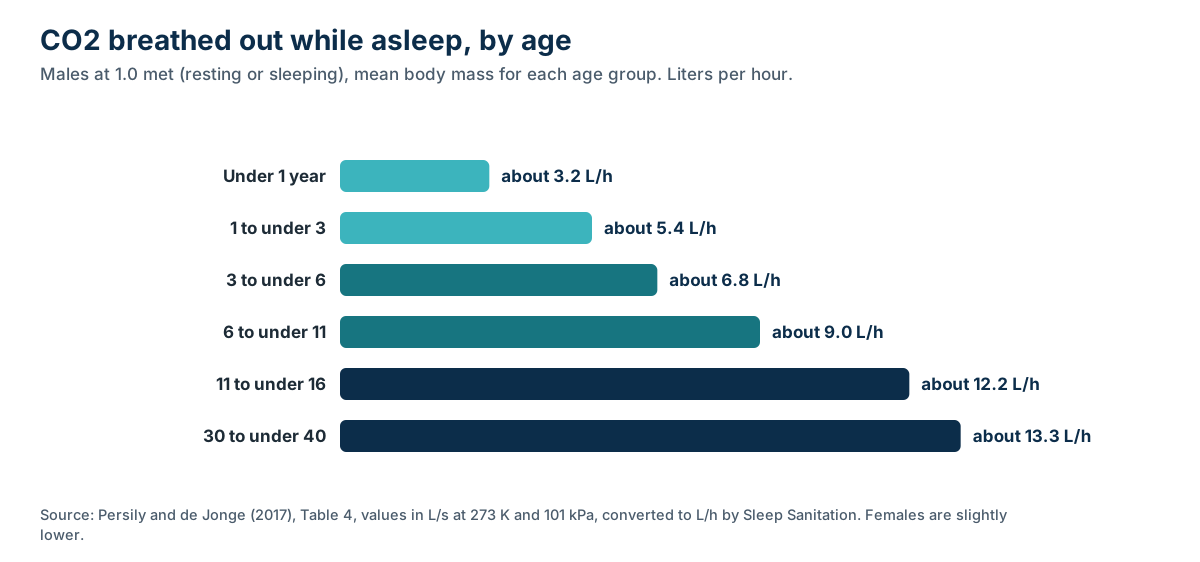
Bedroom CO2 rises with the number and size of the people breathing in the room. Published rates put a sleeping adult at roughly 13 liters of CO2 an hour, a child aged 6 to 11 at about 9 and an infant at about 3. Two adults roughly double the rise over one. Health Canada found pets add only marginally. A child's room usually reads lower than a shared adult bedroom with the same airflow.
Key terms used on this page
- CO2 generation rate:
- How much CO2 a person breathes out, which depends on body size, age, sex and activity. Health Canada puts an average person at about 15 L/hr at rest and about 45 L/hr during moderate activity.
- Met (metabolic rate unit):
- A unit of activity level used to estimate how much CO2 a person produces. Persily and de Jonge use about 1.0 met for sleeping occupants in their bedroom examples, lower than the 1.4 met they use for other residential activity.
- Steady-state CO2:
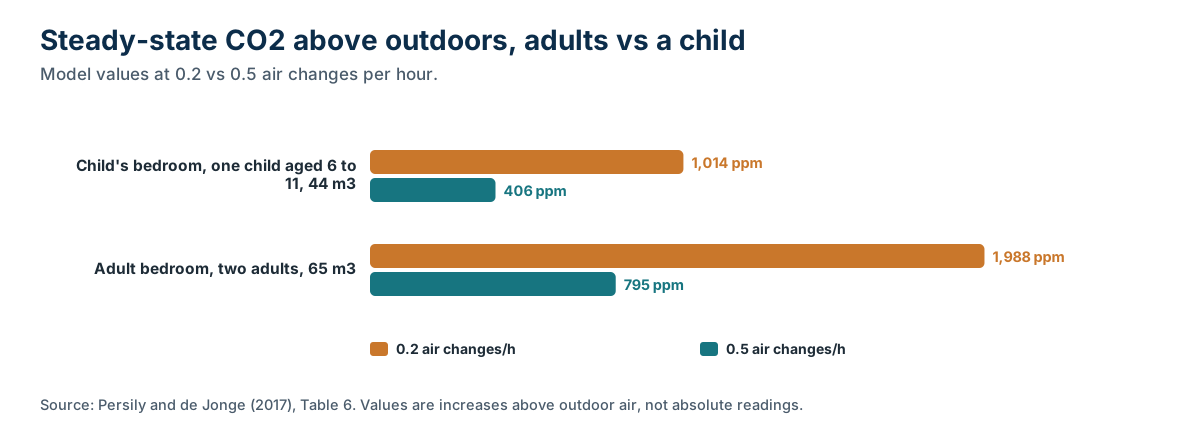
- The level where CO2 stops rising because outdoor air removes it as fast as people add it. Persily and de Jonge's model puts two sleeping adults in a 65 m3 bedroom at 1,988 ppm above outdoors at 0.2 air changes per hour.
- Long-term exposure limit (Health Canada):
- Health Canada's residential guideline for CO2: 1,000 ppm based on a 24-hour average. Health Canada says sampling for comparison should last at least 24 hours under normal conditions.
- Air changes per hour (ACH):
- How many times an hour a room's volume of air is replaced by outdoor air. An ASHRAE-cited review of bedroom studies found mean bedroom rates from 0.2 to 4.9 per hour, lower in heating seasons.
Bedroom CO2 depends on who's breathing in the room. A sleeping adult breathes out roughly 13 liters of CO2 an hour, a child aged 6 to 11 about 9, and an infant about 3, according to published rates. So two adults roughly double the rise of one, and a young child's room usually reads lower than a shared adult bedroom with the same airflow. Pets add only a little. Here's how to account for the people in the room before judging a number.
General information about bedroom air and ventilation, not medical advice. For questions about a child's sleep or health, talk with your pediatrician.
How much CO2 does a sleeper produce?
It depends on body size, age, sex and activity. Persily and de Jonge (2017) built tables of CO2 generation from metabolic data. Their activity table lists sleeping at 0.95 to 1.0 met, the lowest activity level. At 1.0 met, using mean body mass for each age group, their rates for males work out to about:
- Under 1 year: 0.0009 L/s, about 3.2 liters an hour.
- Ages 6 to under 11: 0.0025 L/s, about 9 liters an hour.
- Ages 11 to under 16: 0.0034 L/s, about 12 liters an hour.
- Ages 30 to under 40: 0.0037 L/s, about 13 liters an hour.
Rates for females are slightly lower. Health Canada's residential guideline uses a round figure: "an average person will produce approximately 15 L/hr of CO2 at rest."
Why does a couple's bedroom read so high?
Because the source doubles while the room doesn't. With two adults instead of one, CO2 enters the room twice as fast; with the same outdoor airflow, the rise above outdoor air at steady state doubles too. Persily and de Jonge's bedroom example uses one man and one woman aged 31 to 40, at 1.0 met, in a 65 cubic meter bedroom, and calculates steady-state levels 795 ppm above outdoors at 0.5 air changes per hour and 1,988 ppm above outdoors at 0.2.
That's why couples sharing a closed bedroom can see the highest morning readings in the house. Why CO2 builds up in a closed bedroom overnight explains the curve.
What about a child's room?
Usually lower. Persily and de Jonge's child's bedroom example is one boy or girl aged 6 to 11, at 1.0 met, in a 44 cubic meter bedroom. At the same air change rates, steady state comes out at 406 ppm above outdoors at 0.5 per hour and 1,014 ppm above outdoors at 0.2. The child's room is smaller, but the child breathes out far less, so the level stays lower.
There's a caveat. Air change rate depends on the room's airflow and volume, and a small room with a closed door and no return may get less airflow than the example assumes. A DOE Building America guide notes closed-door bedrooms can see air change rates "50% lower" than areas near the ventilation fans. A child's room isn't automatically well ventilated.
Are children more sensitive?
Health Canada counts them as a group to consider. Its guideline says "infants and children are also considered a vulnerable population," partly because "because of their size, children inhale more air in relation to their body weight than adults." That's a reason it set a long-term residential guideline rather than borrowing workplace limits.
The one bedroom-type study we found in children was reassuring. Klausen et al. (2023) ran a double-blind crossover study with 36 children aged 10 to 12 sleeping in a climate chamber at 700 ppm, at 2,000 to 3,000 ppm with added pure CO2, and at similar levels with reduced ventilation. They found "no significant exposure effects on cognitive performance," and the one sleep-efficiency difference was judged a chance effect. One study doesn't settle the question, and what research says about bedroom CO2 and sleep covers the adult studies.
What about a baby in the parents' room?
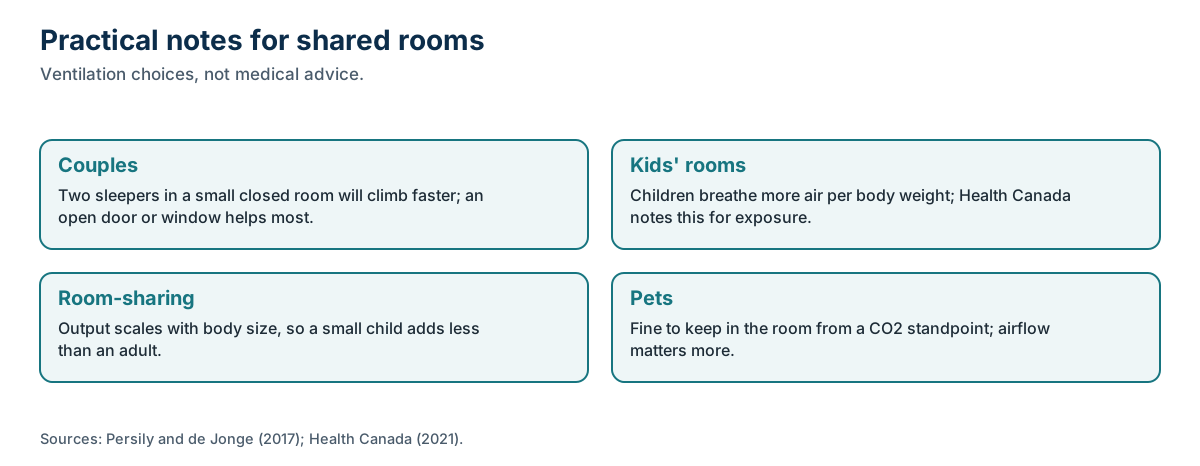
The baby adds little CO2. At about 3 liters an hour, an infant under one produces roughly a quarter of what one adult does, so in a shared room the adults set the level. If you're keeping a bassinet or crib in your room, ventilation choices for the adults apply to the whole room. For safe infant sleep, follow your pediatrician's guidance; this article is only about CO2.
Do pets matter?
A little. Health Canada reports that "in studies in Quebec (winter) and Halifax (winter), marginally higher levels of CO2 were also observed in households with pets." A large dog sleeping in the room likely adds more than a cat, since CO2 output tracks body size and metabolism, but people remain the main source. From a CO2 standpoint, there's no reason to move a pet out; airflow matters more.
Does age change the adult number?
Somewhat. Persily and de Jonge note that their generation rate "increases with age (for the same met value) up to about 30 year of age, at which point it decreases gradually with age," following basal metabolic rate. Their tables show adults over 80 at about 0.0030 L/s at 1.0 met, compared with 0.0037 for ages 30 to 40. That's a smaller effect than adding or removing a sleeper.
What about guests or a sick night?
A guest sleeping in the room, a child climbing into bed, or a restless night all add to the source. Persily and de Jonge's tables show CO2 output rising steeply with activity: their rate for a man aged 30 to 40 at 2.0 met is about double the rate at 1.0 met. That's one reason a single night's log can look different from the next, and why several nights tell you more than one.
How should you adjust your reading?
Before comparing your bedroom with anyone else's, count the sleepers. A couple's closed bedroom reading 1,800 ppm and a child's room reading 900 ppm can have similar airflow per person. The ASHRAE committee brief frames bedroom guidance in terms of ventilation rates that let CO2 reach certain levels, which is the right way to think about it: the number reflects airflow per sleeper.
In the Danish study by Fan et al. (2022), opening doors or windows cut bedroom CO2 substantially. For couples, the free options, an open door or a cracked window, tend to make the biggest difference. Open door vs window vs fan compares them, and the hub links the rest.
Sleep Sanitation's view
Here's where we stand. When a shared bedroom reads high, nobody in it is doing anything wrong; more sleepers simply means more CO2 in the same air. Our optional 72-hour bedroom CO2 test logs three nights in the bedroom you choose and gives a plain-language ventilation report with airflow tips. It's priced by quote, booked on its own or added to a mattress visit, and it isn't a medical test. To book, see scheduling.
What we don't know
- Whether children's sleep responds to bedroom ventilation the way some adult studies suggest. The one double-blind study we found saw no effect.
- How much large dogs add in a closed bedroom. The Health Canada data compare households, not bedrooms.
- How generation rates for people with illness or fever differ during sleep. The published tables use healthy reference values.
Changelog
- 7 October 2026: First published. Sources accessed on this date.
Sources
- Carbon dioxide generation rates for building occupants (Persily and de Jonge, Indoor Air, 2017) · PubMed Central
- Residential Indoor Air Quality Guidelines: Carbon Dioxide (2021) · Health Canada
- Residential Issue Brief: Ventilation, IEQ and Sleep Quality in Bedrooms (2022) · ASHRAE Residential Buildings Committee
- The effect of air quality on sleep and cognitive performance in school children aged 10-12 years (Klausen et al., 2023) · PubMed Central
- Measure Guideline: Selecting Ventilation Systems for Existing Homes (Building America, 2014) · US Department of Energy
- A field intervention study of the effects of window and door opening on bedroom IAQ, sleep quality, and next-day cognitive performance (Fan et al., 2022) · Building and Environment (DOI)
Last reviewed October 7, 2026. Manufacturer specifications and care instructions change; check the current version for your exact model. This page is general information, not medical advice. How we source and check pages: editorial standards.