
Short answer
We place a CO2 monitor in your bedroom, away from the bed, windows and vents, for three nights. When we collect it, we walk you through the overnight pattern, and you get a plain-language ventilation report with airflow tips. It's optional, priced by quote, and booked on its own or added to a mattress visit, never included in one. It's a ventilation check, not a medical test, and it doesn't promise better sleep.
Key terms used on this page
- Parts per million (ppm):
- The unit for CO2 in air: molecules of CO2 per million molecules of air. Health Canada gives the conversions 1 ppm = 1.8 mg/m3 and 0.1% = 1,000 ppm.
- Outdoor air ventilation:
- Outdoor air brought into a space on purpose or by leakage, which dilutes what people and the building give off. ASHRAE says indoor-outdoor CO2 differences can be used to evaluate outdoor ventilation rates, given valid assumptions.
- Steady-state CO2:
- The level where CO2 stops rising because outdoor air removes it as fast as people add it. Persily and de Jonge's model puts two sleeping adults in a 65 m3 bedroom at 1,988 ppm above outdoors at 0.2 air changes per hour.
- NDIR sensor:
- A non-dispersive infrared sensor, which measures CO2 by how much infrared light it absorbs. One maker's datasheet for an NDIR module lists accuracy of plus or minus 30 ppm plus 3% of the reading.
- Long-term exposure limit (Health Canada):
- Health Canada's residential guideline for CO2: 1,000 ppm based on a 24-hour average. Health Canada says sampling for comparison should last at least 24 hours under normal conditions.
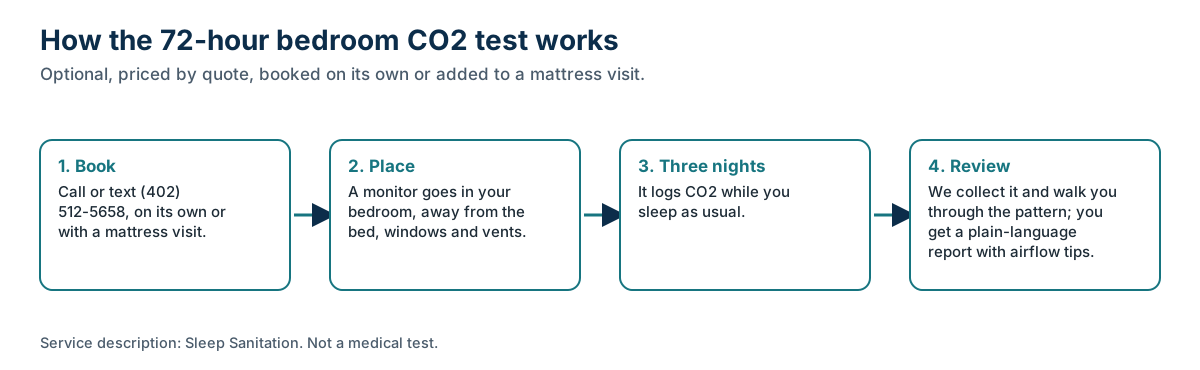
Our 72-hour bedroom CO2 test is simple. We place a monitor in your bedroom, away from the bed, windows and vents, for three nights. It logs carbon dioxide while you sleep as usual. When we collect the monitor, we walk you through the overnight pattern, and you get a plain-language ventilation report with airflow tips. It's an optional add-on, priced by quote, that you can book on its own or add to a mattress visit; it's never included in one. It's a ventilation check, not a medical test. This page explains what it does, why three nights, and what it doesn't do.
General information about our bedroom CO2 test and bedroom ventilation, not medical advice.
What happens, step by step?
- Book. Call or text (402) 512-5658, or email info@sleepsanitation.com. Tell us whether you want the test on its own or added to a mattress visit, and we'll quote it.
- Place. We set a CO2 monitor in your bedroom, away from the bed, windows and vents.
- Three nights. The monitor logs CO2 through three nights of normal sleep.
- Review. We collect the monitor and walk you through the overnight pattern, and you get a plain-language ventilation report with airflow tips.
That's the whole service. We don't add tests, readings or claims beyond it.
Why three nights instead of one?
Because one night can mislead. Weather, wind, who slept where and whether a door was left open all change the curve. Several nights show whether a pattern is typical. Health Canada's residential guideline makes a related point for its 24-hour limit: "the sampling time should be at least 24 hours, taken under normal conditions," and averaging repeated samples gives a more representative estimate.
Three nights also give the curve time to show its shape. In a room with little air exchange, CO2 can still be climbing at dawn. Persily and de Jonge note that reaching about 95% of the steady-state level takes three time constants, which can be longer than a night. Why CO2 builds up in a closed bedroom overnight explains why that matters.
Why does placement matter?
Because a monitor reads the air right around it. ASHRAE's position document says "sensor performance, location, and calibration are all critical for drawing meaningful inferences from measured indoor CO2 concentrations." A monitor next to the pillow catches exhaled breath; one next to an open window or supply vent catches a draft. That's why we place it away from the bed, windows and vents. How home CO2 monitors work covers the general principles.
What does the report cover?
How your bedroom ventilates overnight, explained in plain language, with airflow tips. The tips are the kind of changes covered in open door vs window vs fan: things like the door, a window, the HVAC fan or the ventilation system's settings. For changes to the system itself, talk with an HVAC contractor.
We don't grade your bedroom against a health threshold, because the thresholds people quote weren't built for that. Health Canada's 1,000 ppm is a 24-hour average, and the ASHRAE committee brief offers its bedroom figures as tentative relationships with ventilation, not limits. What is a normal bedroom CO2 level? explains each number.
What isn't it?
Clear boundaries keep expectations honest:
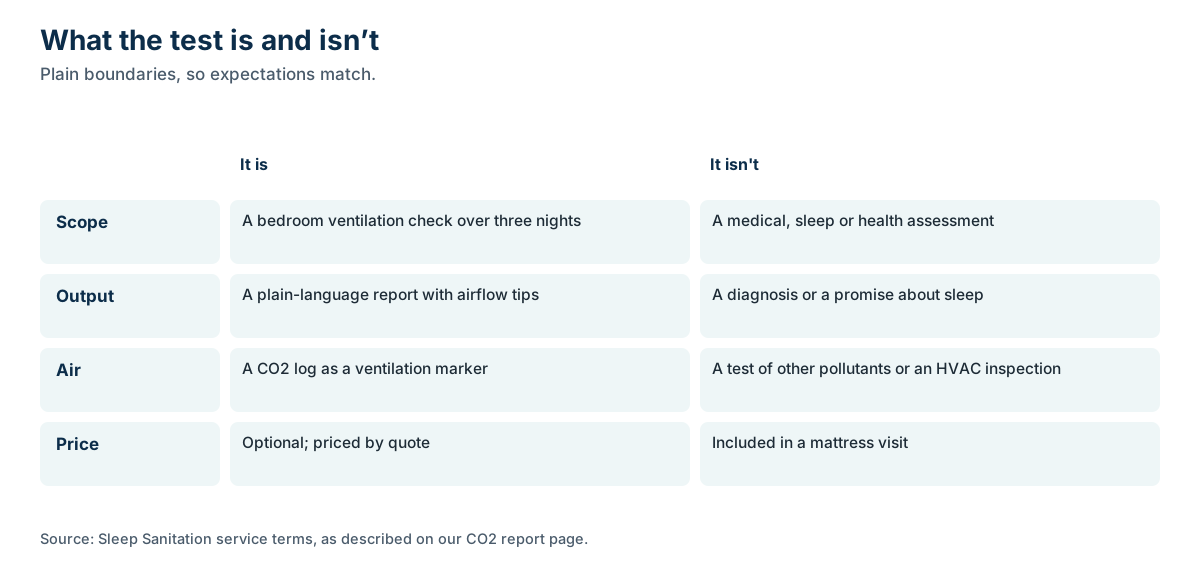
- It isn't a medical test. It doesn't diagnose anything, assess a sleep disorder or measure your health.
- It doesn't promise better sleep. Research on bedroom ventilation and sleep is mixed, as what research says about bedroom CO2 and sleep explains. ASHRAE calls the evidence for direct CO2 effects at common indoor levels "inconsistent."
- It doesn't measure other pollutants. CO2 is a ventilation marker; ASHRAE notes indoor CO2 concentrations "are not overall indicators of IAQ."
- It isn't an HVAC inspection. It shows how the bedroom ventilates, not why a system performs the way it does.
- It isn't a carbon monoxide check. Keep working CO alarms regardless.
- It isn't included in a mattress visit. It's optional and priced by quote.
How does it fit with a mattress visit?
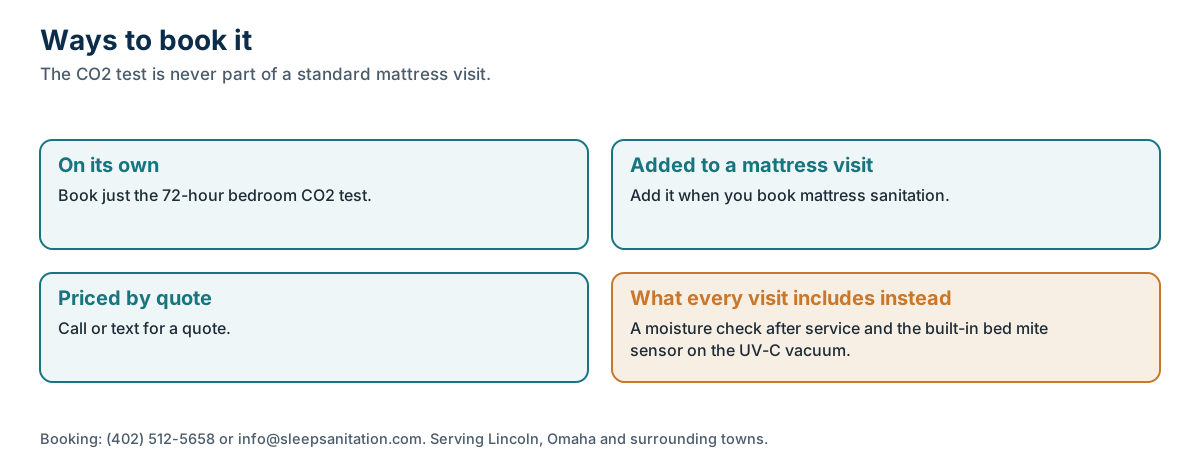
Separately. A mattress visit deals with the surface you sleep on, and every visit includes two checks: a moisture check after service and the built-in bed mite sensor on our UV-C vacuum. The CO2 test looks at the air in the same room. If you'd like both, you can add the CO2 test when you book a mattress visit; if you only want the CO2 test, you can book it on its own. Either way, it's quoted separately. Mattress pricing is on the pricing page.
What should I do before and during the test?
Nothing special. Sleep as you normally do, with the door, windows and fan settings you usually use, so the log reflects ordinary nights. If something unusual happens, such as a guest sleeping in the room or a window left open on a warm night, it helps to mention it, because it explains a change in the curve. The point is to see how your bedroom really behaves, not how it behaves when you're trying to pass a test.
What happens after?
That's up to you. Many changes are free: leaving the door ajar, cracking a window, or running the HVAC fan overnight. If you want to compare, you can repeat a night yourself with a monitor after making one change, using the approach in how to read a night of bedroom CO2 readings. For changes to ventilation equipment, an HVAC contractor is the right next call.
Who might find it useful?
People who wonder whether their bedroom gets enough fresh air with the door closed; households in tight, newer homes where the ventilation system's reach is unclear, covered in tight homes and Nebraska winters; couples sharing a small bedroom, covered in shared bedrooms, kids' rooms and pets; and anyone who'd rather have a log and an explanation than guess from a single glance at a monitor. If you already own a good NDIR monitor and enjoy reading data, how to read a night of bedroom CO2 readings will get you most of the way on your own.
Why outdoor air is the reference
Outdoor air is the floor every indoor reading falls back toward: NOAA puts it at 427.55 ppm in August 2026. A bedroom that stays close to that is getting plenty of outdoor air for the people in it; one that climbs far above it isn't. In a Danish field study by Fan et al. (2022), opening doors or windows cut closed-bedroom CO2 by roughly half or more, and a DOE Building America guide describes closed-door bedrooms getting much less outdoor air than central rooms. Those are the kinds of patterns a three-night log can reveal in your own home.
Sleep Sanitation's view
This section is our view. We offer the CO2 test because it answers a practical question cheaply and honestly, not because a number on a monitor is cause for alarm. We'll tell you what your bedroom's airflow looks like and what's worth trying, and leave the decisions to you. To book or get a quote, call or text (402) 512-5658, email info@sleepsanitation.com, or use scheduling. We serve Lincoln, Omaha and surrounding towns. The service page is 72-hour bedroom CO2 testing, and the hub links everything on bedroom CO2.
What we don't know
- How much a three-night window captures seasonal differences. Winter and summer can look very different, and Health Canada suggests repeated samples across the year for long-term estimates.
- Whether following airflow tips changes any one person's sleep. The research can't tell individuals what to expect.
- How typical any one home's pattern is for Lincoln and Omaha. We found no published local survey to compare against.
Changelog
- 7 October 2026: First published. Sources accessed on this date.
Sources
- Residential Indoor Air Quality Guidelines: Carbon Dioxide (2021) · Health Canada
- ASHRAE Position Document on Indoor Carbon Dioxide (approved 2025) · ASHRAE
- Carbon dioxide generation rates for building occupants (Persily and de Jonge, Indoor Air, 2017) · PubMed Central
- Residential Issue Brief: Ventilation, IEQ and Sleep Quality in Bedrooms (2022) · ASHRAE Residential Buildings Committee
- Trends in Atmospheric Carbon Dioxide (Mauna Loa monthly mean) · NOAA Global Monitoring Laboratory
- Measure Guideline: Selecting Ventilation Systems for Existing Homes (Building America, 2014) · US Department of Energy
- A field intervention study of the effects of window and door opening on bedroom IAQ, sleep quality, and next-day cognitive performance (Fan et al., 2022) · Building and Environment (DOI)
Last reviewed October 7, 2026. Manufacturer specifications and care instructions change; check the current version for your exact model. This page is general information, not medical advice. How we source and check pages: editorial standards.