
Short answer
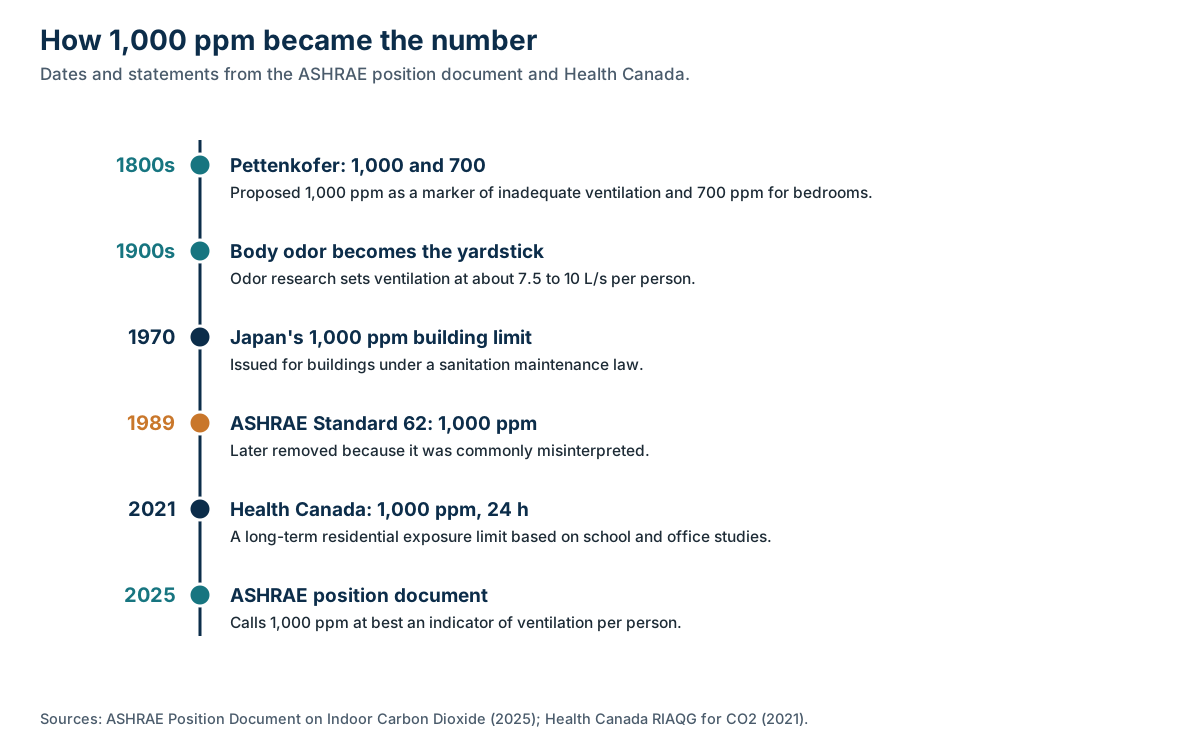
The 1,000 ppm figure goes back to the 19th century, when Max von Pettenkofer proposed it as a marker of inadequate ventilation, with 700 ppm for bedrooms. Later it became shorthand for enough outdoor air, about 8 L/s per person, to keep body odor acceptable. ASHRAE removed it as a limit after it was misread as a health line. Health Canada now uses 1,000 ppm as a 24-hour residential guideline.
Key terms used on this page
- Outdoor air ventilation:
- Outdoor air brought into a space on purpose or by leakage, which dilutes what people and the building give off. ASHRAE says indoor-outdoor CO2 differences can be used to evaluate outdoor ventilation rates, given valid assumptions.
- Bioeffluents:
- Compounds people give off from skin and breath, the source of stuffy-room odor. In a chamber study, bioeffluents with CO2 at 3,000 ppm worsened perceived air quality and symptoms, while pure CO2 at the same level did not.
- Long-term exposure limit (Health Canada):
- Health Canada's residential guideline for CO2: 1,000 ppm based on a 24-hour average. Health Canada says sampling for comparison should last at least 24 hours under normal conditions.
- Parts per million (ppm):
- The unit for CO2 in air: molecules of CO2 per million molecules of air. Health Canada gives the conversions 1 ppm = 1.8 mg/m3 and 0.1% = 1,000 ppm.
- Whole-house mechanical ventilation:
- A fan system that brings in or exhausts air for the whole home on a schedule. Nebraska's 2018 IECC fact sheet says one must be installed in every new home: exhaust, supply, balanced, HRV or ERV.
The 1,000 ppm number began as a ventilation marker, not a toxic threshold. In the 19th century, Max von Pettenkofer proposed it as a sign of inadequate ventilation, with a lower 700 ppm for bedrooms. In the 20th century it became shorthand for enough outdoor air to keep body odor acceptable, about 8 liters per second per person. ASHRAE later removed it as a limit because people kept misreading it as a health line. Health Canada now uses 1,000 ppm as a 24-hour residential guideline. Each of these means something different.
General information about bedroom air and ventilation, not medical advice.
Where did it start?
With a 19th-century hygienist. ASHRAE's position document on indoor CO2 says "Pettenkofer proposed 1000 ppmv of CO2 as a marker of inadequate ventilation indoors and 700 ppmv for bedrooms." Importantly, he didn't think CO2 was the culprit. ASHRAE records that he argued it was organic material from skin and lungs that caused the effects, and that CO2 should be treated "as a surrogate for vitiated air."
So the number's origin is a proxy for stale air in rooms full of people. Its bedroom variant, 700 ppm, was proposed when outdoor air held far less CO2 than today. NOAA puts August 2026 outdoor air at 427.55 ppm, and ASHRAE notes outdoor levels passed 400 ppmv in 2013.
How did body odor become the yardstick?
Through 20th-century ventilation research. ASHRAE explains that work by Lemberg and later Yaglou "showed that perception of human body odor could be used as a criterion for ventilation rates," leading to requirements of "about 7.5 to 10 L/s (15 to 20 cfm) per person." CO2 was "not considered a pollutant but rather a marker of body odor perception, since humans emit both CO2 and bioeffluents at rates related to their metabolism." Later studies on perceived air quality confirmed those results, and they fed into ASHRAE and European ventilation standards.
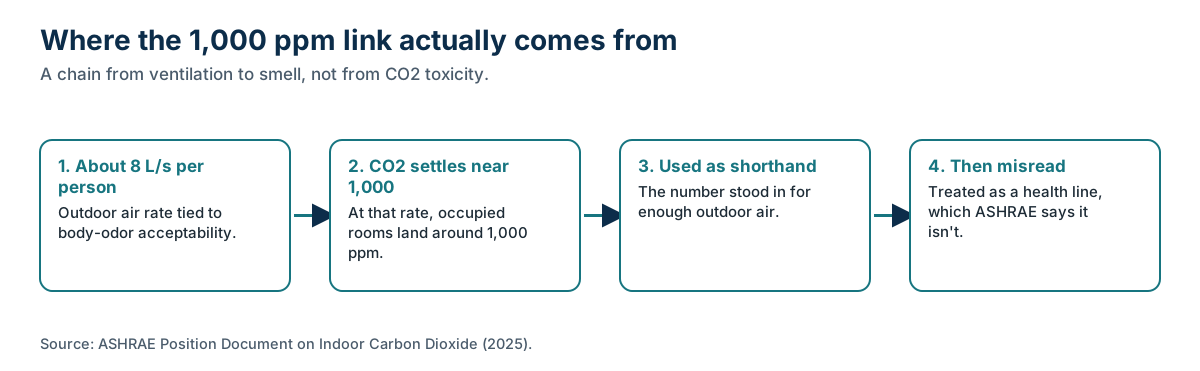
The link to 1,000 ppm is arithmetic. ASHRAE says an indoor level below 1,000 ppmv "is at best an indicator of outdoor air ventilation rate per person," associated with "an outdoor air ventilation rate of about 8 L/s (16 cfm) per person." At that airflow, an occupied room settles near 1,000 ppm. The number was standing in for a ventilation rate.
Why was it removed from ASHRAE's standard?
Because it was misread. ASHRAE says the 1989 edition of its ventilation standard, Standard 62, "had a CO2 limit of 1000 ppmv, but this was removed from subsequent editions due to its common misinterpretation." The current standard uses CO2 only as set points for demand-controlled ventilation.
ASHRAE is direct about the damage: "This value of 1000 ppmv has been used for decades without an understanding of its basis, which is its link to the perception of human body odor by building occupants." It adds that the misunderstanding "has resulted in many confusing and erroneous conclusions about IAQ and ventilation in buildings."
What do home ventilation standards say?
They set airflows, not CO2 limits. A DOE Building America guide summarizes ASHRAE's residential Standard 62.2-2013 formula for whole-building ventilation as Qtot = 0.03 × floor area + 7.5 × (bedrooms + 1), in cubic feet per minute. The guide explains that whole-building ventilation "is intended to dilute the unavoidable contaminant emissions from people, from materials, and from background processes."
Nebraska's energy code fact sheet points builders to the 2018 IRC's ventilation equation or table to size the required whole-house system. None of these set a bedroom CO2 number, and an ASHRAE committee brief notes that standards "rarely have specific requirements for bedrooms." Tight homes and Nebraska winters explains what the code requires locally.
What does Health Canada's 1,000 ppm mean?
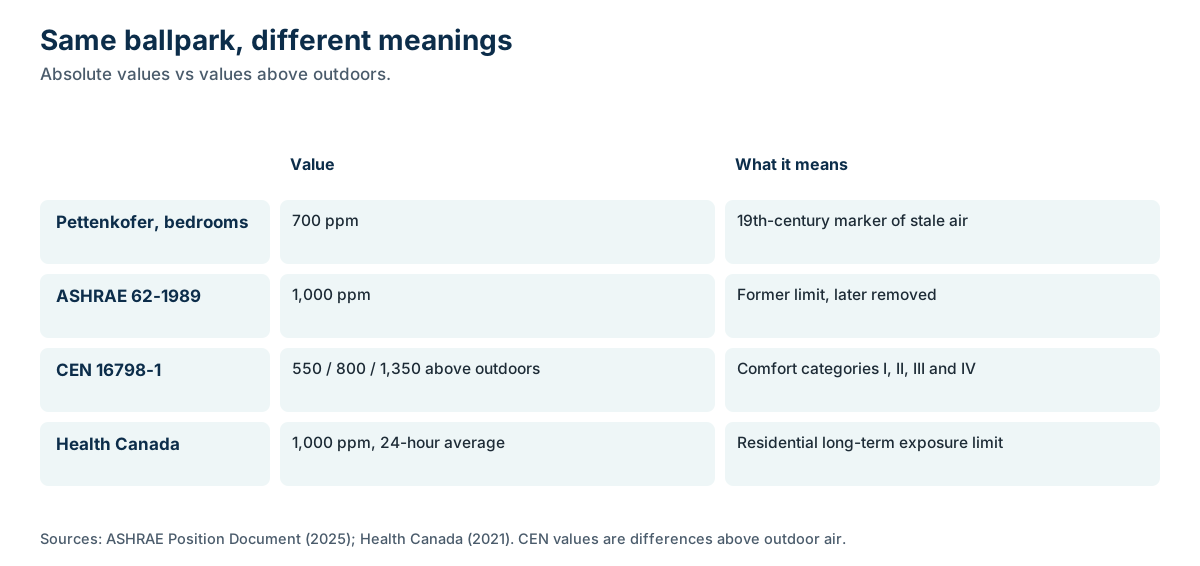
Something different again. Health Canada's 2021 residential guideline says "the recommended long-term exposure limit for CO2 is 1,000 ppm (based on a 24-hour average)." It's based on "effects observed in epidemiological studies in schools or offices and controlled exposure studies."
Health Canada is candid about the evidence. It says "no individual study was considered strong enough on its own" to set the limit, but that "taken as a whole the database indicates that there may be comfort benefits (i.e. improved perception of indoor air quality) and health benefits to reducing indoor CO2 concentrations." It also says "it cannot be determined from the available evidence whether CO2 or some other factor causes the observed effects." And it replaced an older figure: a 1987 acceptable long-term range of up to 3,500 ppm.
Two details matter for bedrooms. The limit is a 24-hour average, and comparisons need sampling of "at least 24 hours, taken under normal conditions." An overnight peak isn't a breach. What is a normal bedroom CO2 level? covers that distinction.
What other numbers are floating around?
Several, and they aren't all on the same scale:
- CEN 16798-1 categories. ASHRAE reports this European standard gives CO2 levels above outdoors of 550, 800 and 1,350 ppmv for its comfort categories, "noting that these values serve as indicators of outdoor air ventilation rates per person."
- 700 ppm above ambient. Health Canada's consumer page says ASHRAE "recommends maintaining indoor CO2 levels no greater than 700 ppm above ambient levels."
- International guidelines. ASHRAE says limits in an international database "tend to be on the order of 1000 ppmv but range as high as about 1500 ppmv," mostly as indicators of ventilation. Japan issued a 1,000 ppmv building limit in 1970.
- Green building programs. ASHRAE notes reference values there vary "from 530 to 1500 ppmv."
The lesson is to check whether a number is an absolute reading or a difference above outdoor air, and whether it's a peak, an average or a design target.
So what should 1,000 ppm mean to you?
A useful rough benchmark for airflow, and nothing more. If your bedroom stays well under 1,000 ppm, it's getting a fair amount of outdoor air for the people in it. If it climbs well past that most nights, it isn't. Neither tells you about your health. Why 5,000 ppm isn't a bedroom target covers the other end of the scale, and the hub links the rest.
Sleep Sanitation's view
This section is our view. We like 1,000 ppm as a rule of thumb for airflow, but we won't present it as a safety line, because the people who wrote the standards say it isn't one. Our optional 72-hour bedroom CO2 test describes your bedroom's ventilation in plain language with airflow tips. It's priced by quote, booked on its own or added to a mattress visit, and it isn't a medical test. See our process.
What we don't know
- Whether a CO2 marker set for daytime rooms and body odor is the right yardstick for a sleeping room. No standard sets one for bedrooms.
- How much Pettenkofer's 700 ppm bedroom figure was based on measurement versus judgment. ASHRAE's summary doesn't say.
- Whether Health Canada's 24-hour average approach captures what matters for sleep, which happens in one long stretch.
Changelog
- 7 October 2026: First published. Sources accessed on this date.
Sources
- ASHRAE Position Document on Indoor Carbon Dioxide (approved 2025) · ASHRAE
- Residential Indoor Air Quality Guidelines: Carbon Dioxide (2021) · Health Canada
- Carbon dioxide in your home · Health Canada
- Measure Guideline: Selecting Ventilation Systems for Existing Homes (Building America, 2014) · US Department of Energy
- Carbon dioxide generation rates for building occupants (Persily and de Jonge, Indoor Air, 2017) · PubMed Central
- Nebraska Residential Energy Code Fact Sheet: 2018 IECC · Nebraska Department of Water, Energy, and Environment
- Residential Issue Brief: Ventilation, IEQ and Sleep Quality in Bedrooms (2022) · ASHRAE Residential Buildings Committee
- Trends in Atmospheric Carbon Dioxide (Mauna Loa monthly mean) · NOAA Global Monitoring Laboratory
Last reviewed October 7, 2026. Manufacturer specifications and care instructions change; check the current version for your exact model. This page is general information, not medical advice. How we source and check pages: editorial standards.