
Short answer
Anything that brings more outdoor air into the bedroom lowers CO2. A cracked window usually does it most directly. Opening the door helps if the rest of the house is ventilated; a Danish study saw it cut CO2 about as much as windows, though only windows were linked to longer sleep. Running the HVAC fan mixes air between rooms, and a ventilation system or ERV adds outdoor air. Each has trade-offs.
Key terms used on this page
- Outdoor air ventilation:
- Outdoor air brought into a space on purpose or by leakage, which dilutes what people and the building give off. ASHRAE says indoor-outdoor CO2 differences can be used to evaluate outdoor ventilation rates, given valid assumptions.
- Transfer grille:
- An opening, often through a wall or above a door, that lets air leave a bedroom when its door is shut. The Building America Solution Center describes transfer grilles and jumper ducts as ways to pressure-balance bedrooms.
- ERV / HRV:
- Energy or heat recovery ventilators: balanced systems that bring in outdoor air and exhaust stale air through a core that transfers heat, and with an ERV some moisture, between the two streams.
- Whole-house mechanical ventilation:
- A fan system that brings in or exhausts air for the whole home on a schedule. Nebraska's 2018 IECC fact sheet says one must be installed in every new home: exhaust, supply, balanced, HRV or ERV.
- Air changes per hour (ACH):
- How many times an hour a room's volume of air is replaced by outdoor air. An ASHRAE-cited review of bedroom studies found mean bedroom rates from 0.2 to 4.9 per hour, lower in heating seasons.
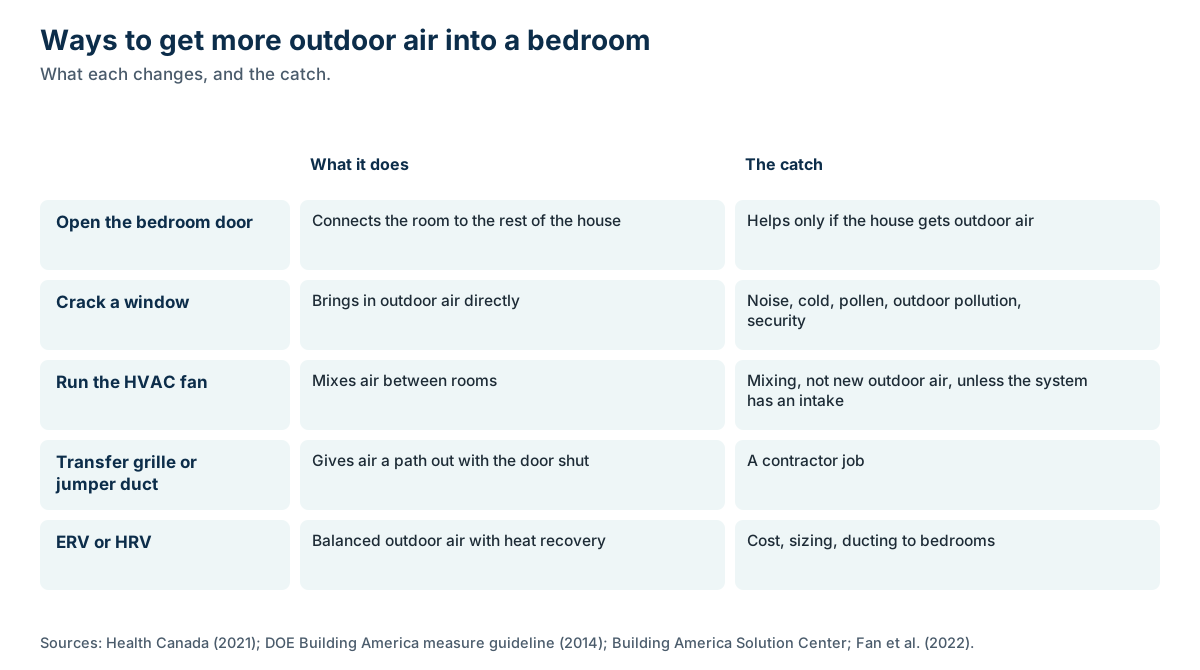
Anything that gets more outdoor air into the bedroom lowers CO2; the options differ in how directly they do it and what they cost you in comfort, noise or money. A cracked window brings in outdoor air directly. An open door connects the room to the rest of the house, which helps if the house itself is ventilated. The HVAC fan mixes air between rooms. Transfer grilles let air leave a closed room, and a ventilation system or ERV adds outdoor air to the whole house. Here's how each compares.
General information about bedroom air and ventilation, not medical advice.
Why does a closed door make such a difference?
Because it isolates the room from the rest of the house's air. A DOE Building America guide on ventilation in existing homes notes that "when doors are closed and there is no central air handler operation, air change rates with point ventilation vary much more throughout a home." It adds: "It is common for some areas (especially some bedrooms) to experience air change rates 50% lower than those of areas where point ventilation systems are located."
The same guide describes a Massachusetts home where, without a mixing fan running, "bedrooms with closed doors experienced RAoA values nearly 50% lower than in central spaces" (RAoA, the reciprocal age of air, is a measure of how fast fresh air reaches a room). With the mixing fan running, bedroom values were only 10% to 15% lower. A closed bedroom can miss out on ventilation the rest of the house is getting.
How much does opening a window help?
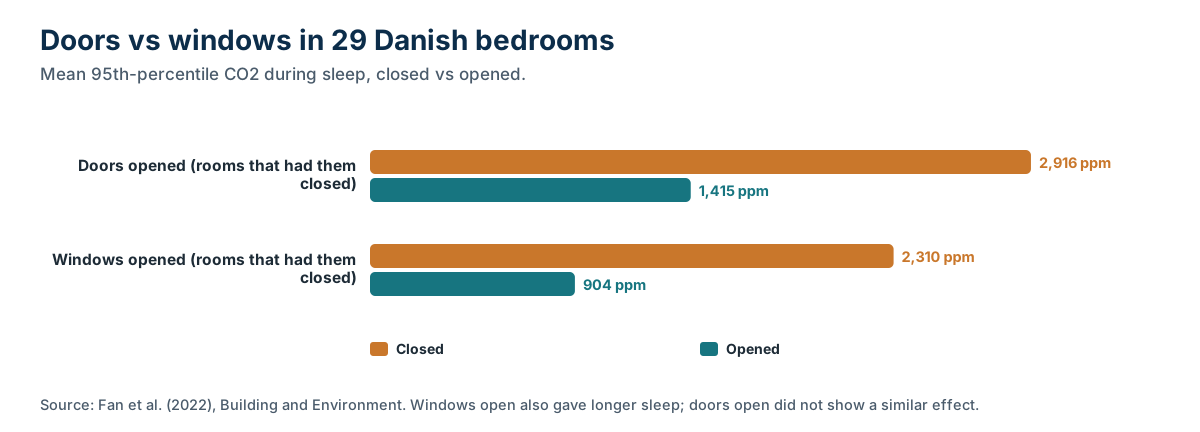
Usually a lot. In Fan et al. (2022), a study of Danish bedrooms in winter, opening windows that had been closed cut the mean 95th-percentile CO2 during sleep from 2,310 ppm to 904 ppm. In the dormitory study by Strøm-Tejsen et al. (2016), an open window brought the average from 2,585 ppm down to 660 ppm.
Fan et al. also found that with windows open, "sleep was longer under this condition and sleep quality was subjectively assessed to be better," though the NO2 concentration rose slightly. That's the trade-off with windows: they bring in whatever is outdoors, along with noise, cold, pollen and moisture.
Health Canada's residential guideline lists "opening windows (taking into consideration ambient air quality)" as a ventilation strategy and adds a caution: during forest fire smoke, "reducing air intake and thus infiltration of ambient air pollutants may be more beneficial from a health risk perspective, compared to reducing indoor CO2 levels to below the recommended exposure limit." Its consumer page suggests you "check the outdoor air quality conditions in your region before opening windows."
How much does opening the door help?
Nearly as much for CO2, but maybe not for sleep. In the same Danish study, opening doors cut the mean 95th-percentile CO2 from 2,916 ppm to 1,415 ppm. Yet the authors report that "similar effects were not observed when the doors were open although the 95th percentile of CO2 concentration decreased by as much as when the windows were open."
Why the difference? The study couldn't say for sure. A door connects the bedroom to indoor air, with whatever the rest of the house contains; a window brings in outdoor air. Noise, light and temperature also change differently. It's one study, but it's a good reason not to treat a lower CO2 number as the whole goal. Is CO2 the problem, or a marker of stale air? explores that.
Does running the HVAC fan help?
It can, by mixing. Health Canada suggests "using the furnace fan or, if necessary, a separate fan or air supply to make sure air is distributed throughout the home." Running the fan pulls air from the closed bedroom back to the system and pushes mixed house air in, so the bedroom shares the rest of the house's lower CO2.
What it doesn't do on its own is add outdoor air, unless your system has an outdoor air intake connected to it. If the whole house is stuffy, mixing spreads the stuffiness around. Health Canada also suggests "setting the mechanical ventilation system to a higher setting or letting it run longer" if you have one, and "having the ventilation system checked regularly by a qualified ventilation contractor."
Why does air need a way out?
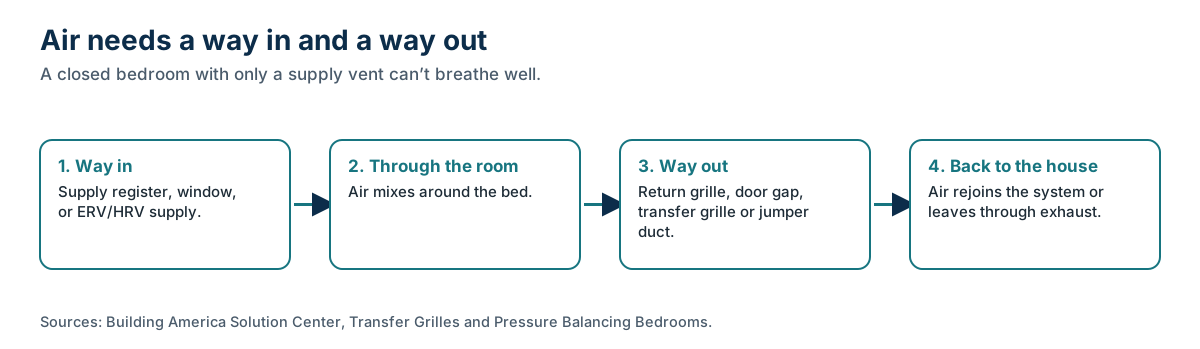
Because air can't flow into a sealed room. The Building America Solution Center explains that in homes with forced-air heating and cooling, "when stale air can't get back to the return registers from bedrooms or offices because the doors are closed, air pressure can build up in those rooms." Its pressure balancing guidance and transfer grille guide recommend ducted returns, "transfer grilles, jump ducts, and/or door undercuts in bedrooms" to give room air a path back to the air handler.
For CO2, that path matters: a supply vent can only flush a room if air can leave it. A transfer grille or jumper duct is a contractor job, but it lets you keep the door shut and still have air moving through the room.
What do mechanical ventilation systems add?
Planned outdoor air. A whole-house system can exhaust air, supply it, or both. A balanced ERV or HRV brings in outdoor air and "exhausts an equal amount of stale air from the home," passing both through a heat exchanger; "an ERV also transfers moisture." The DOE's building science guide says these systems "reduce the costs of heating ventilated air in the winter by transferring heat from the warm inside exhaust air to the colder outside supply air."
Distribution still matters. The DOE checklist recommends "that each occupied room with a door have at least one ducted supply, or one ducted return, or both." A ventilator that only exhausts from a bathroom may do little for a closed bedroom across the house. Nebraska's 2018 code fact sheet requires a whole-house mechanical ventilation system in new homes; tight homes and Nebraska winters covers what that means.
What about a box fan in the window?
A window fan pushing outdoor air in, or pulling room air out with the door open, increases the exchange. That's the same principle as the quiet intake fan in the Strøm-Tejsen study, which ran whenever CO2 exceeded 900 ppm. A fan that just stirs air inside a closed room, like a ceiling fan, doesn't add outdoor air, though it may help comfort.
Which should you try first?
The cheapest change you can live with, tested one at a time. Open the door, crack the window an inch, or run the HVAC fan overnight, then compare a night's readings. How to read a night of bedroom CO2 readings shows how to compare curves. If none is practical, a contractor can look at returns, transfer grilles or a ventilation system. The hub links the rest of the topic.
Sleep Sanitation's view
This section is our view. Most bedroom CO2 questions can be answered with free changes: a door, a window, a fan setting. Our optional 72-hour bedroom CO2 test logs three nights and gives a plain-language ventilation report with airflow tips, so you can see which changes are worth trying. It's priced by quote and isn't a medical test or an HVAC inspection; for changes to the system itself, talk with an HVAC contractor. Book through scheduling.
What we don't know
- Why open doors and open windows lowered CO2 similarly but differed in sleep effects in the Danish study. Noise, temperature, outdoor versus indoor air and chance are all candidates.
- How much a typical door undercut contributes to bedroom air exchange in Nebraska homes. We found no local measurements.
- How often existing ventilation systems in local homes actually deliver outdoor air to bedrooms. Distribution depends on duct layout.
Changelog
- 7 October 2026: First published. Sources accessed on this date.
Sources
- A field intervention study of the effects of window and door opening on bedroom IAQ, sleep quality, and next-day cognitive performance (Fan et al., 2022) · Building and Environment (DOI)
- Residential Indoor Air Quality Guidelines: Carbon Dioxide (2021) · Health Canada
- Carbon dioxide in your home · Health Canada
- Measure Guideline: Selecting Ventilation Systems for Existing Homes (Building America, 2014) · US Department of Energy
- Transfer Grilles · Building America Solution Center (US DOE / PNNL)
- Pressure Balancing Bedrooms · Building America Solution Center (US DOE / PNNL)
- Balanced HRV/ERV · Building America Solution Center (US DOE / PNNL)
- HVAC Energy Recovery Ventilation · US Department of Energy, Building Science Education
- The effects of bedroom air quality on sleep and next-day performance (Strøm-Tejsen et al., Indoor Air, 2016) · Wiley (DOI; open access)
- Nebraska Residential Energy Code Fact Sheet: 2018 IECC · Nebraska Department of Water, Energy, and Environment
Last reviewed October 7, 2026. Manufacturer specifications and care instructions change; check the current version for your exact model. This page is general information, not medical advice. How we source and check pages: editorial standards.