
Short answer
Each sleeper breathes out CO2 all night, and a closed bedroom only loses it as fast as outdoor air replaces room air. With little air exchange, the level climbs toward a high plateau and may still be rising at dawn. Published model values put two adults in a closed 65 m3 bedroom about 800 to 2,000 ppm above outdoor air, depending on the ventilation rate.
Key terms used on this page
- Steady-state CO2:
- The level where CO2 stops rising because outdoor air removes it as fast as people add it. Persily and de Jonge's model puts two sleeping adults in a 65 m3 bedroom at 1,988 ppm above outdoors at 0.2 air changes per hour.
- Ventilation time constant:
- The inverse of the air change rate. Persily and de Jonge note that three time constants are needed to reach about 95% of steady state, so a room at 0.2 air changes per hour may never get there in one night.
- CO2 generation rate:
- How much CO2 a person breathes out, which depends on body size, age, sex and activity. Health Canada puts an average person at about 15 L/hr at rest and about 45 L/hr during moderate activity.
- Air changes per hour (ACH):
- How many times an hour a room's volume of air is replaced by outdoor air. An ASHRAE-cited review of bedroom studies found mean bedroom rates from 0.2 to 4.9 per hour, lower in heating seasons.
- Met (metabolic rate unit):
- A unit of activity level used to estimate how much CO2 a person produces. Persily and de Jonge use about 1.0 met for sleeping occupants in their bedroom examples, lower than the 1.4 met they use for other residential activity.
- Infiltration:
- Outdoor air that leaks into a home through gaps in the shell rather than through a fan or window. Health Canada notes that homes have become more airtight, which has lowered air exchange rates.
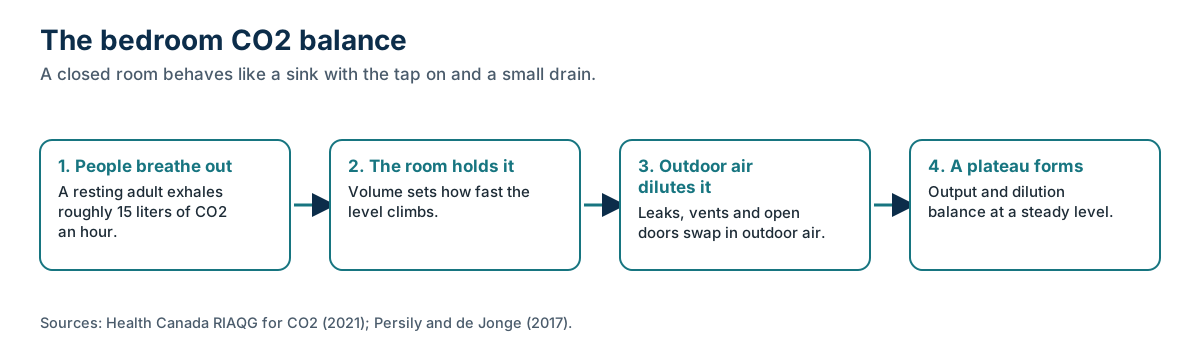
CO2 builds up in a closed bedroom because sleepers keep breathing it out and very little outdoor air comes in to carry it away. The room acts like a sink with the tap running and a small drain: the level rises until what drains out matches what pours in. With a closed door and window, that balance point can be high, and the room may still be climbing toward it when you wake up.
General information about bedroom air and ventilation, not medical advice.
Where does the CO2 come from?
From you. Health Canada's residential guideline says the main source indoors "is from the respiration of occupants," and that "an average person will produce approximately 15 L/hr of CO2 at rest." Sleep is close to rest: Persily and de Jonge, in their 2017 paper on CO2 generation rates, use an activity level of 1.0 met for sleeping occupants in their bedroom examples.
The exact amount depends on body size, age and sex. In Persily and de Jonge's tables, their two-adult bedroom example works out to about 0.0036 liters per second per person, roughly 13 liters an hour each. A child produces less, as shared bedrooms, kids' rooms and pets explains. Gas stoves and unvented heaters add CO2 too, but in most bedrooms the sleepers are the source.
Where does it go?
Out with the air that leaves the room, replaced by air that comes in. In a closed bedroom, that exchange happens through gaps around the door and window, through a supply or return vent if the room has one, and through leaks in the walls and ceiling. The total is usually expressed as air changes per hour: how many times an hour the room's volume is swapped for outdoor air.
An ASHRAE committee brief reports that reviewed bedroom studies found mean air change rates "from 0.2 to 4.9 h-1," with lower ventilation in heating seasons. At the low end, a bedroom swaps its air for outdoor air only once every five hours.
What is the plateau?
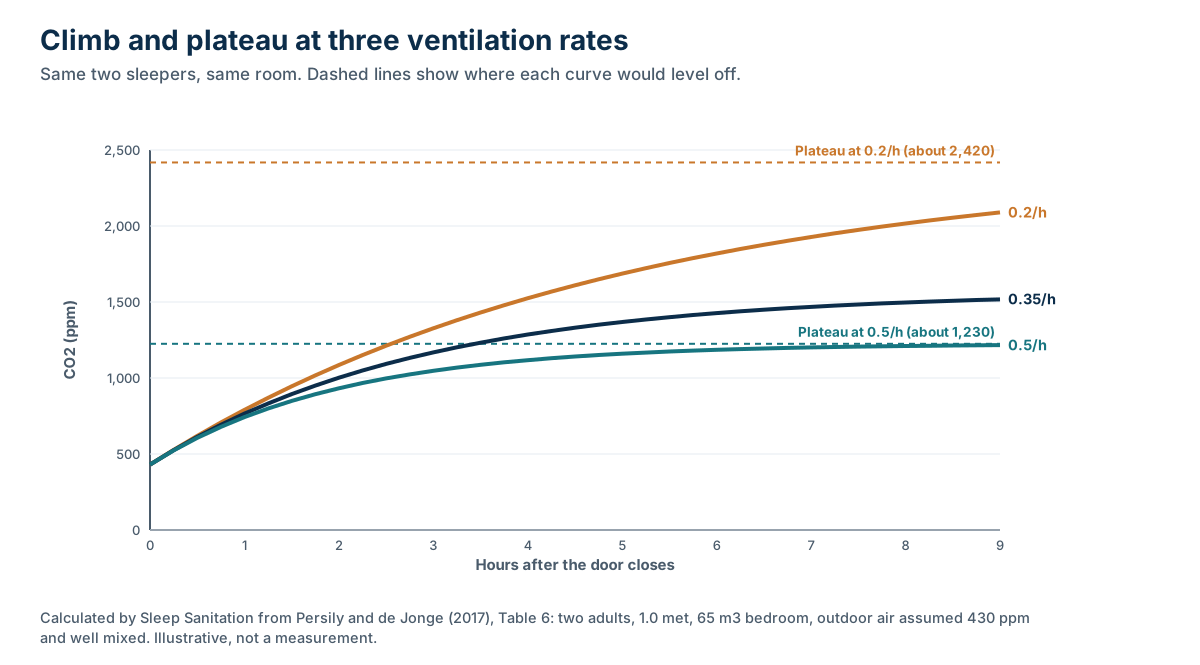
The level where the two flows balance. If people add CO2 at a steady rate and outdoor air removes it in proportion to how much is there, the concentration rises toward a steady state and then stays put. Persily and de Jonge's Table 6 gives examples for a couple (one man and one woman aged 31 to 40, resting at 1.0 met) in a 65 cubic meter bedroom:
- At 0.5 air changes per hour: 795 ppm above outdoors.
- At 0.35 air changes per hour: 1,136 ppm above outdoors.
- At 0.2 air changes per hour: 1,988 ppm above outdoors.
Add outdoor air of about 430 ppm and those plateaus are roughly 1,230, 1,570 and 2,420 ppm. The relationship is simple: halve the outdoor air per person and the rise above outdoors roughly doubles.
How long does it take to get there?
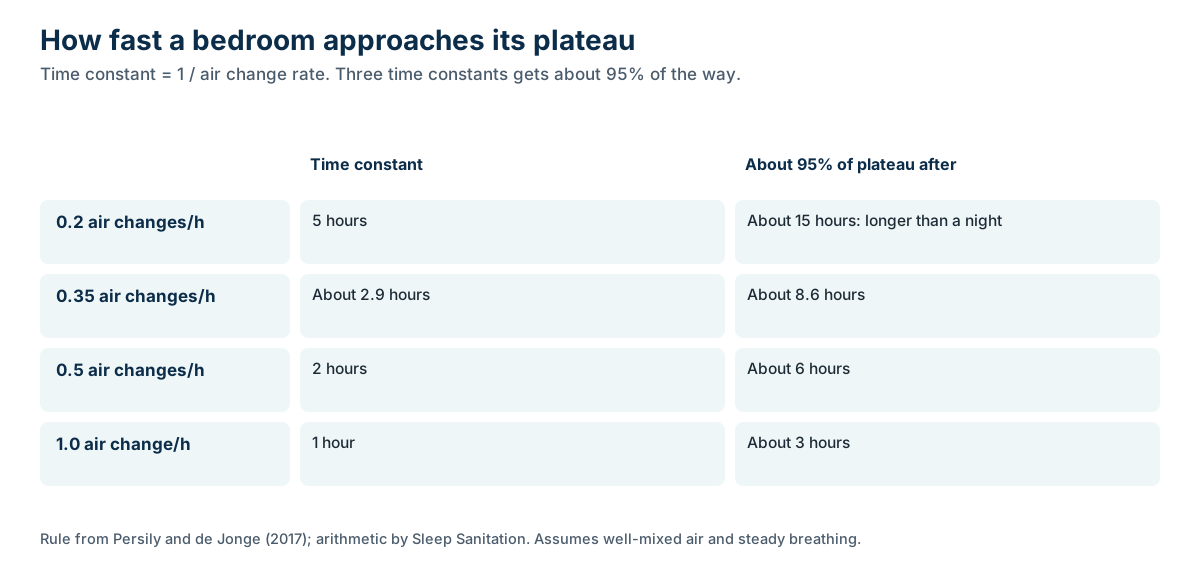
Longer than you might think. Persily and de Jonge explain that the time needed "depends on the inverse of the air change rate, that is, the time constant of the space, with three time constants required to achieve about 95% of the steady-state concentrations."
At 0.5 air changes per hour, the time constant is two hours, so the room is near its plateau after about six hours. At 0.2 air changes per hour, the time constant is five hours, and getting to 95% takes about 15 hours, which is longer than anyone sleeps. In a tight bedroom, the curve is still rising at dawn. That's why a monitor's morning peak in a closed room says more about the night's length than about a fixed ceiling.
Why doesn't room size change the plateau?
Because the plateau depends on airflow, not volume. A bigger room holds more air, so the same breath raises the concentration more slowly and the early climb is gentler. But if the outdoor airflow per person is the same, both rooms end up at the same steady state. Room size buys time, not a lower ceiling.
This is also why air changes per hour can mislead. Two rooms with the same air change rate but different sizes get different total airflow. Persily and de Jonge's child's bedroom example uses a 44 m3 room; the adult example uses 65 m3. The numbers in this article apply to those specific rooms.
Does CO2 settle on the floor?
Health Canada notes that CO2 is "a gas heavier than air, with a density of approximately one and a half times that of air," and the NIOSH Pocket Guide lists its relative gas density as 1.53. In a lived-in bedroom, though, warm breath, body heat and air movement mix the room. The ventilation models above assume well-mixed air, and that's a reasonable approximation for a bedroom with people in it. It's still worth placing a monitor at nightstand height rather than on the floor or next to your pillow, as how home CO2 monitors work explains.
What changes the curve?
Anything that changes the people or the airflow:
- Opening the bedroom door. The room joins the rest of the house's air. A DOE Building America guide notes that with doors closed and no central air handler running, some bedrooms can see air change rates "50% lower" than areas near the ventilation fans.
- Opening a window. Brings in outdoor air directly. Open door vs window vs fan compares the effects.
- Running a fan. An HVAC fan mixes air between rooms; a whole-house ventilation system adds outdoor air. Tight homes and Nebraska winters covers mechanical systems.
- More sleepers. A second adult roughly doubles the source.
Plants and air purifiers don't remove CO2 in useful amounts, as do air purifiers or houseplants lower bedroom CO2? explains.
Can I estimate my own room's air change rate?
Roughly. After everyone leaves a closed bedroom in the morning, the level decays toward the house or outdoor level, and the speed of that decay reflects the air change rate. ASHRAE's position document confirms that indoor-outdoor CO2 differences "can be used to evaluate outdoor ventilation rates," but adds that "accurate ventilation measurements require the validity of several assumptions and accurate input values." A home estimate is a rough guide, not a measurement an engineer would sign off on.
Sleep Sanitation's view
This section is our view. The physics here is the most useful thing to understand about bedroom CO2, because it explains almost every pattern people see on a monitor: the evening climb, the dawn peak and the drop when someone opens the door. Our optional 72-hour bedroom CO2 test logs three nights so the pattern is visible, with a plain-language ventilation report and airflow tips. It's priced by quote and isn't a medical test. The bedroom CO2 hub links the rest of the topic, and our process page explains how visits work.
What we don't know
- How well-mixed real bedrooms are near the bed compared with across the room. Models assume uniform air; a sleeper's breathing zone may read higher.
- Typical air change rates for closed bedrooms in Nebraska homes. Published reviews draw mostly on European and Asian studies.
- How much bedroom furnishings and closet volumes change effective room size in practice.
Changelog
- 7 October 2026: First published. Sources accessed on this date.
Sources
- Carbon dioxide generation rates for building occupants (Persily and de Jonge, Indoor Air, 2017) · PubMed Central
- Residential Indoor Air Quality Guidelines: Carbon Dioxide (2021) · Health Canada
- ASHRAE Position Document on Indoor Carbon Dioxide (approved 2025) · ASHRAE
- Residential Issue Brief: Ventilation, IEQ and Sleep Quality in Bedrooms (2022) · ASHRAE Residential Buildings Committee
- NIOSH Pocket Guide to Chemical Hazards: Carbon dioxide · CDC / NIOSH
- Measure Guideline: Selecting Ventilation Systems for Existing Homes (Building America, 2014) · US Department of Energy
- Trends in Atmospheric Carbon Dioxide (Mauna Loa monthly mean) · NOAA Global Monitoring Laboratory
Last reviewed October 7, 2026. Manufacturer specifications and care instructions change; check the current version for your exact model. This page is general information, not medical advice. How we source and check pages: editorial standards.