
Short answer
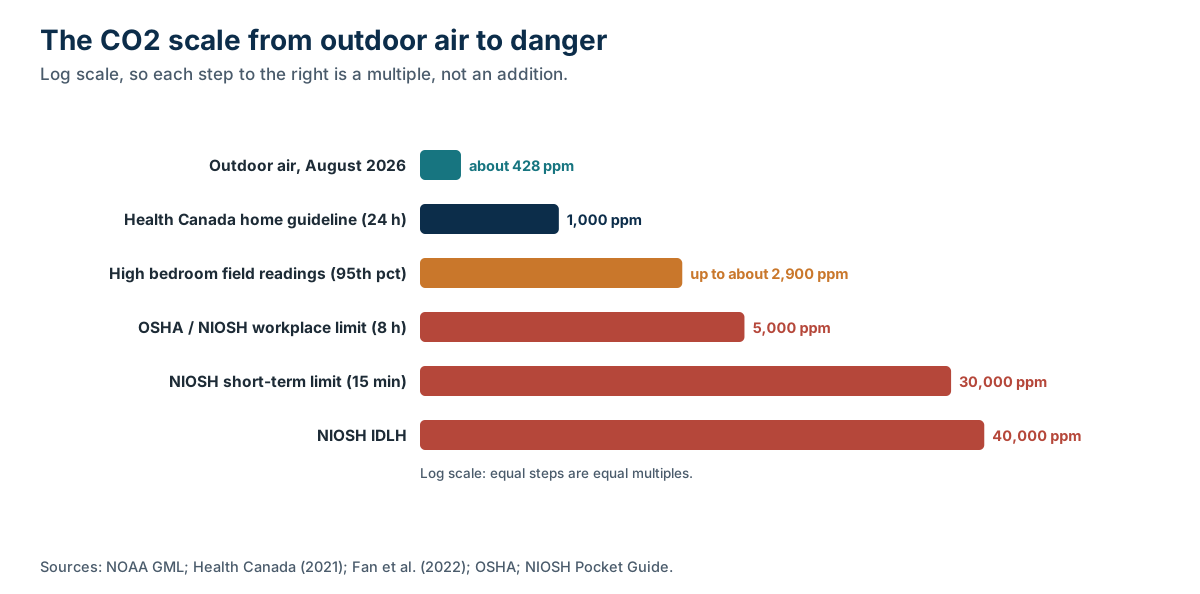
5,000 ppm is the OSHA and NIOSH workplace exposure limit, averaged over a work shift for adult workers. It marks where CO2 itself becomes an occupational concern, not what a good bedroom looks like. Bedroom readings almost never approach it, which is why skeptics say CO2 isn't a bedroom poison. They're right about toxicity, but a high bedroom reading still signals little outdoor air, which is a separate question.
Key terms used on this page
- Time-weighted average (TWA):
- An exposure averaged over a set period, such as an 8-hour work shift. OSHA's permissible exposure limit for CO2 is 5,000 ppm as an 8-hour TWA.
- IDLH:
- Immediately dangerous to life or health: the level NIOSH uses for respirator and escape planning. For CO2 it is 40,000 ppm, about a hundred times outdoor air.
- Long-term exposure limit (Health Canada):
- Health Canada's residential guideline for CO2: 1,000 ppm based on a 24-hour average. Health Canada says sampling for comparison should last at least 24 hours under normal conditions.
- Parts per million (ppm):
- The unit for CO2 in air: molecules of CO2 per million molecules of air. Health Canada gives the conversions 1 ppm = 1.8 mg/m3 and 0.1% = 1,000 ppm.
- Outdoor CO2 baseline:
- The CO2 level of outdoor air, the floor an indoor reading falls back toward when a room is well aired. NOAA's Mauna Loa record averaged 427.55 ppm in August 2026; ASHRAE notes it passed 400 ppmv in 2013.
5,000 ppm is the workplace exposure limit for CO2 set by OSHA and recommended by NIOSH, averaged over a work shift. It describes the most adult workers should be exposed to on the job. It isn't a bedroom target, a bedroom limit or a sign that anything below it is ideal. Bedroom readings almost never approach it, which is why people who say CO2 isn't a bedroom poison are right. But that's a different question from how well a bedroom ventilates.
General information about bedroom air and ventilation, not medical advice.
What exactly is the 5,000 ppm limit?
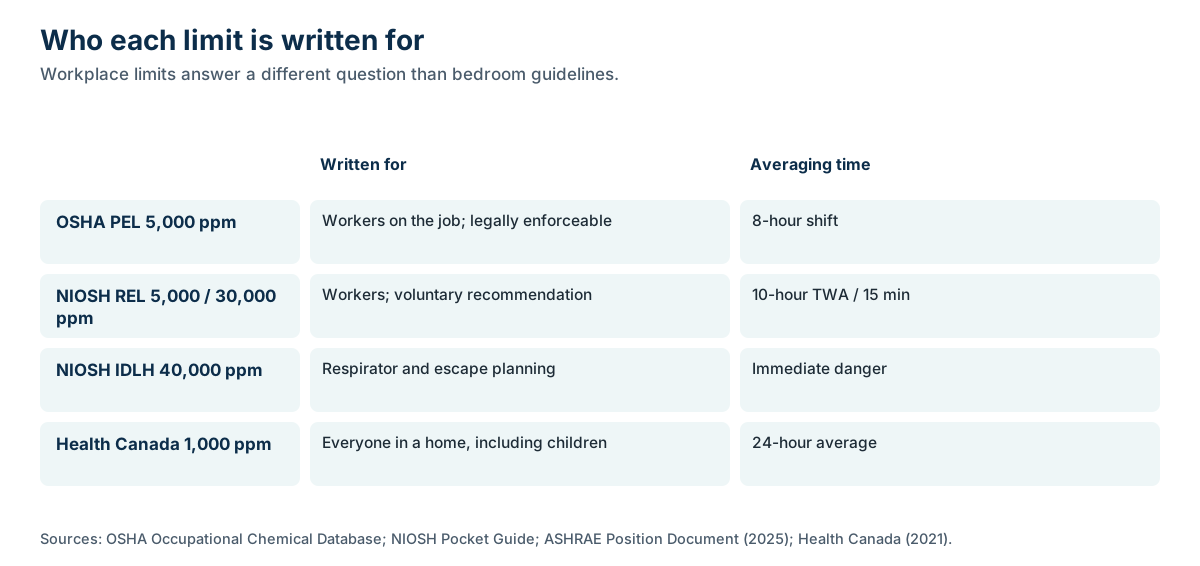
An occupational exposure limit. OSHA's chemical database lists a permissible exposure limit for CO2 of 5,000 ppm as an 8-hour time-weighted average. The NIOSH Pocket Guide lists the same 5,000 ppm as its recommended limit, with a short-term limit of 30,000 ppm. ASHRAE's position document explains the short-term value as "a 15-minute time-weighted average that should not be exceeded at any time during a workday," and notes that the "OSHA limit is regulatory while the NIOSH limit is voluntary."
These are rules and recommendations for workplaces. They assume adult workers, a work shift and a workweek. They were never meant to describe a good bedroom.
What about the danger level?
Far higher. NIOSH lists CO2's IDLH, the level considered immediately dangerous to life or health, at 40,000 ppm, which it uses for respirator selection and escape planning. That's roughly a hundred times outdoor air, which NOAA puts at 427.55 ppm in August 2026. NIOSH also notes CO2 is a "normal constituent of air." The symptoms NIOSH lists for high exposure, including headache, dizziness, restlessness and breathing difficulty, belong to that occupational and emergency context.
Is CO2 toxic at bedroom levels?
No. ASHRAE states that "carbon dioxide is considered nontoxic at concentrations up to 5000 ppmv." Bedroom field studies rarely report averages anywhere close. In a Danish study by Fan et al. (2022), closed bedrooms in winter had a mean 95th-percentile CO2 during sleep of up to 2,916 ppm, and an ASHRAE committee brief reports mean bedroom levels in reviewed studies up to about 2,600 ppm.
So when skeptics reply to an alarming monitor screenshot that CO2 isn't a bedroom poison, they're correct on toxicology.
Then why not just use 5,000 ppm as the line?
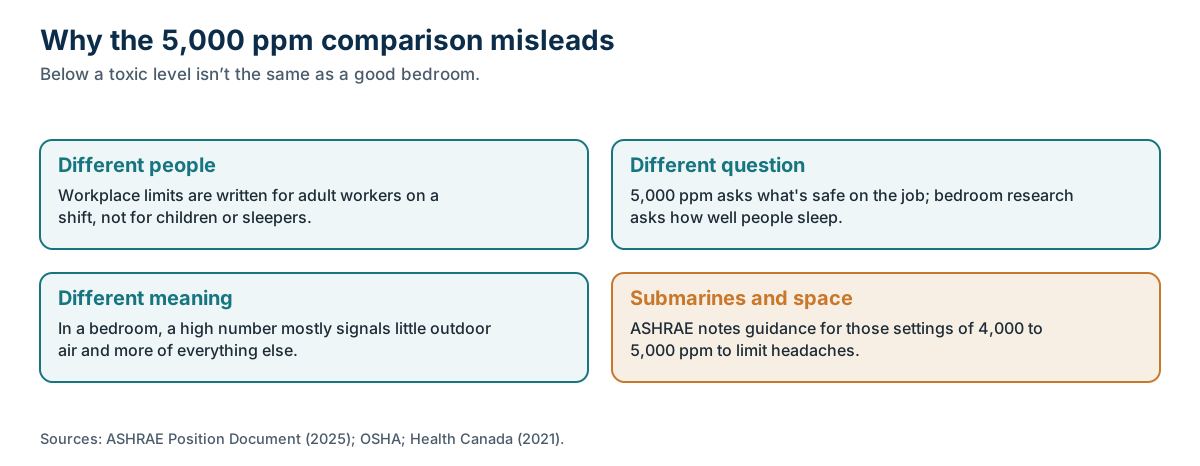
Because it answers the wrong question, in four ways.
Different people. Workplace limits are written for adult workers on the job. A bedroom holds children, older adults and people who are ill. Health Canada's guideline notes that "because of their size, children inhale more air in relation to their body weight than adults."
Different exposure. A shift limit assumes time away from work. Health Canada's residential limit is a 24-hour average because people live at home around the clock.
Different outcome. OSHA asks what's tolerable at work. The bedroom research asks whether people sleep as well as they could. In those studies, differences appeared at levels far below 5,000 ppm, as what research says about bedroom CO2 and sleep explains, though the evidence is mixed.
Different meaning. At bedroom levels, a high reading mostly tells you that little outdoor air is reaching the room, and that other things people and furnishings give off are building up too. Is CO2 the problem, or a marker of stale air? covers that.
What does Health Canada use instead?
A much lower figure built for homes: 1,000 ppm "based on a 24-hour average." It replaced a 1987 residential range of up to 3,500 ppm, which Health Canada says was derived from the lowest level at which an effect had been seen in humans, 7,000 ppm, divided by an uncertainty factor of two. The newer value draws on school, office and controlled-exposure studies and on the comfort benefit of lower CO2. Where the 1,000 ppm number comes from tells that story.
What about submarines and spacecraft?
They come up often in online arguments. ASHRAE notes that guidelines for the International Space Station and US submarines "currently suggest that CO2 concentrations be maintained at 4000 to 5000 ppmv," with the stated aim of reducing headaches. That shows people tolerate those levels for long periods, and that even there the guidance aims to limit symptoms. It doesn't say those levels are a good benchmark for a house, where getting more outdoor air is usually easy and cheap.
Isn't CO2 the gas from furnaces and stoves?
Combustion makes both CO2 and, when burning is incomplete, carbon monoxide. They're different gases with different risks. Carbon monoxide is poisonous at low levels and needs a carbon monoxide alarm. A CO2 monitor won't detect it. Health Canada's ventilation advice includes "avoiding the use of unvented fuel-burning appliances (e.g., space heaters) indoors," which addresses both. If you have fuel-burning appliances, keep CO alarms working regardless of what a CO2 monitor says.
What about CO2 alarms and safety devices?
Some monitors include an alarm that sounds at a preset level. In a bedroom, a CO2 alarm going off at 1,000 or 2,000 ppm is telling you about ventilation, not warning you of danger in the occupational sense. It's reasonable to treat it as a nudge to open the door or a window. It is not a substitute for a carbon monoxide alarm, which is designed for a different gas and a different risk.
Where do bedrooms sit on the scale?
Between outdoor air and workplace limits, usually much closer to the first. A well-aired bedroom reads near outdoor air. A closed bedroom with two sleepers can reach 1,000 to 2,500 ppm by morning, depending on airflow. That range is where ventilation choices and comfort live, not toxicity. What is a normal bedroom CO2 level? gives the reference points, and the hub links everything else.
Both sides of the online argument
People posting 2,000 ppm screenshots and people replying that CO2 is harmless are usually talking past each other. The first group is noticing that their bedroom gets little fresh air, which is true and often fixable. The second is pointing out that CO2 isn't a poison at those levels, which is also true. Neither a 5,000 ppm limit nor a panic about 1,200 ppm is the right frame. The useful question is whether you'd like more outdoor air in the room, and if so, how.
Sleep Sanitation's view
This section is our view. We don't describe bedroom CO2 as dangerous, and we don't describe it as irrelevant. It's a ventilation signal. Our optional 72-hour bedroom CO2 test logs three nights and gives a plain-language ventilation report with airflow tips. It's priced by quote, booked on its own or added to a mattress visit, and it isn't a medical test or a carbon monoxide check. See how we're different for more on how we work.
What we don't know
- Whether long nightly exposure to 2,000 to 3,000 ppm has any effect over years. The studies we found ran for days or weeks.
- How the workplace limits' underlying studies would translate to sleeping children or older adults. Those groups weren't the basis for them.
- Whether submarine and spacecraft experience, in tightly managed settings, says much about ordinary bedrooms.
Changelog
- 7 October 2026: First published. Sources accessed on this date.
Sources
- Carbon Dioxide: Occupational Chemical Database · OSHA
- NIOSH Pocket Guide to Chemical Hazards: Carbon dioxide · CDC / NIOSH
- ASHRAE Position Document on Indoor Carbon Dioxide (approved 2025) · ASHRAE
- Residential Indoor Air Quality Guidelines: Carbon Dioxide (2021) · Health Canada
- Carbon dioxide in your home · Health Canada
- A field intervention study of the effects of window and door opening on bedroom IAQ, sleep quality, and next-day cognitive performance (Fan et al., 2022) · Building and Environment (DOI)
- Trends in Atmospheric Carbon Dioxide (Mauna Loa monthly mean) · NOAA Global Monitoring Laboratory
- Residential Issue Brief: Ventilation, IEQ and Sleep Quality in Bedrooms (2022) · ASHRAE Residential Buildings Committee
Last reviewed October 7, 2026. Manufacturer specifications and care instructions change; check the current version for your exact model. This page is general information, not medical advice. How we source and check pages: editorial standards.