
Short answer
Monitors that measure CO2 use NDIR sensors, which detect how much infrared light the gas absorbs. Some cheaper air quality devices show an eCO2 or CO2eq value calculated from other gas signals, which isn't a CO2 measurement. For a bedroom, use an NDIR monitor, check it reads near 420 to 440 ppm outdoors, place it away from your face, windows and vents, and log a whole night.
Key terms used on this page
- NDIR sensor:
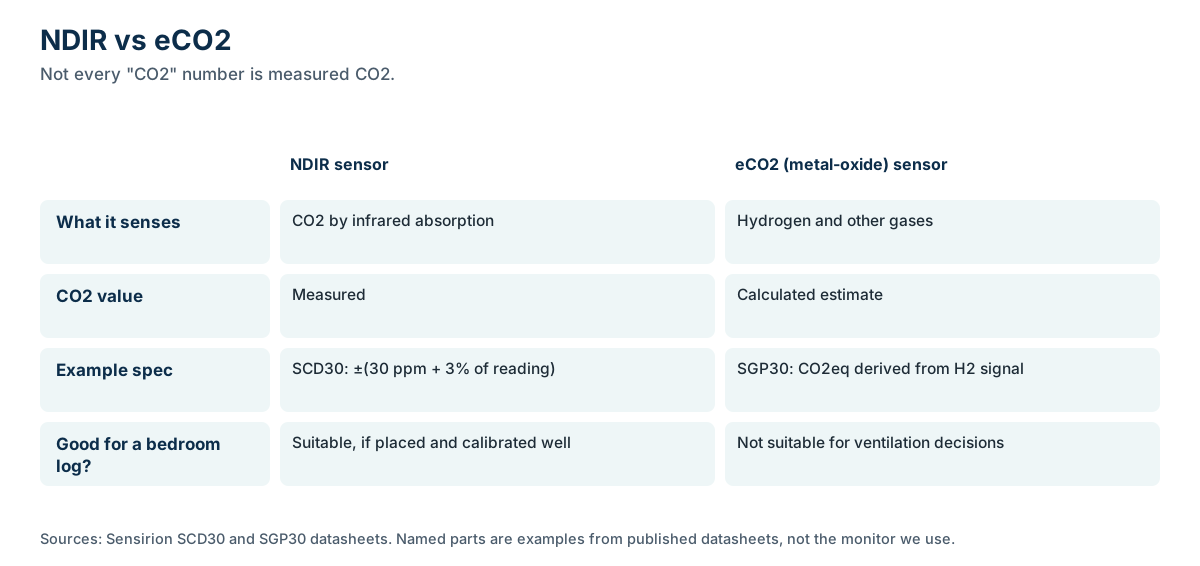
- A non-dispersive infrared sensor, which measures CO2 by how much infrared light it absorbs. One maker's datasheet for an NDIR module lists accuracy of plus or minus 30 ppm plus 3% of the reading.
- eCO2 (equivalent CO2):
- An estimated CO2 value that some air quality sensors calculate from other gas signals rather than measure. One maker's datasheet says its CO2eq signal is calculated from ethanol and hydrogen measurements.
- Automatic self-calibration:
- A feature in some NDIR sensors that resets their baseline by assuming they regularly see outdoor-level air. One datasheet says its sensor has to be exposed to air with 400 ppm CO2 regularly for this to work.
- Outdoor CO2 baseline:
- The CO2 level of outdoor air, the floor an indoor reading falls back toward when a room is well aired. NOAA's Mauna Loa record averaged 427.55 ppm in August 2026; ASHRAE notes it passed 400 ppmv in 2013.
- Parts per million (ppm):
- The unit for CO2 in air: molecules of CO2 per million molecules of air. Health Canada gives the conversions 1 ppm = 1.8 mg/m3 and 0.1% = 1,000 ppm.
Home CO2 monitors come in two kinds, and only one measures CO2. Monitors with NDIR sensors shine infrared light through a small chamber and measure how much the CO2 absorbs. Some cheaper air quality devices show an "eCO2" or "CO2eq" number that's calculated from other gases, which can rise and fall for reasons that have nothing to do with ventilation. For a bedroom, you want NDIR, a quick outdoor check, sensible placement and a full night of logging.
General information about bedroom air and ventilation, not medical advice.
How does an NDIR sensor work?
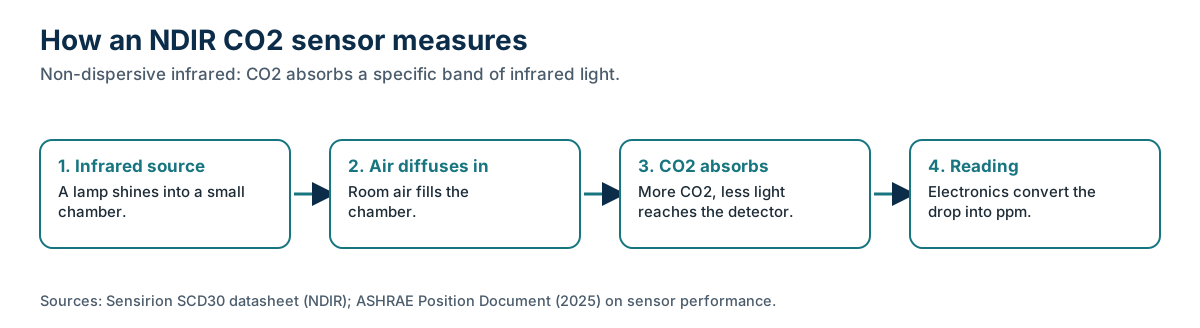
NDIR stands for non-dispersive infrared. CO2 absorbs infrared light in a specific band. The sensor shines infrared light through a sample chamber that room air diffuses into, and a detector measures how much light arrives. More CO2 means less light, and the electronics convert that difference into parts per million.
Sensor makers publish datasheets for these modules. Sensirion's SCD30 datasheet, for example, describes "NDIR CO2 sensor technology" with an accuracy of "±(30 ppm + 3%)" of the measured value over its specified range. We cite it as an example of what a published specification looks like, not as a recommendation, and not because it's the monitor we use.
What is eCO2, and why isn't it CO2?
Some devices use metal-oxide gas sensors designed for volatile organic compounds. They report a total VOC value and, often, an equivalent CO2 value. Sensirion's SGP30 datasheet, for one such sensor, says: "Air quality signals TVOC and CO2eq are calculated from Ethanol and H2 measurements using internal conversion and baseline compensation algorithms."
In other words, the CO2 number is inferred from other gases. Because it responds to ethanol and hydrogen, cooking, cleaning products or a glass of wine can move it; an open window may not move it the way real CO2 would. That makes eCO2 unsuitable for judging bedroom ventilation. If a product page lists TVOC alongside CO2eq or eCO2, assume the CO2 value is an estimate.
How accurate are the real ones?
Good enough for bedroom patterns, with caveats. A 2026 study in the journal Sensors, evaluating 23 low-cost NDIR CO2 sensors co-located in Irish school conditions, found "strong linearity" between sensors but "notable variability," with a mean root mean square error of 18.3 ppm before correction. A simple co-location correction cut that further. Performance "declined marginally above 1500 ppm and during dynamic occupancy."
For a bedroom, that means a decent NDIR monitor will show the shape of the night, the climb and the peak, reliably. Comparing two monitors to within a few tens of ppm, or treating 990 versus 1,010 ppm as meaningful, asks more than these devices deliver. ASHRAE's position document puts it simply: "Sensor performance, location, and calibration are all critical for drawing meaningful inferences from measured indoor CO2 concentrations."
What is automatic calibration?
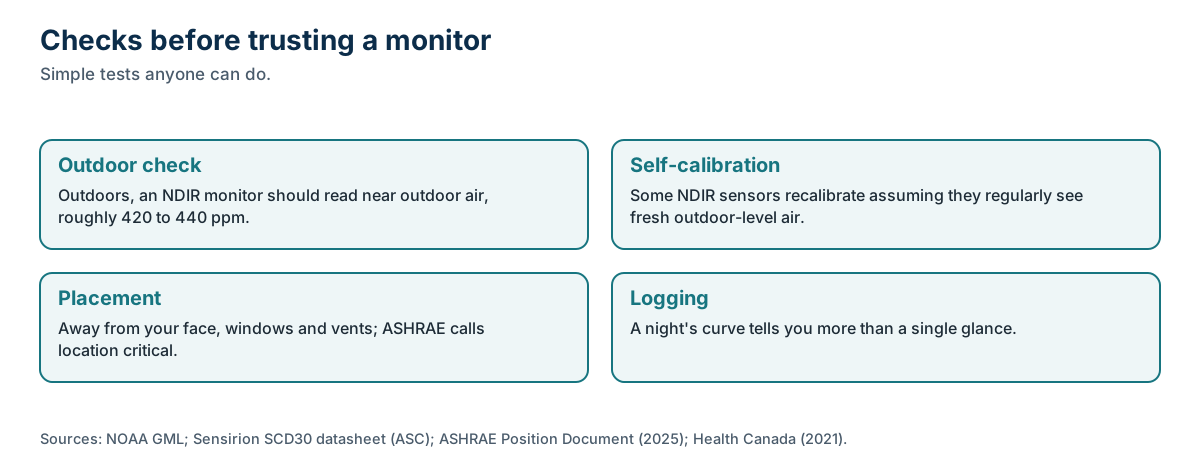
NDIR sensors can drift over time, so some include a self-calibration routine. The idea is that the sensor will see outdoor-level air every so often, take the lowest reading as roughly 400 ppm, and adjust. The SCD30 datasheet says the sensor needs regular exposure to air at 400 ppm for its automatic self-calibration (ASC) to work properly, and that concentrations below 400 ppm "may result in sensor drifts when ASC is activated."
This matters in a bedroom. If the room never airs out to near-outdoor levels, a self-calibrating sensor may slowly shift its baseline upward and under-read. The fix is simple: take the monitor outside, or to an open window, now and then.
How do I check my monitor?
Take it outdoors, away from people, traffic and exhaust, for 10 or 15 minutes. It should read near outdoor air. NOAA's Mauna Loa record averaged 427.55 ppm in August 2026; local outdoor air varies, and ASHRAE notes urban levels can be higher, with transient local concentrations "approaching or exceeding 600 ppmv" in some locations. A reading in the low 400s on a breezy day is a good sign. A reading under 400, or far above 500 in open air, suggests calibration trouble.
Where should it go in a bedroom?
Somewhere it reads the room, not you or a draft:
- About nightstand or dresser height, not on the floor or the headboard.
- Away from your face. Exhaled breath is far higher in CO2 than room air, so a monitor next to your pillow reads spikes.
- Away from windows, doors and supply vents, which deliver pockets of fresher air.
- Out of direct sun and away from heaters, which can affect readings.
These are the same principles behind the placement in our own 72-hour test.
How long should I measure?
At least a full night, ideally several. A single glance tells you the level at one moment. A log shows the climb after lights out, whether it levels off, and how it responds when someone opens the door. Health Canada's guideline says that when comparing with its 24-hour limit, "the sampling time should be at least 24 hours," and that averaging samples from different times of year gives a better estimate. It also notes that in most homes, identifying sources and reduction measures is "more informative and cost-effective" than testing alone, so let the data point you to a change. How to read a night of bedroom CO2 readings covers what to look for.
What should I do with the numbers?
Use them to compare, not to grade. A monitor's real value is showing whether a change you make, like opening the door or running a fan, moves the curve. What is a normal bedroom CO2 level? explains the reference points people quote, and open door vs window vs fan lists changes worth testing. If the readings look strange, run the outdoor check before drawing conclusions.
Does a monitor tell me how much fresh air I get?
Indirectly. CO2 is a tracer for outdoor air per person, and ASHRAE confirms indoor-outdoor differences "can be used to evaluate outdoor ventilation rates." Turning a curve into an exact air change rate requires assumptions about how many people were breathing, their CO2 output and how well-mixed the room was. Persily and de Jonge publish the generation rates that make those estimates possible. For most people, comparing nights under different settings is more useful than calculating a rate. The hub links the rest.
Sleep Sanitation's view
This section is our view. A good NDIR monitor is a useful tool, and an eCO2 device can mislead you. Our optional 72-hour bedroom CO2 test places a monitor in your bedroom for three nights and gives a plain-language ventilation report with airflow tips. It's priced by quote, booked on its own or added to a mattress visit, and it isn't a medical test. We don't recommend or rate monitor brands. See our process.
What we don't know
- How well typical consumer monitors hold calibration over years in homes. The evaluation we cite ran in schools over three test periods.
- How much bedroom placement changes readings in real rooms. We found no published bedroom placement study.
- How many eCO2 devices are sold as CO2 monitors. Product listings aren't always clear about the sensor type.
Changelog
- 7 October 2026: First published. Sources accessed on this date.
Sources
- SCD30 CO2, humidity and temperature sensor datasheet · Sensirion (sensor maker)
- SGP30 indoor air quality sensor datasheet (TVOC and CO2eq) · Sensirion (sensor maker)
- Low-Cost CO2 Sensors: On-Site Performance Evaluation and Co-Location Correction Procedure for Reliable Ventilation Assessments in Schools · Sensors (PubMed Central)
- ASHRAE Position Document on Indoor Carbon Dioxide (approved 2025) · ASHRAE
- Residential Indoor Air Quality Guidelines: Carbon Dioxide (2021) · Health Canada
- Trends in Atmospheric Carbon Dioxide (Mauna Loa monthly mean) · NOAA Global Monitoring Laboratory
- Carbon dioxide generation rates for building occupants (Persily and de Jonge, Indoor Air, 2017) · PubMed Central
Last reviewed October 7, 2026. Manufacturer specifications and care instructions change; check the current version for your exact model. This page is general information, not medical advice. How we source and check pages: editorial standards.