
Short answer
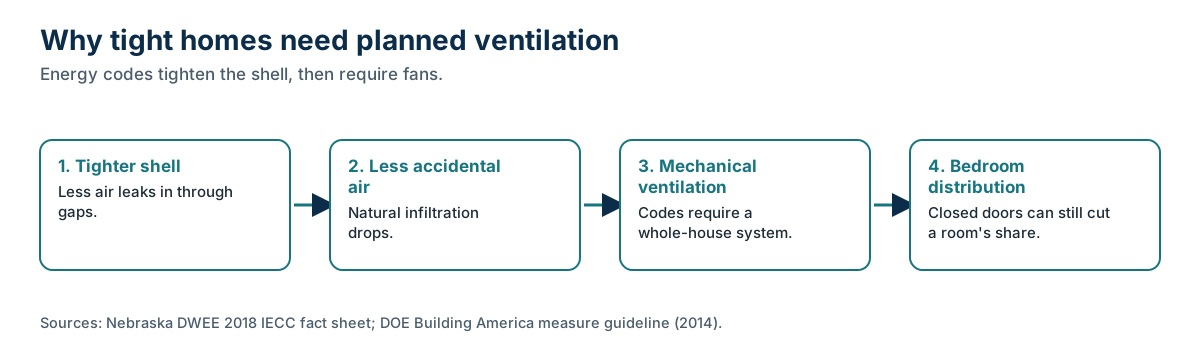
Tighter homes leak less outdoor air, so they depend on mechanical ventilation. Nebraska's energy code, the 2018 IECC since July 2020, requires new homes to test below 3 air changes per hour at 50 pascals and to have whole-house mechanical ventilation. In winter, windows stay shut and reviewed bedroom studies found lower air change rates, so bedroom CO2 often climbs. Check that your ventilation system runs and reaches the bedroom.
Key terms used on this page
- ACH50 (blower door result):
- Air changes per hour at 50 pascals of pressure, the result of a blower door test of how leaky a home is. Nebraska's code requires new homes to test below 3 ACH50.
- Whole-house mechanical ventilation:
- A fan system that brings in or exhausts air for the whole home on a schedule. Nebraska's 2018 IECC fact sheet says one must be installed in every new home: exhaust, supply, balanced, HRV or ERV.
- Infiltration:
- Outdoor air that leaks into a home through gaps in the shell rather than through a fan or window. Health Canada notes that homes have become more airtight, which has lowered air exchange rates.
- ERV / HRV:
- Energy or heat recovery ventilators: balanced systems that bring in outdoor air and exhaust stale air through a core that transfers heat, and with an ERV some moisture, between the two streams.
- Relative humidity:
- How much moisture the air holds compared with its maximum at that temperature. Dust mites depend on humid air. NIEHS advises keeping indoor humidity at or below 50 percent, and the practice parameter gives a range of 35 to 50 percent.
- Air changes per hour (ACH):
- How many times an hour a room's volume of air is replaced by outdoor air. An ASHRAE-cited review of bedroom studies found mean bedroom rates from 0.2 to 4.9 per hour, lower in heating seasons.
Tight homes and cold weather both cut the outdoor air reaching a bedroom. Newer homes are built to leak less, so they rely on mechanical ventilation to bring outdoor air in. Nebraska's energy code requires exactly that. In winter, windows stay shut and studies find bedroom air change rates drop, so bedroom CO2 tends to climb in the cold months. The practical question is whether your home's ventilation system is running and whether any of its air actually reaches the bedroom.
General information about bedroom air and ventilation, not medical advice.
Why are homes getting tighter?
To save energy. Health Canada's residential guideline says that "due to an increased focus on reducing energy costs for heating and air conditioning, buildings in Canada have generally become more airtight," which "has led to decreasing AER in residences." AER means air exchange rate. The same logic drives US energy codes: less leakage means less heat lost, and also less outdoor air arriving by accident.
What does Nebraska's code require?
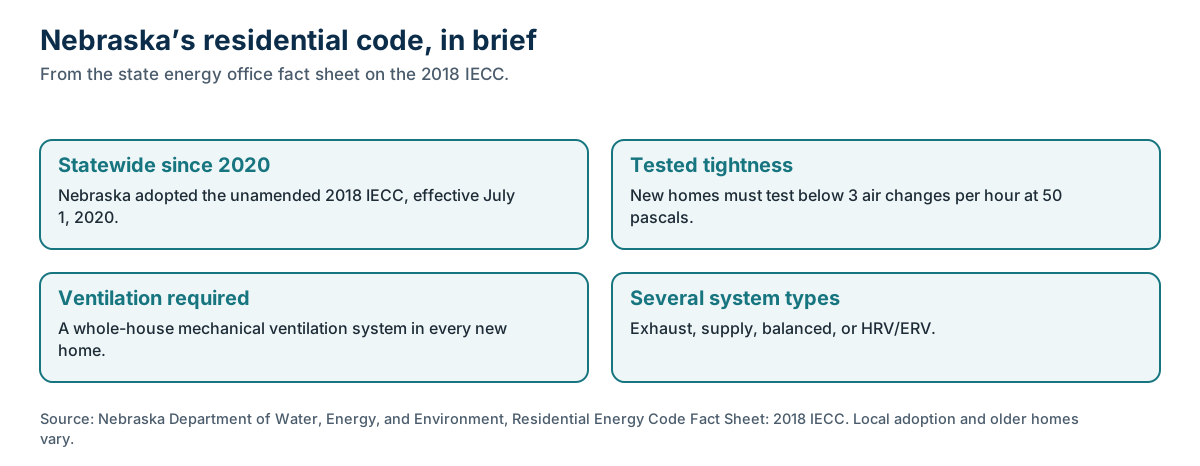
Two relevant things. The Nebraska Department of Water, Energy, and Environment's fact sheet says "the unamended 2018 IECC was adopted in Nebraska statewide on July 1, 2020," a status the DOE's energy code tracker also lists as mandatory statewide.
First, tightness. The fact sheet says whole-home air leakage "needs to be tested via a blower door test" and must be less than 3 air changes per hour at 50 pascals of pressure difference. If the home fails, more air sealing is needed.
Second, ventilation. "A whole-house mechanical ventilation system needs to be installed in every home." It can be "an exhaust only, a supply only, a balanced system, or with a heat or energy recover ventilator (HRV or ERV)," designed to run "continuously or at least for 1 hour every 4 hours," and sized with the 2018 IRC's equation or table.
Code applies to new construction, additions and renovations from that date. Older homes may have very different envelopes and systems.
If the house is ventilated, why is the bedroom stuffy?
Because whole-house airflow doesn't always reach a room with the door shut. A DOE Building America guide notes that "when doors are closed and there is no central air handler operation," it's common for some bedrooms "to experience air change rates 50% lower than those of areas where point ventilation systems are located." An exhaust-only system in a bathroom or laundry room may pull outdoor air in through leaks closest to it, not through the bedroom.
The DOE's HRV/ERV checklist recommends "that each occupied room with a door have at least one ducted supply, or one ducted return, or both." Open door vs window vs fan covers transfer grilles and other fixes that let a closed bedroom share the house's ventilation.
What changes in winter?
Several things at once:
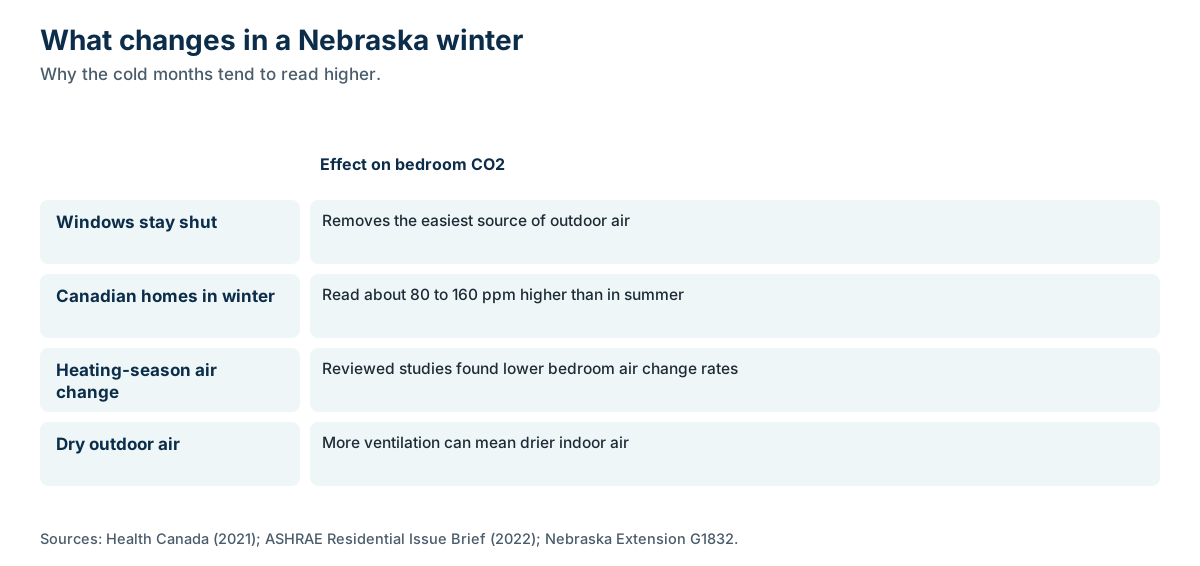
- Windows stay shut. The easiest source of outdoor air disappears.
- Air change rates drop. An ASHRAE committee brief, summarizing a review by Sekhar and colleagues, says measured results "suggested that the ventilation rates were lower during heating seasons, especially in naturally ventilated bedrooms."
- Readings rise. Health Canada found winter home medians "approximately 80 to 160 ppm higher than those measured in summer" in the two cities measured both ways.
- Air gets drier. More outdoor air in winter tends to lower indoor humidity, a trade-off covered below.
Some of the bedroom research also happened in winter. The Danish field study by Fan and colleagues (2022) ran during the heating season, when its closed bedrooms reached mean 95th-percentile CO2 levels near 3,000 ppm. What research says about bedroom CO2 and sleep has the details.
What about humidity in winter?
Ventilation moves moisture as well as CO2. Cold outdoor air holds little water, so bringing in more of it tends to dry a heated house. An ERV, the DOE notes, "also transfers moisture," which can keep some humidity indoors. Nebraska Extension's moisture checklist asks whether indoor relative humidity "is kept below 50 percent to 60 percent — an optimum range is between about 30 percent and 50 percent," and the same checklist asks whether moderate indoor temperatures are maintained during heating season to avoid condensation. The EPA's mold guide gives a similar range.
So winter ventilation is a balance: enough outdoor air to keep the bedroom from getting stuffy, not so much that the air gets uncomfortably dry. Bedroom CO2, humidity and bed mites connects this to the relative humidity guidance in our allergens hub.
What can you check?
Start simple:
- Find the ventilation system. Look for a labeled bath fan on a timer or continuous setting, a fresh-air duct at the furnace, or an HRV or ERV unit. Your builder's documents may list it.
- Make sure it's on. Systems can be switched off or set to their lowest setting. Health Canada suggests "setting the mechanical ventilation system to a higher setting or letting it run longer."
- Check the bedroom's air path. Is there a supply register, a return or a door gap? A closed door with no return can choke the room's airflow.
- Have it serviced. Health Canada also recommends "having the ventilation system checked regularly by a qualified ventilation contractor."
- Compare nights. Log a normal night, change one thing, and log again. How to read a night of bedroom CO2 readings shows how.
What if the house has no ventilation system?
Older homes may not have a dedicated ventilation system at all. In that case the bedroom depends on leaks, windows, the door and the furnace fan. Health Canada's list of strategies still applies: open windows when outdoor air quality allows, run the kitchen range hood when cooking, and use "the furnace fan or, if necessary, a separate fan or air supply to make sure air is distributed throughout the home." A contractor can tell you whether adding a ventilation system makes sense for your house.
Is an older, leakier house better?
Not necessarily. Leaks bring in outdoor air, but unpredictably: more on windy, cold nights, less on calm ones, and from wherever the gaps are. A tight house with a working, well-distributed ventilation system can deliver steadier outdoor air than a leaky one. Either can have a stuffy bedroom with the door shut, which is why measuring beats guessing.
Sleep Sanitation's view
This section is our view. In our area, winter is when a bedroom CO2 log is most informative, because windows are shut and the house's ventilation system is doing all the work. Our optional 72-hour bedroom CO2 test logs three nights and gives a plain-language ventilation report with airflow tips. It's priced by quote and isn't a medical test or an HVAC inspection; for system changes, talk with an HVAC contractor. See our process and the bedroom CO2 hub.
What we don't know
- How many homes in Lincoln and Omaha have working, well-distributed mechanical ventilation. We found no local survey.
- How bedroom CO2 differs between homes built before and after Nebraska's 2020 code change. No local data compares them.
- Typical winter indoor humidity in tight Nebraska homes with and without ERVs.
Changelog
- 7 October 2026: First published. Sources accessed on this date.
Sources
- Nebraska Residential Energy Code Fact Sheet: 2018 IECC · Nebraska Department of Water, Energy, and Environment
- Nebraska: Building Energy Code Status · US Department of Energy, Building Energy Codes Program
- Residential Indoor Air Quality Guidelines: Carbon Dioxide (2021) · Health Canada
- Residential Issue Brief: Ventilation, IEQ and Sleep Quality in Bedrooms (2022) · ASHRAE Residential Buildings Committee
- Bedroom ventilation: Review of existing evidence and current standards (Sekhar et al., Building and Environment, 2020) · Elsevier (DOI)
- Measure Guideline: Selecting Ventilation Systems for Existing Homes (Building America, 2014) · US Department of Energy
- Balanced HRV/ERV · Building America Solution Center (US DOE / PNNL)
- Identifying Moisture and Mold Sources in Houses (G1832) · Nebraska Extension, University of Nebraska-Lincoln
- A Brief Guide to Mold, Moisture and Your Home · US EPA
Last reviewed October 7, 2026. Manufacturer specifications and care instructions change; check the current version for your exact model. This page is general information, not medical advice. How we source and check pages: editorial standards.