
Short answer
Every measure leaves a gap. Heat kills mites but leaves allergen; vacuuming removes allergen but not live mites; washing reaches only bedding; encasings seal only what they cover; humidity works slowly. Allergist guidance says covers alone are unlikely to help clinically unless part of a multifaceted plan, and a large trial and a Cochrane review found no clinical effect. Cleaning is one piece.
Key terms used on this page
- Multifaceted control:
- Using several dust mite measures together, such as encasing, washing, vacuuming and humidity control. The practice parameter says mite covers alone are unlikely to achieve a clinical benefit unless used as part of a more comprehensive plan.
- Clinical outcome:
- A health result, such as symptoms, lung function or medication use, as opposed to an environmental result such as allergen in dust. A 2008 Cochrane review of 54 trials found no effect of mite control measures on asthma outcomes. We report environmental results only.
- Mite-impermeable encasing:
- A zippered cover that fully encloses a mattress, box spring or pillow so mite allergen can't pass through. The practice parameter says woven microfiber with a mean pore size smaller than 10 micrometers can block Der p 1, and it does not recommend nonwoven covers.
- Relative humidity:
- How much moisture the air holds compared with its maximum at that temperature. Dust mites depend on humid air. NIEHS advises keeping indoor humidity at or below 50 percent, and the practice parameter gives a range of 35 to 50 percent.
- Live-mite kill:
- A study outcome that counts whether mites are alive after a treatment. It is different from allergen removal: dead mites and their droppings can stay in the fabric, still carrying allergen, until something removes them.
- Allergen removal:
- A study outcome that measures how much mite allergen comes out of a surface, usually in dust samples. The practice parameter summarizes a rug study in which vacuuming, washing and shampooing removed allergen without killing the mites.
People often want the one thing that solves dust mites: the right spray, the right vacuum, the right cleaning. The research points the other way. Each measure handles part of the problem and misses another part, and allergist guidance is explicit that single measures fall short.
This article is general information about cleaning, not medical advice. For allergy or asthma questions, talk to your doctor or an allergist.
The gaps each measure leaves
Heat kills, but leaves allergen. Steam studies have recorded mites dying, such as the 1995 lab test on carpet squares that found no live mites in treated squares over four months. But dead mites and their droppings stay in the fabric until something removes them. Eggs also need more heat than adults.
Vacuuming removes, but doesn't kill. The allergist practice parameter says regular vacuuming "can help remove dust mite allergens, although it is not capable of removing live mites."
Washing reaches only what goes in the machine. Sheets, pillowcases and blankets, yes. The mattress, no.
Encasings seal only what they cover. The parameter notes that even with encasings on, "the blankets, sheets, and pillowcases remain a potential source of exposure."
Humidity control works slowly. Keeping air dry makes the bed a worse place for mites over time. It does nothing about allergen already there.
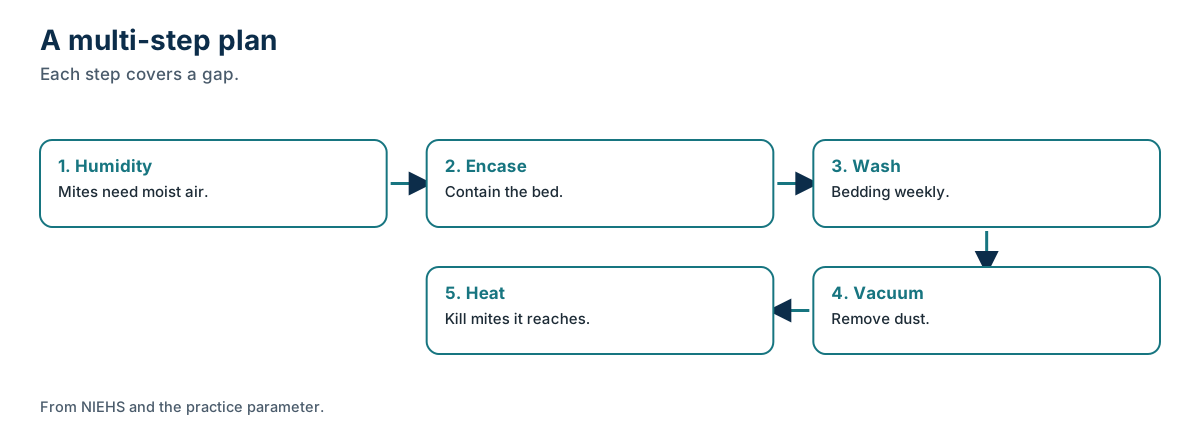
What allergists say about combining
The practice parameter makes the point most clearly in its discussion of encasings: "Although encasings effectively contain mite allergens, in many cases mite covers alone are unlikely to achieve a clinical benefit unless they are used as part of a more comprehensive multifaceted avoidance plan."
Its recommendations read as a set. Among them: keep relative humidity at 35 to 50 percent; wash bedding weekly; vacuum regularly with filtration; use mite allergen-proof mattress, box spring and pillow encasings. NIEHS lists a similar group: humidity "at, or below, 50 percent," encasing the mattress and pillows, weekly washing, replacing wool or feathered bedding with synthetic materials, damp dusting, and a filtered vacuum.
What a trial and a review of single measures found
Two large sources tested measures on clinical outcomes, which are health results rather than allergen in dust.
The 2003 Woodcock trial gave 1,122 adults with asthma either impermeable or ordinary bed covers. Mattress allergen was lower at 6 months with the impermeable covers, but the authors concluded the covers, "as a single intervention," seemed "clinically ineffective in adults with asthma."
The 2008 Cochrane review pooled 54 trials with 3,002 patients: 36 testing physical methods, 10 chemical and 8 combinations. It reported: "we did not find an effect of the interventions." That included combined approaches, so it isn't simply a case for doing more things at once. It's a reminder that environmental measures and health outcomes are different questions.
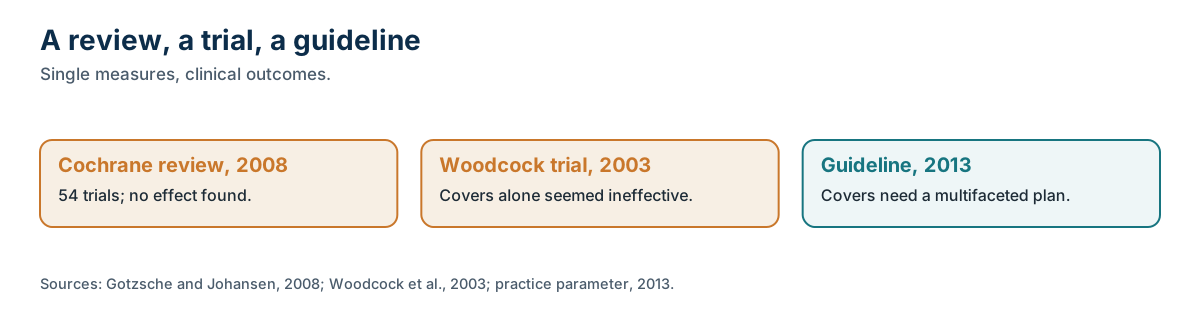
We cite these for honesty, not to argue against any measure. Whether a given plan helps a given person is for a doctor to judge.
Allergen comes from more than the bed
Part of why one step falls short is that mite allergen lives in many places. The practice parameter names mattresses, box springs and pillows as major sources, but also points to carpets, upholstered furniture and clothing: "Clothing is an important and probably under-rated source of mite allergen exposure." It notes that allergen levels vary widely within a single room, so that "the entire room needs to be cleaned as opposed to only areas near the bed."
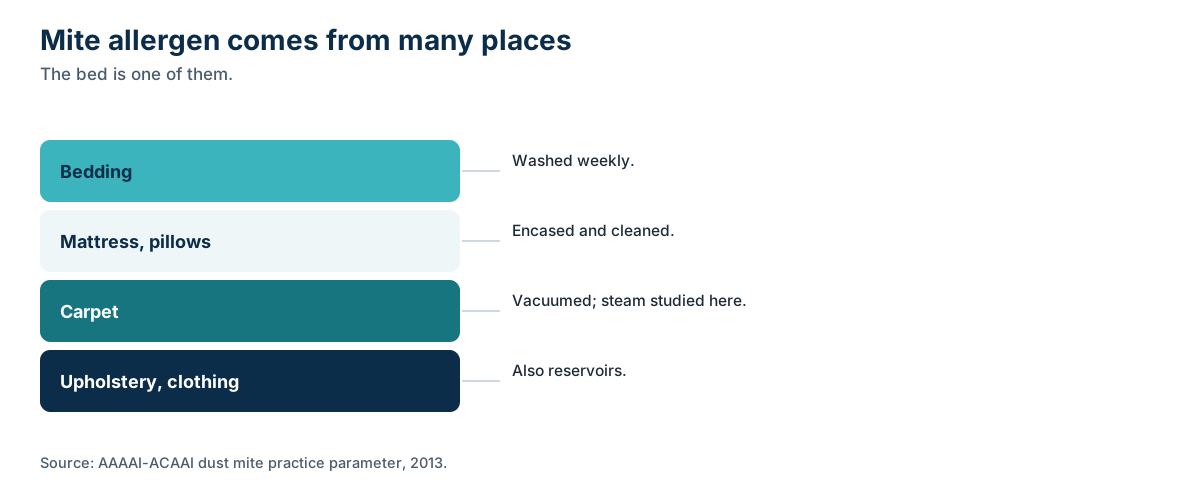
Most of the cleaning research was done on carpets and furniture for that reason. In the Vojta study, homes got dry steam plus vacuuming or intensive vacuuming on carpets and furniture, and encasing plus laundering on beds. Every surface got its own intervention.
Allergen comes back
The other reason is time. In Vojta's carpets (19 homes; the carpet comparison used 11 homes, 5 of them steamed), allergen after intensive vacuuming alone "approached pretreatment values by 4 weeks," and steam plus vacuuming held it down "for up to 8 weeks." That's a decrease that lasted, and then didn't. NIEHS's summary holds for every surface: "No matter how clean a home is, dust mites cannot be completely eliminated."
Daily habits handle what a one-time treatment can't. The 2012 Wu study, with 20 volunteers and no control group, shows what steady effort can do on a mattress: daily vacuuming lowered total mite allergen from 4.07 to 0.42 micrograms over eight weeks.
A plan, piece by piece
Drawing only on the sources above, a household plan might look like this:
- Humidity. At or below 50 percent, by dehumidifier or air conditioning, per NIEHS.
- Encasings. Woven, mite-impermeable covers on the mattress, box spring and pillows.
- Weekly washing. Sheets, pillowcases and blankets.
- Regular vacuuming. With a filtered machine, ideally done by someone without the allergy.
- Heat, if you want it. A cleaning visit that applies heat to the mattress surface and folds.
How to weight those for a particular person is a question for an allergist.
Where cleaning fits
A cleaning visit is the fifth item, and an optional one. It adds heat at the bed and nothing the other four already cover. Ours starts with a look at the materials, so steam output and pass speed suit the mattress, and moves through the surface and the seams, tufts, ridges and edges where dust and shed skin flakes collect. Price: the standard price, and severe or biohazard contamination is quoted as a custom surcharge before we start. Organic cleaning methods are our default. Whether steam is appropriate for your mattress is set by its care label and warranty terms, which govern; check your warranty before booking.
What a visit adds is heat where heat reaches, on one day. What it can't add is the barrier an encasing provides every night, the weekly wash, or dry air. We'd rather say that than sell a visit as the whole answer.
We call the work cleaning, in the CDC's sense; Hub 2 explains the CDC's sanitize definition. We make no health claims, for the reasons set out in does mattress sanitation cure allergies?.
Bunk beds, a specific case
The practice parameter has one recommendation that shows how specific multi-step advice can get. It discourages "members of families with an atopic background from sleeping in bunk beds," and adds that if bunk sleeping is necessary, "the sensitized person ideally should sleep in the top bed and the top and bottom mattresses (and any fabric-covered 'bunky-boards') should be enclosed in allergen-impermeable encasings." The logic is that dust from the upper mattress falls toward the lower bunk. It's a good illustration of why a single cleaning of one mattress can't stand in for a plan: the plan has to account for every bed and fabric surface near the person.
Why sprays aren't on the list
You might expect a mite-killing spray among the steps. The practice parameter recommends against it: "Do not recommend the use of acaricides to eliminate mite populations because of their limited efficacy at lowering allergen levels and concerns about the use of chemical agents in the home." A spray adds a chemical and leaves the allergen. Killing dust mites vs removing allergen explains why that matters.
Where to read next
The dust mite and allergen guide covers each measure's evidence in detail, and the hub lists every article. Can sanitation replace an encasement? looks at two of the steps head to head. Hub 1's glossary explains the allergen reservoir, the build-up every step is working against.
What we don't know
- Which combination of measures does most for allergen in a mattress. We found no study that compared combinations on mattresses.
- Whether adding a heat treatment to the other steps changes allergen in a mattress more than the other steps alone.
- How the clinical evidence would look with the more rigorous studies the Cochrane authors called for.
Changelog
- 3 October 2026: First published. Sources accessed on this date.
Sources
- Environmental assessment and exposure control of dust mites: a practice parameter (Portnoy et al., Ann Allergy Asthma Immunol, 2013) · AAAAI and ACAAI
- Dust Mites and Cockroaches (accessed 2026-10-03) · National Institute of Environmental Health Sciences (NIH)
- Control of exposure to mite allergen and allergen-impermeable bed covers for adults with asthma (Woodcock et al., N Engl J Med, 2003) · PubMed
- House dust mite control measures for asthma (Gotzsche and Johansen, Cochrane review, 2008) · PubMed
- Effects of physical interventions on house dust mite allergen levels in carpet, bed, and upholstery dust in low-income, urban homes (Vojta et al., Environ Health Perspect, 2001) · PubMed Central
- The use of domestic steam cleaning for the control of house dust mites (Colloff et al., Clin Exp Allergy, 1995) · PubMed
- Daily vacuuming of mattresses significantly reduces house dust mite allergens, bacterial endotoxin, and fungal beta-glucan (Wu et al., J Asthma, 2012) · PubMed
- Cleaning and disinfecting your school (definitions) · CDC
Last reviewed October 3, 2026. Manufacturer specifications and care instructions change; check the current version for your exact model. This page is general information, not medical advice. How we source and check pages: editorial standards.