
Short answer
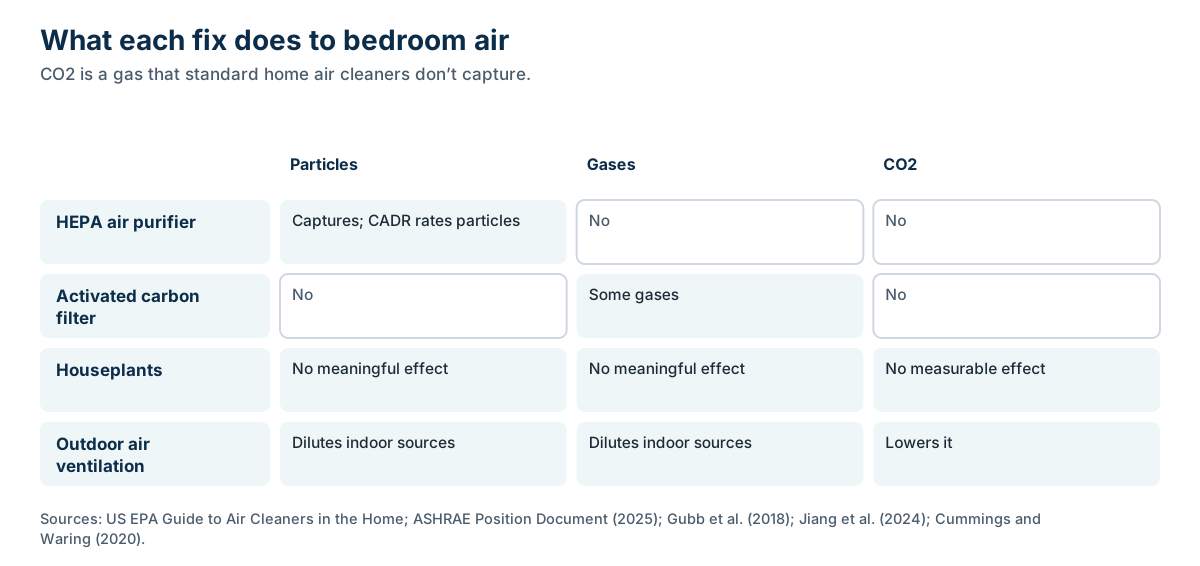
No. Portable air purifiers capture particles, and activated carbon captures some gases, but neither removes CO2; ASHRAE says CO2 can be removed only by chemical sorption-type air cleaners. Houseplants take up very little CO2 at indoor light levels, under 3.9 mg an hour in one study, while a resting adult breathes out roughly 27,000 mg. An office study found ferns didn't significantly change CO2. Only outdoor air lowers it.
Key terms used on this page
- Clean air delivery rate (CADR):
- A rating for portable air cleaners. The EPA says the CADR rating system is for particles only, so it says nothing about gases such as CO2.
- Sorption air cleaner:
- A device that captures a gas chemically. ASHRAE says removing or converting CO2 in air can be achieved only by chemical reaction processes using sorption-type air cleaners, not by ordinary filters.
- Outdoor air ventilation:
- Outdoor air brought into a space on purpose or by leakage, which dilutes what people and the building give off. ASHRAE says indoor-outdoor CO2 differences can be used to evaluate outdoor ventilation rates, given valid assumptions.
- CO2 generation rate:
- How much CO2 a person breathes out, which depends on body size, age, sex and activity. Health Canada puts an average person at about 15 L/hr at rest and about 45 L/hr during moderate activity.
- HEPA filtration:
- High-efficiency particulate air filtration. The practice parameter recommends vacuums with HEPA filtration, or a central vacuum that vents outside, so mite fecal particles stay in the machine instead of going back into the room.
No. Portable air purifiers filter particles, and those with activated carbon capture some gases, but neither removes CO2 in a meaningful way. ASHRAE says CO2 can be removed only by chemical, sorption-type air cleaners. Houseplants don't help either: one study measured plant CO2 uptake at typical indoor light at under 3.9 milligrams an hour, while a resting adult breathes out roughly 27,000 milligrams. The only practical way to lower bedroom CO2 is to bring in more outdoor air.
General information about bedroom air and ventilation, not medical advice.
Why don't air purifiers remove CO2?
Because they're built to catch other things. The EPA's guide to air cleaners explains that to filter particles you choose a purifier with a high enough clean air delivery rate, and that "portable air cleaners often achieve a high CADR by using a high-efficiency particulate air (HEPA) filter." For gases, it recommends "an activated carbon filter or other filter designed to remove gases," and notes that "the CADR rating system is for particles only."
CO2 is a small, stable gas present at hundreds to thousands of ppm. HEPA filters don't catch gases, and ordinary carbon filters aren't designed for CO2. ASHRAE's position document states: "The removal or conversion of CO2 in the air can be achieved only by chemical reaction processes using sorption-type air cleaners."
What does ASHRAE say about CO2-removing devices?
It's cautious. ASHRAE warns that "air-cleaning technologies that remove only CO2 may not improve overall IAQ and can interfere with systems using CO2 for ventilation control or IAQ monitoring." It adds that using air cleaning to reduce CO2 at common indoor levels "can result in an unjustified expectation that other indoor pollutants are not a concern."
That follows from CO2's role as a marker. A high bedroom reading usually means little outdoor air is diluting everything people and the room give off. Pull out the CO2 alone and the marker drops while the rest stays. Is CO2 the problem, or a marker of stale air? explains why that distinction matters.
Then what are air purifiers good for?
Particles. The EPA says filtration "can be an effective supplement to source control and ventilation," and that portable air cleaners and HVAC filters "can reduce indoor air pollution; however, they cannot remove all pollutants from the air." Then it adds the key line: "Filtration does not replace the need to control pollutants and ventilate."
So a purifier can be a reasonable choice for airborne particles, and a ventilation change is the choice for CO2. They solve different problems. Our allergens hub covers HEPA filtration in the context of mattress allergens.
How much CO2 does one sleeper add?
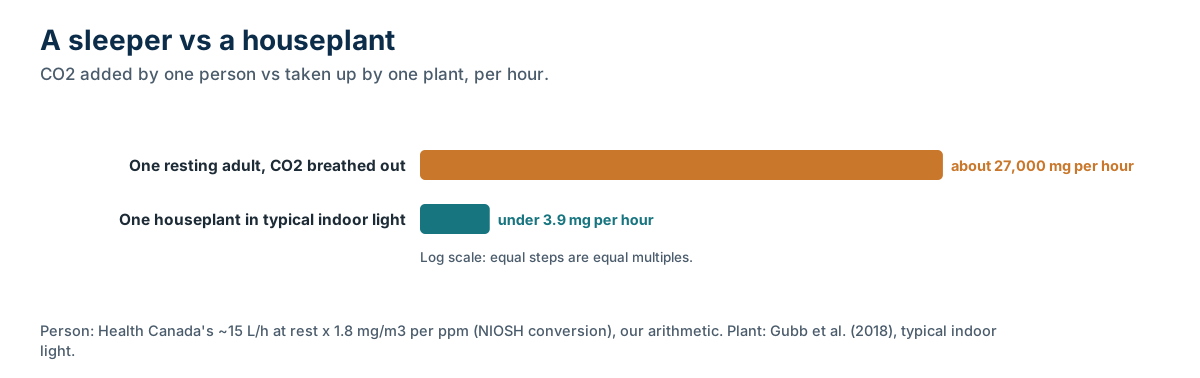
A lot, relative to anything a plant can absorb. Health Canada's residential guideline says "an average person will produce approximately 15 L/hr of CO2 at rest." Using Health Canada's and NIOSH's conversion of 1 ppm = 1.8 mg/m3, which corresponds to about 1.8 grams per liter of pure CO2, that's roughly 27 grams, or 27,000 milligrams, of CO2 per hour. The calculation is ours; the inputs come from Health Canada and the NIOSH Pocket Guide.
How much CO2 does a houseplant take up?
Very little at indoor light. Gubb et al. (2018), at the University of Reading, measured CO2 uptake by common houseplants across a range of indoor light levels. "At typical 'low' indoor light levels 'A' rates were generally low (< 3.9 mg hr-1)," where A is the rate of CO2 assimilation. They found that only a few of the plants tested could reach net uptake within the typical indoor light range.
Compare the numbers: under 3.9 milligrams an hour for a plant versus roughly 27,000 for one resting adult. By our arithmetic, it would take thousands of plants, in good light, to offset one sleeper. And a bedroom at night is dark, so the plants on your dresser aren't taking up CO2 while you sleep.
Has anyone measured plants in a real room?
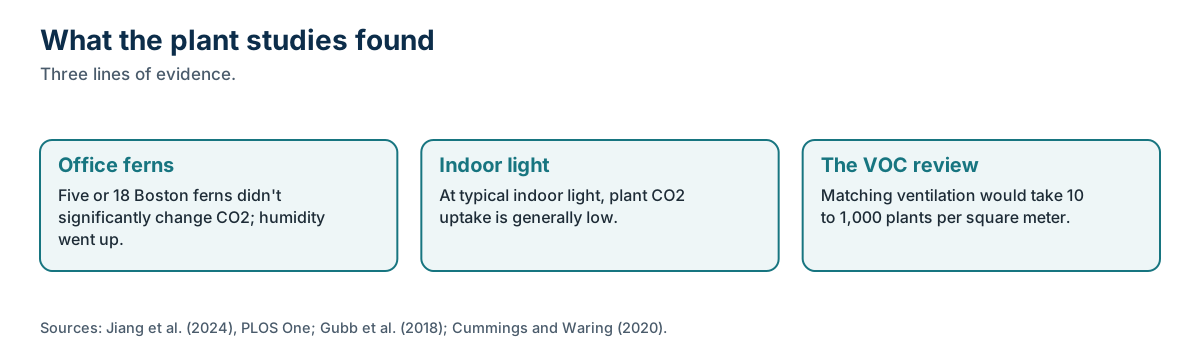
Yes. Jiang et al. (2024), in PLOS One, rotated three treatments through three offices: no plants, five Boston ferns and eighteen Boston ferns. They found a significant rise in relative humidity, from a median of 29.1% with no plants to 49.2% with 18, but "did not find significant associations between the number of indoor plants and indoor air temperature or corrected" CO2 concentration. The authors concluded their research "does not provide support for using indoor plants to regulate indoor air temperatures" or CO2 in offices.
What about the claims that plants clean the air?
Those mostly concern volatile organic compounds, not CO2, and they come from small sealed chambers. A review by Cummings and Waring (2020) translated 196 chamber results into clean air delivery rates and concluded that it would take 10 to 1,000 plants per square meter of floor space to match the VOC removal that outdoor-to-indoor air exchange already provides in typical buildings. Their title sums it up: potted plants do not improve indoor air quality.
What about CO2 "scrubbers" and absorbent products?
You may see products marketed as absorbing CO2. ASHRAE's statement is the useful test: removing CO2 from air takes chemical, sorption-type processes, and such devices raise two concerns. They can give a false sense that the air is fine when other indoor pollutants are still building up, and they can confuse ventilation controls or monitors that rely on CO2. Before spending money, ask what the device does with the CO2 it captures, how often its material must be replaced, and whether it does anything about the rest of the air. For a bedroom, a window, a door or a ventilation system usually costs less and dilutes everything at once.
Can plants make a bedroom worse?
They add moisture. In the fern study, humidity rose substantially. In a dry winter that may be welcome, but our allergens hub explains why bed mites favor humid conditions, and bedroom CO2, humidity and bed mites covers the balance. Keep plants for enjoyment, not as an air treatment.
What does lower bedroom CO2?
Outdoor air. A cracked window, an open door, a ventilation system running longer or a better air path to the bedroom. Open door vs window vs fan compares the options and their trade-offs, and the hub links the rest of the topic.
Sleep Sanitation's view
This section is our view. We'd rather tell you a purifier won't lower CO2 than let you buy one expecting it to. Our optional 72-hour bedroom CO2 test logs three nights and gives a plain-language ventilation report with airflow tips. It's priced by quote and isn't a medical test or an air purifier evaluation. Every mattress visit includes two checks, a moisture check and the built-in bed mite sensor on our UV-C vacuum; the CO2 test isn't one of them. See our process.
What we don't know
- How sorption-type CO2 removal devices perform in homes. We found no independent residential studies.
- Whether any combination of plants and grow lights could matter in a small sealed room. The studies we found used typical indoor or office conditions.
- How much plant-added humidity affects bed mite conditions in a bedroom. No study we found measured it.
Changelog
- 7 October 2026: First published. Sources accessed on this date.
Sources
- ASHRAE Position Document on Indoor Carbon Dioxide (approved 2025) · ASHRAE
- Guide to Air Cleaners in the Home · US EPA
- Can houseplants improve indoor air quality by removing CO2 and increasing relative humidity? (Gubb et al., 2018) · Air Quality, Atmosphere and Health (DOI)
- Effects of indoor plants on CO2 concentration, indoor air temperature and relative humidity in office buildings (Jiang et al., 2024) · PLOS One
- Potted plants do not improve indoor air quality: a review and analysis of reported VOC removal efficiencies (Cummings and Waring, 2020) · J Expo Sci Environ Epidemiol (DOI)
- Residential Indoor Air Quality Guidelines: Carbon Dioxide (2021) · Health Canada
- NIOSH Pocket Guide to Chemical Hazards: Carbon dioxide · CDC / NIOSH
Last reviewed October 7, 2026. Manufacturer specifications and care instructions change; check the current version for your exact model. This page is general information, not medical advice. How we source and check pages: editorial standards.