
Short answer
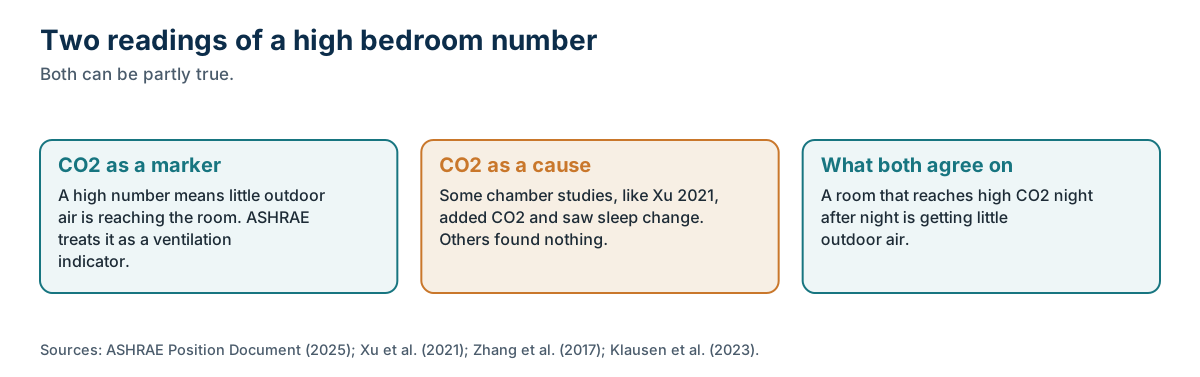
Probably mostly a marker, possibly a bit of both. When outdoor air is short, CO2 rises along with body odors, humidity and other indoor emissions. A chamber study found pure CO2 up to 3,000 ppm had no significant effects while the same CO2 from people's bioeffluents did. Another found sleep worsened as pure CO2 rose. ASHRAE regards CO2 as a ventilation indicator, not an overall air quality score.
Key terms used on this page
- Bioeffluents:
- Compounds people give off from skin and breath, the source of stuffy-room odor. In a chamber study, bioeffluents with CO2 at 3,000 ppm worsened perceived air quality and symptoms, while pure CO2 at the same level did not.
- Outdoor air ventilation:
- Outdoor air brought into a space on purpose or by leakage, which dilutes what people and the building give off. ASHRAE says indoor-outdoor CO2 differences can be used to evaluate outdoor ventilation rates, given valid assumptions.
- Sorption air cleaner:
- A device that captures a gas chemically. ASHRAE says removing or converting CO2 in air can be achieved only by chemical reaction processes using sorption-type air cleaners, not by ordinary filters.
- Steady-state CO2:
- The level where CO2 stops rising because outdoor air removes it as fast as people add it. Persily and de Jonge's model puts two sleeping adults in a 65 m3 bedroom at 1,988 ppm above outdoors at 0.2 air changes per hour.
- Parts per million (ppm):
- The unit for CO2 in air: molecules of CO2 per million molecules of air. Health Canada gives the conversions 1 ppm = 1.8 mg/m3 and 0.1% = 1,000 ppm.
Most evidence says bedroom CO2 is mainly a marker: when a room gets too little outdoor air, CO2 rises along with everything else people and the room give off. A few studies suggest CO2 itself may also have some effect at higher indoor levels, but that's contested. For practical purposes the distinction matters less than it sounds, because the same fix, more outdoor air, lowers all of them. Here is what the studies that tried to separate CO2 from stale air actually found.
General information about bedroom air and ventilation, not medical advice.
Why has CO2 always been a stand-in?
Because it's easy to measure and tracks people. ASHRAE's position document on indoor CO2 recounts that in the 19th century, Max von Pettenkofer argued it was "not CO2 but the presence of organic material from human skin and lungs" that caused the ill effects blamed on poor ventilation. He proposed CO2 as a surrogate for what ASHRAE calls "deleterious airborne substances of unknown origin." Later ventilation standards were built on the perception of body odor, with CO2 as a measurable proxy.
Health Canada's residential guideline says the same about modern standards: many were "established based on target CO2 concentrations that would indicate adequate ventilation for occupant comfort with respect to bioeffluents (odours) and not on direct health effects of CO2." Where the 1,000 ppm number comes from traces that history.
What rises along with CO2?
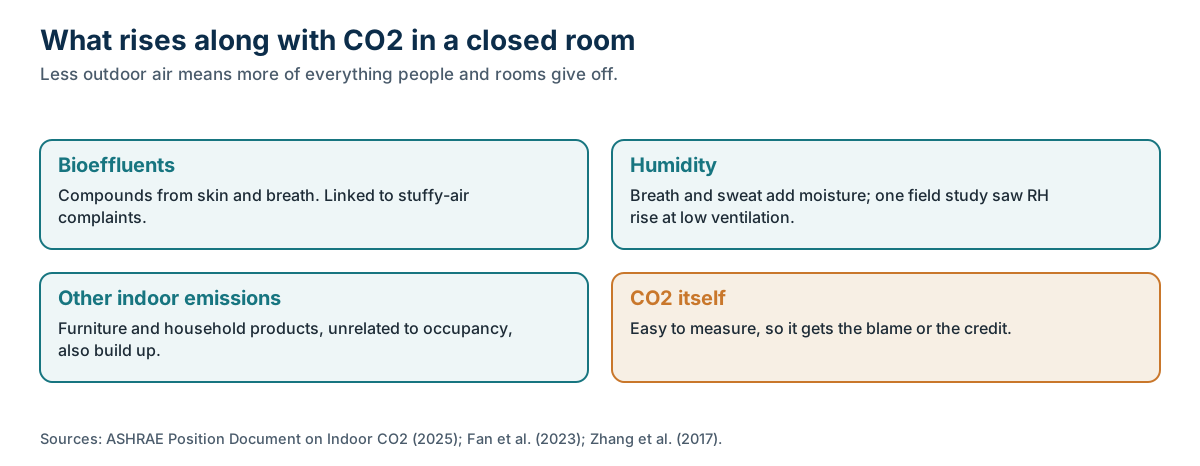
Anything generated indoors that isn't removed by other means. ASHRAE explains that if outdoor air ventilation is reduced in an occupied building, CO2 increases together with other contaminants generated indoors, and says this likely explains links between CO2 and symptom rates. In a bedroom, that includes:
- Bioeffluents from skin and breath.
- Moisture from breathing. In Fan et al. (2023), relative humidity rose along with CO2 at low ventilation.
- Emissions from furnishings and products, which don't depend on how many people are in the room but still build up when air exchange is low.
The reverse also holds. ASHRAE notes that many important contaminants "are removed from indoor air by processes (e.g., deposition of particles) and engineering controls" that don't affect CO2. So a low CO2 reading doesn't prove the air is clean, and a high one doesn't say which other pollutants are present. As ASHRAE puts it, indoor CO2 concentrations "are not overall indicators of IAQ."
What happens when researchers separate them?
The cleanest test is to add pure CO2 to well-ventilated air and compare it with the same CO2 level produced by people. Zhang et al. (2017) did exactly that in a chamber at the Technical University of Denmark. With high outdoor air, the baseline was 500 ppm. They then added chemically pure CO2 to reach 1,000 or 3,000 ppm, or restricted ventilation so that the occupants' own CO2 reached those levels.
The same 25 subjects were exposed for 255 minutes to each condition. The authors report: "No statistically significant effects on perceived air quality, acute health symptoms or cognitive performance were seen during exposures when CO2 was added." But "exposures to bioeffluents with CO2 at 3,000 ppm reduced perceived air quality, increased the intensity of reported headache, fatigue, sleepiness and difficulty in thinking clearly," and slowed some tasks. Their conclusion: moderate concentrations of bioeffluents, "but not pure CO2," cause the effects.
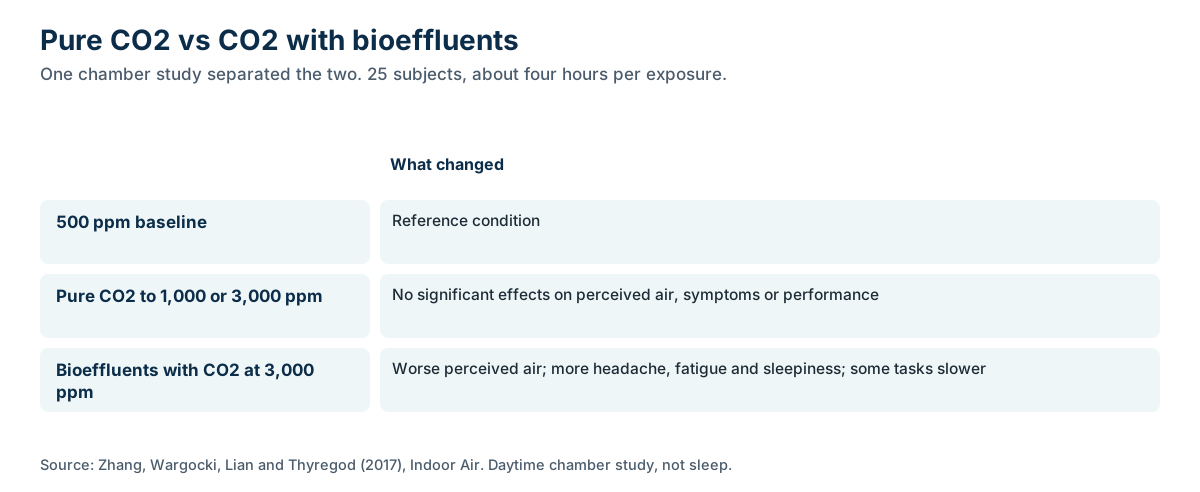
That was a daytime study, not sleep. But it's the strongest evidence that in a stuffy room, what comes with the CO2 matters more than the CO2.
Is there evidence that CO2 itself matters?
Some. In Satish et al. (2012), 22 participants in an office-like chamber, exposed to added ultrapure CO2 at 1,000 ppm compared with 600 ppm, showed "moderate and statistically significant decrements" in six of nine scales of a decision-making test, with larger drops at 2,500 ppm. Allen et al. (2016) found higher cognitive scores in better-ventilated, lower-VOC office conditions and reported that "VOCs and CO2 were independently associated with cognitive scores."
For sleep specifically, Xu et al. (2021) raised CO2 alone in bedroom-like chambers to 800, 1,900 and 3,000 ppm and found sleep quality decreased significantly as CO2 rose, by both questionnaire and physiological measures. What research says about bedroom CO2 and sleep covers that study and the null results alongside it.
How do reviewers weigh it?
Cautiously. A 2020 review of 37 experimental studies by Du et al. found that in the stronger studies, pure CO2 at common indoor levels "was only found to affect high-level decision-making," while lower ventilation and the build-up of indoor pollutants "could reduce the speed of various functions but leave accuracy unaffected." ASHRAE's position document concludes that evidence for direct effects at commonly observed indoor concentrations "is inconsistent."
Health Canada reached its 1,000 ppm guideline while acknowledging the same uncertainty: "it cannot be determined from the available evidence whether CO2 or some other factor causes the observed effects." Its consumer page puts it plainly: such effects "may not be from CO2 exposure, but from poor indoor air quality in general."
What about the doors-versus-windows result?
It fits the marker view. In Fan et al. (2022), opening bedroom doors lowered the 95th-percentile CO2 about as much as opening windows did, yet only open windows were linked to longer, better-rated sleep. A door connects the bedroom to indoor air that may carry its own pollutants; a window brings in outdoor air. If CO2 alone explained sleep, the two should have matched. Temperature, noise and other differences could also play a part, which the study couldn't fully separate.
What about the pushback online?
A common reply to alarming bedroom readings is that CO2 isn't a poison at these levels, and that submarines and spacecraft run higher. The first part is right: ASHRAE says CO2 "is considered nontoxic at concentrations up to 5000 ppmv." ASHRAE also notes guidance for the International Space Station and submarines of 4,000 to 5,000 ppm, aimed at reducing headaches, which is guidance to limit symptoms, not evidence that higher is fine. Why 5,000 ppm isn't a bedroom target covers the limits. The skeptics and the worriers are often arguing past each other: one side is right that CO2 isn't toxic, the other that a stuffy bedroom isn't ideal.
Why the distinction rarely changes what you do
Whichever view is right, the response is the same: more outdoor air dilutes CO2, bioeffluents, moisture and indoor emissions together. Devices that strip out CO2 alone don't help much; ASHRAE warns that air cleaning aimed only at CO2 "may not improve overall IAQ." Do air purifiers or houseplants lower bedroom CO2? explains why home air cleaners don't touch CO2 anyway. Open door vs window vs fan covers the practical options.
Sleep Sanitation's view
This section is our view. We treat bedroom CO2 as a ventilation gauge: an honest, easy-to-read sign of how much outdoor air reaches the room. That's how our optional 72-hour bedroom CO2 test is framed: three nights of logging and a plain-language ventilation report with airflow tips, priced by quote and not a medical test. It doesn't measure other pollutants. The hub links the rest of the topic; see how we're different for our wider approach.
What we don't know
- Whether pure CO2 at typical bedroom levels affects sleep for most people. One chamber study says yes; a study in children found no effect.
- Which of the things that build up with CO2, if any, matter most for sleep. No bedroom study has separated them one by one.
- How results from short daytime chamber exposures carry over to a full night in a real bedroom.
Changelog
- 7 October 2026: First published. Sources accessed on this date.
Sources
- Effects of exposure to carbon dioxide and bioeffluents on perceived air quality, self-assessed acute health symptoms, and cognitive performance (Zhang et al., 2017) · Indoor Air (DOI)
- ASHRAE Position Document on Indoor Carbon Dioxide (approved 2025) · ASHRAE
- Residential Indoor Air Quality Guidelines: Carbon Dioxide (2021) · Health Canada
- Carbon dioxide in your home · Health Canada
- Experimental study on sleep quality affected by carbon dioxide concentration (Xu et al., Indoor Air, 2021) · Wiley (DOI)
- Is CO2 an indoor pollutant? Direct effects of low-to-moderate CO2 concentrations on human decision-making performance (Satish et al., 2012) · PubMed Central
- Associations of cognitive function scores with carbon dioxide, ventilation, and volatile organic compound exposures in office workers (Allen et al., 2016) · PubMed Central
- Indoor CO2 concentrations and cognitive function: A critical review (Du et al., Indoor Air, 2020) · Wiley (DOI)
- A field intervention study of the effects of window and door opening on bedroom IAQ, sleep quality, and next-day cognitive performance (Fan et al., 2022) · Building and Environment (DOI)
- A single-blind field intervention study of whether increased bedroom ventilation improves sleep quality (Fan et al., 2023) · Science of the Total Environment (DOI)
Last reviewed October 7, 2026. Manufacturer specifications and care instructions change; check the current version for your exact model. This page is general information, not medical advice. How we source and check pages: editorial standards.