
Short answer
Saatva's blog post on cleaning a mattress gives a 'Bonus tip: If you have a garment steam cleaner, go over your mattress with that before vacuuming.' It doesn't mention dry-vapor steam, set a heat limit or name a model. It warns that bleach can stain or damage memory foam. Following the label is the safe default; Sleep Sanitation's adjustable-output method is our own, not a Saatva exemption, so check your warranty terms.
Key terms used on this page
- Care instructions (manufacturer care guidance):
- What a manufacturer publishes about cleaning its product: a sewn-in label, a care web page, a help-center article or a brand blog post. They carry different weight. A sewn-in label or a product-care page speaks for a specific product; a blog post often gives general advice about many mattress types. On this hub we name the document type for every quote.
- Dry-vapor steam:
- Steam made in a sealed, pressurized boiler and released through a hose and nozzle as hot vapor with a low liquid-water content. In the vendor specifications we reviewed, professional units are rated from 80 psi (Ladybug 2350) to 150 psi (Daimer), with stated boiler temperatures from about 345°F (Optima) to 360°F (Daimer); these are maker claims. Daimer describes its steam as about 5% water or less and Vapor Clean claims 'just 5-6% moisture'; that is a vendor claim, not an independent standard.
- Innerspring mattress:
- A mattress whose support core is a unit of steel coils, with comparatively thin comfort layers and a quilted top. The coil core is open to airflow, which is one reason general cleaning guides treat innerspring beds as more tolerant of moisture than solid-foam beds.
- Hybrid mattress:
- A mattress that combines a coil support core with substantial comfort layers of foam, latex or another material on top. What applies to a hybrid depends on what sits under the cover: the coils below or the foam or latex above.
- Memory foam (viscoelastic foam):
- An open-cell, slow-recovery polyurethane foam that softens with body heat and conforms to pressure. Because its cells are open, liquid can travel into it, and because it is dense and insulating, it is slow to dry.
- Pass speed:
- How fast the steam tool moves across the fabric. A faster pass gives the fabric less time under the tool, so less heat and less condensed water reach any one spot. Purple's general guide makes the same point for home steamers: move 'without leaving it in one spot for too long.'
Saatva is the one brand we checked whose own website suggests steam. The suggestion is short, it comes from a blog post rather than a care label, and it refers to a household garment steamer. This page quotes it exactly, sets out what it does and doesn't say, and then gives Sleep Sanitation's interpretation separately.
Not affiliated with or endorsed by any manufacturer listed. Brand names are used only to identify products and their published care instructions.
1. What the manufacturer actually says
The source is Saatva's blog post How to Clean Your Mattress in 5 Simple Steps (no publication date shown; accessed 2 October 2026). The post is written by Sunny Sea Gold, described on the page as a content strategist and journalist. It covers mattresses in general rather than a specific Saatva model.
The steam tip, in full:
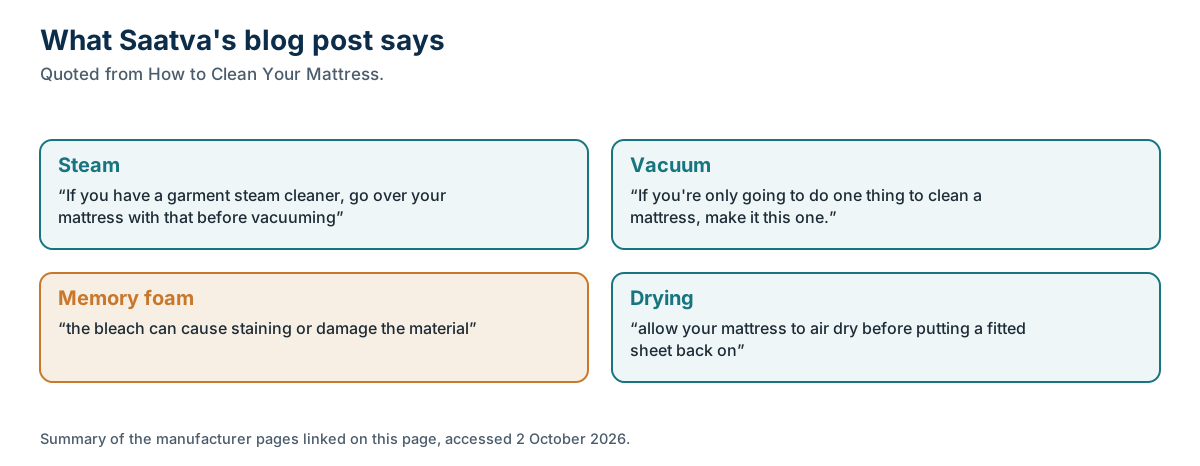
"Bonus tip: If you have a garment steam cleaner, go over your mattress with that before vacuuming to kill and loosen even more dust mites."
Other statements relevant to cleaning:
- "If you're only going to do one thing to clean a mattress, make it this one," about vacuuming.
- "Use the vacuum's upholstery and crevice attachments to get into the nooks and crannies of a mattress."
- "You can use a mixture of either liquid dish soap or white vinegar with cold water."
- "If you have a more stubborn stain, like a blood stain, you can use hydrogen peroxide mixed with warm water on the surface of the mattress."
- "Keep in mind that you'll want to use a gentler solution on memory foam because the bleach can cause staining or damage the material."
- "Dab the excess liquid with a damp cloth and allow your mattress to air dry before putting a fitted sheet back on."
2. Does it mention steam?
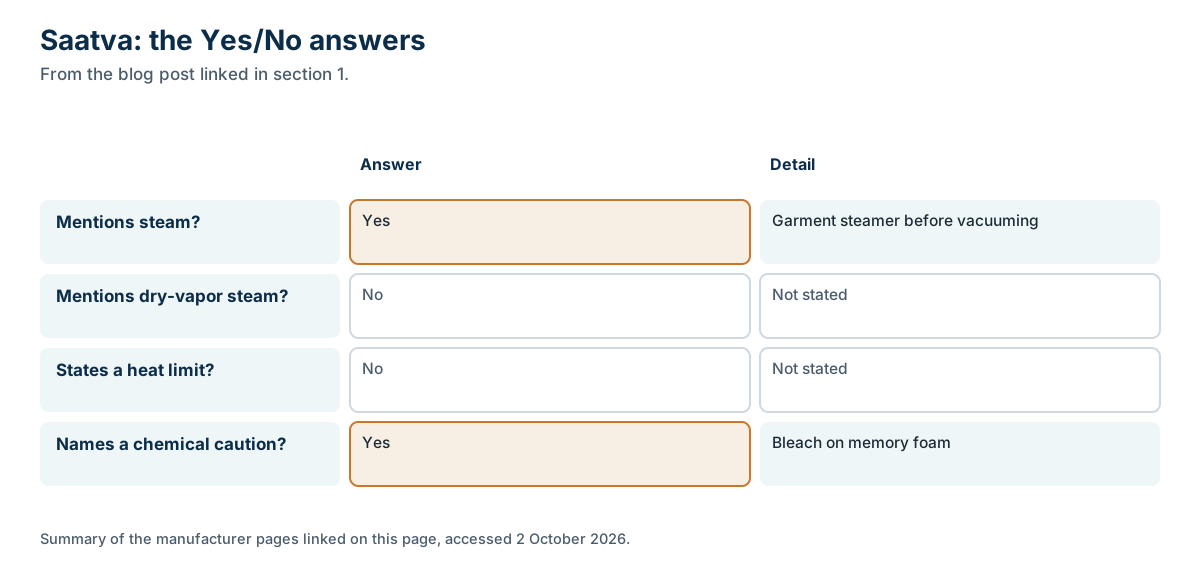
Yes. The bonus tip recommends a "garment steam cleaner" before vacuuming. It is the only positive mention of steam in any of the seven care pages in our compatibility guide.
Three limits apply to the tip. It names a household appliance, not a professional machine. It gives no temperature, duration or distance. And it sits in a general blog post. We did not find steam in Saatva's help-center care guidance, so we treat the blog as the only Saatva statement on steam we've seen.
3. Does it mention dry-vapor steam?
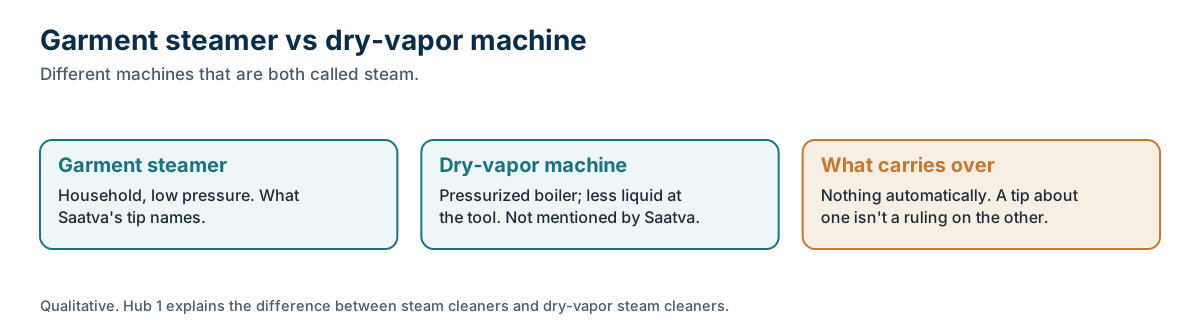
No. The post doesn't use the term dry-vapor steam and doesn't describe pressurized or low-moisture steam. A garment steamer is a different kind of machine; Hub 1's steam cleaner vs dry-vapor steam cleaner explains how.
4. The restrictions it states
| Variable | What the Saatva post says |
|---|---|
| Water | Use liquid "with cold water"; "Dab the excess liquid"; air dry before re-making the bed |
| Soaking | Not stated in How to Clean Your Mattress |
| Heat | Not stated as a cleaning limit; the post suggests warm water with peroxide for blood |
| Steam | Garment steamer suggested as a "Bonus tip" |
| Chemicals | Bleach "can cause staining or damage" memory foam |
| Covers | Not stated; the post's "covers" advice refers to protectors and bedding |
The same page promotes the Saatva Classic, described as having "coil-on-coil construction" and "a layer of memory foam," and the Zenhaven, a latex mattress. One general post can't speak for every material in that range, which may be why it says so little; the bleach warning is its only material-specific caution, and it applies to the Classic's foam layer.
5. How dry vapor differs from wet cleaning
The Saatva post's cleaning steps are mostly wet: soap or vinegar solutions, peroxide and water, dabbing and air drying. A garment steamer adds condensed water at the surface too. Hub 1 explains why the moisture load is the variable that decides drying time and odor risk, in why moisture matters.
A dry-vapor system is built to deliver heat with less liquid. For the Magnum XP, one of the three Vapor Clean machines we run, Vapor Clean claims "just 5-6% moisture" on its product page. That is a maker's claim. For how that compares with extraction, see dry-vapor steam vs carpet extraction.
6. Sleep Sanitation's professional interpretation
This section is our view, not Saatva's.
Saatva's tip tells us the brand doesn't treat brief surface steam as off-limits in general. It doesn't tell us anything about professional equipment, and we don't read it as approval of our method. Following whatever your model's label says is the safe default.
Our position is that we can sanitize any mattress or topper, including Saatva models. Because the post doesn't separate materials, our technician looks at what the model is made of. On a coil-based model with a quilted top, the fabric and fiber layers are what the steam meets. On foam or latex comfort layers, we choose the machine from our Vapor Clean equipment, set the steam output lower and keep the pass speed quick. Vapor Clean describes the Magnum XP's "Fully Adjustable Steam Regulator" and "Vacuum Capability" (maker's claims). We don't use bleach on any mattress.
That is our method and reasoning, not a Saatva exemption. Check your warranty terms and contact Saatva if you're unsure. This is not legal advice.
What the rest of Saatva's routine looks like
The post's five steps are mostly dry. It starts with vacuuming: "A good once-over with a vacuum cleaner will help get rid of a significant amount of dust, crumbs, dust mites, and other nasties." It recommends baking soda: "Generously sprinkle your whole mattress with baking soda—up to a full 1-pound box of it if this is the first time you've cleaned your bed," then "Leave it on for a full day if possible, then vacuum it up." It suggests sunlight: exposing the mattress to "antibacterial UV light, either through a big sunny window or" outdoors "on a dry, sunny day." And it recommends protectors: "Mattress and pillow protectors will lessen your need for mattress cleaning in the future."
It also has an unusual moisture tip. Dust mites "need moisture from your sweat to thrive," it says, "So instead of making your bed every morning, try turning the covers back. This can help decrease the moisture in your bed."
Common misreadings
"Saatva says steam cleaning is fine." The post says a garment steamer can be used before vacuuming. It doesn't say any kind of steam is fine, and it doesn't mention professional equipment.
"The tip covers every Saatva model." The post is general. A model with memory foam or latex near the surface may carry a label with different advice.
"A blog tip is the same as a care label." Document type matters. Our compatibility guide names the document type for every quote for this reason.
Why a blog tip still matters
It would be easy to dismiss the garment-steamer tip because it comes from a blog. We don't. It is published on Saatva's own site, under its brand, and it shows that the brand doesn't treat brief surface steaming as off-limits in general. What it can't do is stand in for your model's label or for any statement about professional equipment.
Where this fits
See the full comparison in the compatibility guide and the hub overview. For material detail, read the innerspring, hybrid and pillow-top pages. When you're ready, you can schedule a visit. Our pricing page lists what a visit costs.
Related guidance and background
How other manufacturers word the same issue, for comparison:
- Tempur-Pedic (US). "TEMPUR® material should never become wet" (Tempur-Pedic).
- Purple. "you should not steam clean a memory foam, latex, or adjustable mattress since the heat and water could damage its materials" (Purple).
Public guidance and reference sources behind this page:
- Clean, sanitize, disinfect. The CDC defines the three words differently: cleaning removes dirt and germs, sanitizing lowers germs to a safer level, and disinfecting kills germs, usually with a registered chemical used as labeled. We use "sanitize" in that sense and make no disinfection claim.
- Drying. The EPA's mold and moisture guide advises drying wet materials within 24 to 48 hours, and says that in most cases mold won't grow if you do. That is the public-health reason behind every manufacturer's drying instruction.
- Dust mites. The 2013 dust mite practice parameter from the AAAAI and ACAAI says no clinical trials have shown a benefit from physical measures such as heating, so we don't claim health outcomes for steam of any kind.
What we don't know
- Model-specific labels. The post is general. Your Saatva model's label may say more.
- How Saatva would view professional steam. The tip names a garment steamer only.
- Update date. The post shows no publication or update date.
- Warranty terms. The page doesn't discuss warranties, and we haven't quoted Saatva's warranty on the pages we checked.
Changelog
- 2 October 2026: First published. Saatva's blog post accessed on this date.
Sources
- How to Clean Your Mattress in 5 Simple Steps (blog, accessed 2026-10-02) · Saatva
- Magnum XP-Vac product page (maker's claims, accessed 2026-10-02) · Vapor Clean
- Product care (US, accessed 2026-10-02) · Tempur-Pedic
- How To Clean a Mattress in 9 Steps (last updated 16 Oct 2025, accessed 2026-10-02) · Purple
- Cleaning and disinfecting your school (definitions) · CDC
- A brief guide to mold, moisture and your home · US EPA
- Dust mite practice parameter (Portnoy et al., 2013) · AAAAI-ACAAI
Last reviewed October 2, 2026. Manufacturer specifications and care instructions change; check the current version for your exact model. This page is general information, not medical advice. How we source and check pages: editorial standards.