
Short answer
Heat kills dust mites, and dry vapor delivers heat with little water. But the published dry steam studies measured allergen in carpet and upholstery, not live mites in mattresses. One researcher group describes dry steam as believed to kill mites with vapor above 100°C. We treat that as plausible, not proven for your bed, and make no health claims.
Key terms used on this page
- Dry steam cleaning:
- The term carpet researchers use for low-moisture, high-temperature vapor cleaning. In the Yu study, dry steam was added to repeated HEPA vacuuming on one half of each carpet and compared with vacuuming alone.
- Live-mite kill:
- A study outcome that counts whether mites are alive after a treatment. It is different from allergen removal: dead mites and their droppings can stay in the fabric, still carrying allergen, until something removes them.
- Allergen load:
- The total amount of allergen collected from a surface, as opposed to its concentration per gram of dust. Studies report both. A surface can lose dust and allergen load while the concentration per gram stays about the same. The Vojta study (19 homes; carpet comparison 11 homes, 5 steamed) reported both.
- HEPA filtration:
- High-efficiency particulate air filtration. The practice parameter recommends vacuums with HEPA filtration, or a central vacuum that vents outside, so mite fecal particles stay in the machine instead of going back into the room.
- Mite eggs and heat:
- Dust mite eggs are harder to kill than adult mites. A study summarized in the practice parameter found about 80 percent of eggs survived 40°C, dry heat at 50°C killed them after 3 to 5 hours, and eggs at 60°C died instantaneously.
- Settled dust:
- Dust collected from a surface such as a mattress, carpet or sofa, usually with a vacuum and a sampling filter. The practice parameter prefers settled-dust samples over air samples for measuring mite allergen.
Dry-vapor steam is the method Sleep Sanitation uses, so this is the question we're most tempted to answer with a confident yes. The honest answer is narrower. Heat kills mites; dry vapor delivers heat with little water; and the published studies of dry steam measured allergen in carpets and furniture, not live mites in mattresses.
This article is general information about cleaning, not medical advice. For allergy or asthma questions, talk to your doctor or an allergist.
What "dry vapor" means
Dry vapor is low-moisture steam produced by heating water in a pressurized boiler to well above boiling, so less liquid water comes out with the vapor. Hub 1 covers what dry vapor steam cleaning is and whether it's actually dry. In research papers, the same idea usually goes by the name dry steam cleaning.
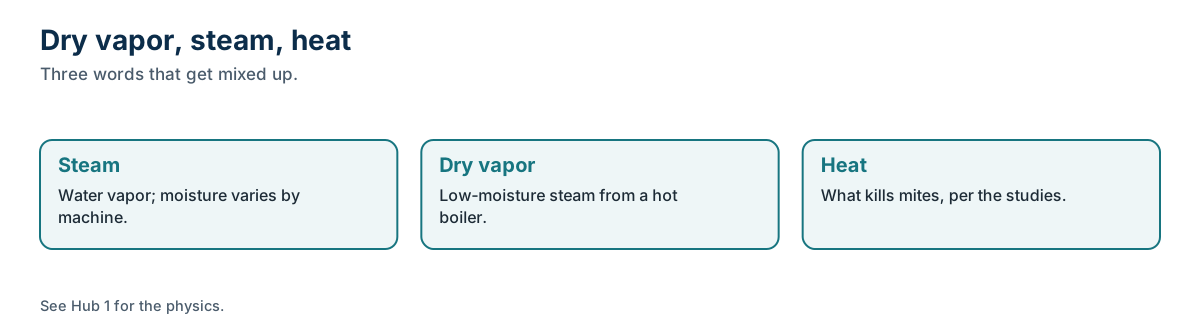
The distinction matters for dust mites in two ways. Heat is what kills them. And moisture is something mites need, so a method that kills with heat but leaves the bed wet works against itself.
What the researchers believe about dry steam
The Yu team, writing in 2009, summarized the idea behind dry steam this way: "Dry steam cleaning is believed to kill dust mites with high temperature vapor (above 100 °C), and simultaneously to soften and loosen sticky dust which is removed by a towel attached to the cleaning head or by subsequent regular vacuuming."
Note the word "believed." That's a description of the method's rationale, not a measured result. The researchers then tested something else: allergen in carpets.
The carpet and upholstery studies
Vojta and colleagues, 2001. In low-income urban homes with high mite allergen, carpets got a single treatment of either dry steam cleaning plus vacuuming or intensive vacuuming alone, and upholstered furniture got one or the other. Samples were taken at 3 days and at 2, 4 and 8 weeks. Both approaches cut carpet allergen. With vacuuming alone, levels "approached pretreatment values by 4 weeks"; with steam plus vacuuming, the decrease "persisted for up to 8 weeks." Both also cut allergen in upholstered furniture. The full text reports 19 homes; the carpet comparison used 11 homes, 5 of them steamed. Beds weren't steamed; they were encased, and the bedding was laundered.
Yu and colleagues, 2009. In 50 urban homes, mostly low-income, one half of each wall-to-wall carpet got repeated HEPA vacuuming plus dry steam and the other half repeated HEPA vacuuming alone, with samples taken immediately before and after. Allergen was measurable in only 15 of the 50 carpets. In those 15, mite allergen loading fell 85.5 percent with steam and 80.8 percent without, and the difference was not significant: it "was statistically significant only for dust and PAHs." The authors concluded that "dry steam cleaning added modestly to cleaning effectiveness."
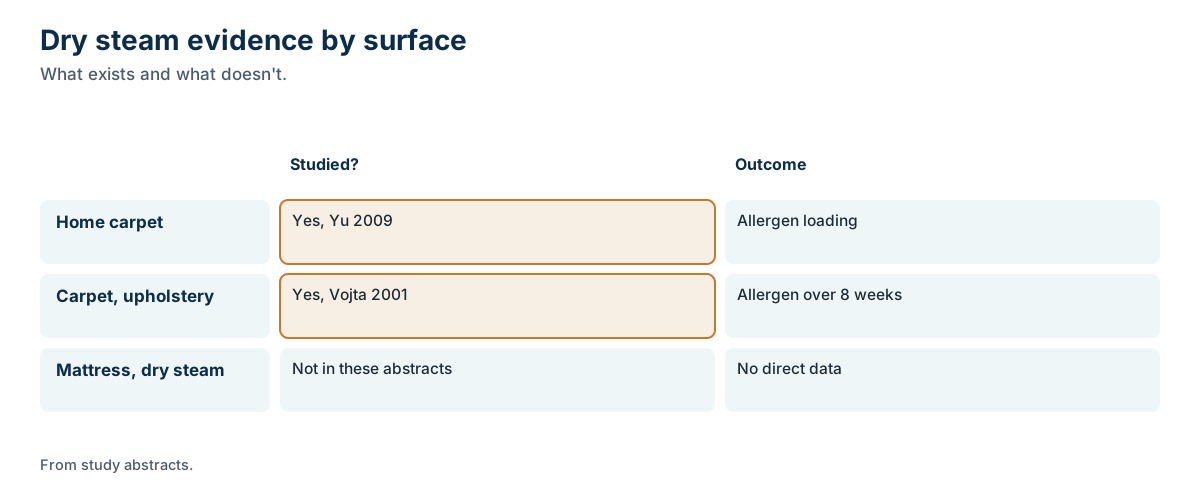
What these measured: allergen in carpet and upholstery dust, at time points from immediately after cleaning to eight weeks. What they didn't: live mites, and mattresses.
The closest mattress evidence
For live mites in a mattress, the nearest published test is the Glass and Needham study of a 96°C hard surface steam cleaner, which reported 100 percent mortality of D. farinae in carpet and mattress samples; the abstract doesn't report the sample size. The abstract doesn't describe the machine's moisture output, so we can't say it was dry vapor in the sense used here. It does show heat from a steam head killing mites in mattress fabric.
The same study found that passes mattered: in carpet, two passes cut Der f 1 by 61.4 percent and five passes by 100 percent. That fits what you'd expect from heat transfer. A fast, single pass delivers less heat to the fabric than slower or repeated ones.
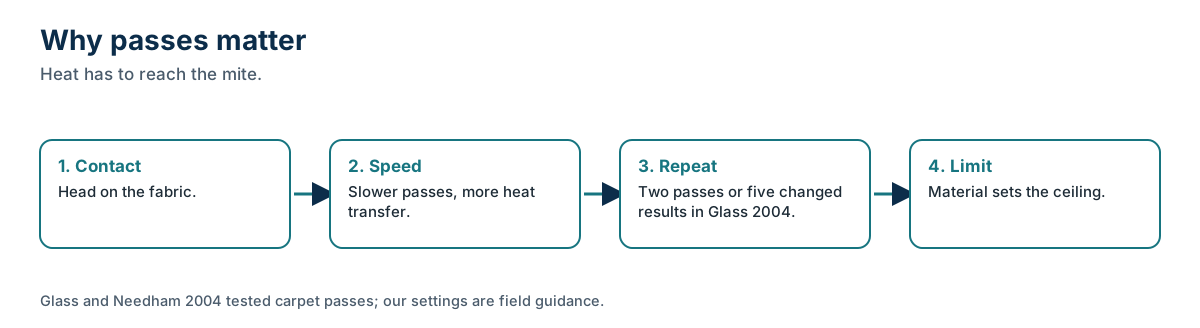
Heat at the head vs heat at the mite
The allergist practice parameter summarizes egg survival data: about 80 percent of D. pteronyssinus eggs survived 40°C, while eggs at 60°C "died instantaneously." A boiler running far above those temperatures doesn't guarantee the fabric reaches them, because vapor cools as it leaves the head and meets cooler material. That gap between boiler and surface temperature is why we set pass speed by material rather than running every bed the same way.
Moisture is part of the mite question
NIEHS recommends keeping indoor humidity "at, or below, 50 percent" to reduce dust mites. A treatment that leaves a mattress damp adds exactly what mites need. Low moisture is the point of dry vapor; Hub 1's moisture load entry and its article on how much moisture dry vapor uses explain how little a properly set machine adds.
What manufacturers say, and what we do
Some makers prohibit steam no matter how dry. Tempur's UK care page puts it in one passage: "There is a high risk that soaking with water or other cleaning fluids will cause irreversible damage, destroying the benefits of comfort and support which the TEMPUR ® Material provides. It will also invalidate your guarantee. Do not steam-clean or dry-clean the TEMPUR ® Material." The word "dry" in dry vapor doesn't appear anywhere in that warning as an exception, and we don't read one into it.
On the mattresses we clean, of any brand, our approach is quick, repeated low-moisture dry-vapor passes. That is Sleep Sanitation's own method and reasoning, never a claim of any maker's permission. Your care label and warranty terms govern your decision; check your warranty, or ask the manufacturer, before booking. Hub 2's compatibility guide quotes each brand.
Why we don't quote a kill rate
We don't publish a percentage for how many mites our steam kills, for a plain reason: a figure for our own service would need our own controlled testing on mattresses, with a method someone else could check, and we haven't done that work. The numbers in this article belong to the studies that produced them, on the carpets, sofas and samples they tested. Borrowing them for our visits would be the kind of overreach this hub was written to avoid. If a cleaner quotes you a kill rate, ask what was tested, on what surface, and who ran the test.
How a visit works
In practice, the dry-vapor part of a visit looks like this. We check the materials first, and that check decides the steam output and pass speed for the bed in front of us. The head then works across the sleep surface and spends extra time on the seams, tufts, ridges and edges where dust and shed skin flakes collect. Our machines are Italian-made Vapor Clean units: the Magnum XP, which has a built-in vac, the ProV 350 and the Pro6 Duo. Organic cleaning methods are our default, and this dry-vapor work sits inside the standard price; severe or biohazard contamination is quoted as a custom surcharge before we start.
We call the result cleaning, not sanitizing in the CDC's sense; Hub 2 sets out the CDC's sanitize definition, and we make no disinfection or health claim.
Where to read next
The dust mite guide lays out every study side by side, and the Dust Mites and Allergens hub lists every article. Does steam kill dust mites in mattresses? covers the higher-moisture steam studies, and vacuum before or after steam looks at how the carpet researchers sequenced the two.
What we don't know
- Whether dry steam plus vacuuming lowers allergen in mattresses as it did in carpet. We found no study that tested it.
- The moisture output of the steam cleaner in the Glass and Needham study.
Changelog
- 3 October 2026: First published. Sources accessed on this date.
Sources
- Effects of physical interventions on house dust mite allergen levels in carpet, bed, and upholstery dust in low-income, urban homes (Vojta et al., Environ Health Perspect, 2001) · PubMed Central
- Evaluation of HEPA vacuum cleaning and dry steam cleaning in reducing levels of PAHs and house dust mite allergens in carpets (Yu et al., J Environ Monit, 2009) · PubMed Central
- Cleaning efficacy of HEPA-filtered vacuuming and dry steam cleaning on carpet (Yiin et al., J Occup Environ Hyg, 2008) · PubMed
- Eliminating Dermatophagoides farinae and their allergens through high temperature treatment of textiles (Glass and Needham, J Med Entomol, 2004) · PubMed
- The use of domestic steam cleaning for the control of house dust mites (Colloff et al., Clin Exp Allergy, 1995) · PubMed
- Environmental assessment and exposure control of dust mites: a practice parameter (Portnoy et al., Ann Allergy Asthma Immunol, 2013) · AAAAI and ACAAI
- Dust Mites and Cockroaches (accessed 2026-10-03) · National Institute of Environmental Health Sciences (NIH)
- Caring for your TEMPUR (UK, updated 11 July 2023, accessed 2026-10-02) · Tempur UK
- Magnum XP-Vac product page (maker's claims, accessed 2026-10-02) · Vapor Clean
- ProV 350 product page ('Italian Made'; maker's claims, accessed 2026-10-02) · Vapor Clean
- Pro6 Duo product page ('Made in Italy'; maker's claims, accessed 2026-10-02) · Vapor Clean
- Cleaning and disinfecting your school (definitions) · CDC
Last reviewed October 3, 2026. Manufacturer specifications and care instructions change; check the current version for your exact model. This page is general information, not medical advice. How we source and check pages: editorial standards.