
Short answer
Vacuuming removes allergen-carrying dust from a mattress, but not all live mites. Allergist guidance says it plainly. In one study, 20 people vacuumed their mattresses daily for eight weeks and total mite allergen fell from 4.07 to 0.42 micrograms. In another, two weeks of daily vacuuming cut dust weight but didn't significantly change allergen concentration.
Key terms used on this page
- Mite fecal particle:
- The droppings of dust mites, which carry much of their allergen. The practice parameter notes that vacuuming can remove mite allergens in the form of fecal particles even though it does not remove all live mites.
- HEPA filtration:
- High-efficiency particulate air filtration. The practice parameter recommends vacuums with HEPA filtration, or a central vacuum that vents outside, so mite fecal particles stay in the machine instead of going back into the room.
- Settled dust:
- Dust collected from a surface such as a mattress, carpet or sofa, usually with a vacuum and a sampling filter. The practice parameter prefers settled-dust samples over air samples for measuring mite allergen.
- Allergen load:
- The total amount of allergen collected from a surface, as opposed to its concentration per gram of dust. Studies report both. A surface can lose dust and allergen load while the concentration per gram stays about the same. The Vojta study (19 homes; carpet comparison 11 homes, 5 steamed) reported both.
- Der f 1:
- A major allergen from Dermatophagoides farinae, measured in dust samples alongside Der p 1. Many studies report the two added together as total mite allergen. A lower Der f 1 reading means less allergen in the sample, not fewer live mites.
- Allergen removal:
- A study outcome that measures how much mite allergen comes out of a surface, usually in dust samples. The practice parameter summarizes a rug study in which vacuuming, washing and shampooing removed allergen without killing the mites.
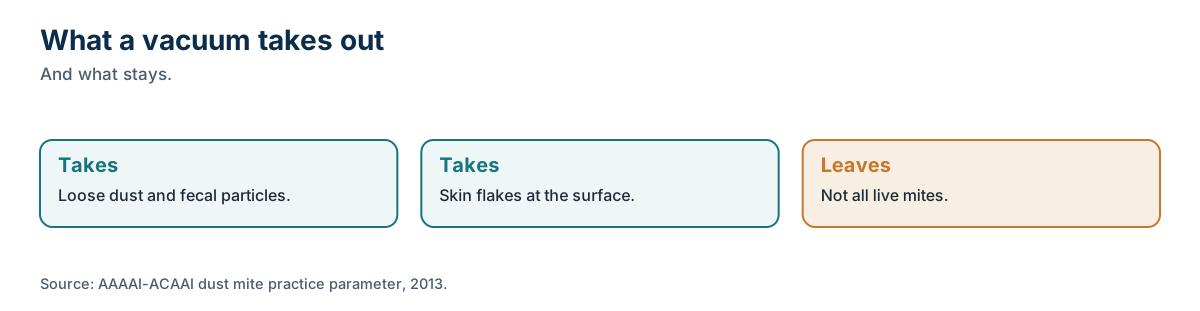
Vacuuming is the cheapest thing anyone can do to a mattress, and it's one of the few dust mite measures with a direct mattress study behind it. The catch is in what it removes. A vacuum takes out dust, skin flakes and mite droppings. It doesn't take out most of the living mites.
This article is general information about cleaning, not medical advice. For allergy or asthma questions, talk to your doctor or an allergist.
What allergists say vacuuming does
The 2013 practice parameter from the AAAAI and ACAAI gives vacuuming a strong recommendation, and it's precise about the limit: "Regular, thorough vacuuming can help remove dust mite allergens, although it is not capable of removing live mites."
It explains why that's still useful: "Although vacuuming does not remove all live mites, mite allergens in the form of fecal particles can be removed." It also points vacuuming at the bed specifically: "Emphasis should be placed on bedrooms, mattresses, and other locations where dust mites are likely to live."
The eight-week mattress study
Wu and colleagues ran the most direct test we found, published in 2012. Twenty volunteers vacuumed their own mattresses daily for eight weeks. Dust samples were taken every two weeks and analyzed for Der p 1 and Der f 1, plus bacterial endotoxin and fungal beta-glucan.
Total mite allergen fell from a geometric mean of 4.07 micrograms at the start to 0.42 micrograms at week eight, a reduction the authors put at 85.1 percent. Endotoxin and beta-glucan fell by similar proportions. The authors attribute most of it to dust: the drop "was mainly due to a 77.7% (70.8-84.7) reduction in total dust."
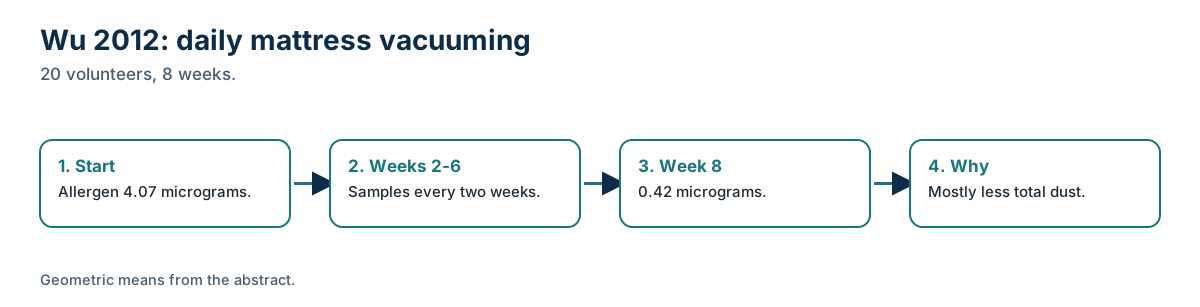
What it measured: total allergen, endotoxin and beta-glucan in mattress dust samples, in 20 mattresses, every two weeks for eight weeks. What it didn't: live mites, or a comparison group that didn't vacuum.
The two-week study that found something different
Jeon and colleagues published a randomized study of 40 children in 2019. Caregivers in one group cleaned the child's room and vacuumed the mattress daily for two weeks; the other group cleaned without vacuuming the mattress. Dust samples came from the mattresses before and after.
Dust weight fell significantly in the vacuuming group. But "The concentrations of HDM allergens were not changed significantly," with P values of 0.333 for Der p 1 and 0.841 for Der f 1. The study also tracked the children's symptoms; that's a medical outcome, and we leave it to doctors.
Why the two results differ
The studies aren't really in conflict. They measured different things over different periods.
Time. Eight weeks against two. Allergen in a mattress built up over months or years, and a fortnight of vacuuming may not shift its concentration much.
Load vs concentration. Wu reported total allergen collected. Jeon reported allergen concentration, which is allergen per gram of dust. If a vacuum removes dust and allergen together, the total falls while the concentration can stay about the same. Our glossary entry on allergen load explains the difference.
Design. Jeon had a comparison group; Wu didn't. A comparison group makes a result more trustworthy, though it doesn't change what was measured.
Put together, the fair reading is that steady vacuuming takes allergen-carrying dust out of a mattress over time, and that a short burst may not change allergen concentration.
The vacuum itself
The practice parameter recommends machines "that have HEPA filtration or using a central vacuum with adequate filtration or that vents to the outside." The point is to keep fecal particles in the machine instead of blowing them back into the room. NIEHS adds an alternative: "Use a double-layered microfilter bag or a HEPA filter in your vacuum cleaner." Hub 1 defines HEPA vacuuming and compares it with steam and extraction in HEPA vacuuming vs steam vs extraction.
Vacuuming raises exposure for a while
This part surprises people. The practice parameter says "Ideally, allergic individuals should not do the vacuuming because mite allergen exposure is increased during vacuuming and when the dust compartments are emptied." NIEHS suggests: "Wear a mask while vacuuming, and stay out of the vacuumed area for 20 minutes after vacuuming, to allow dust and allergens to settle."
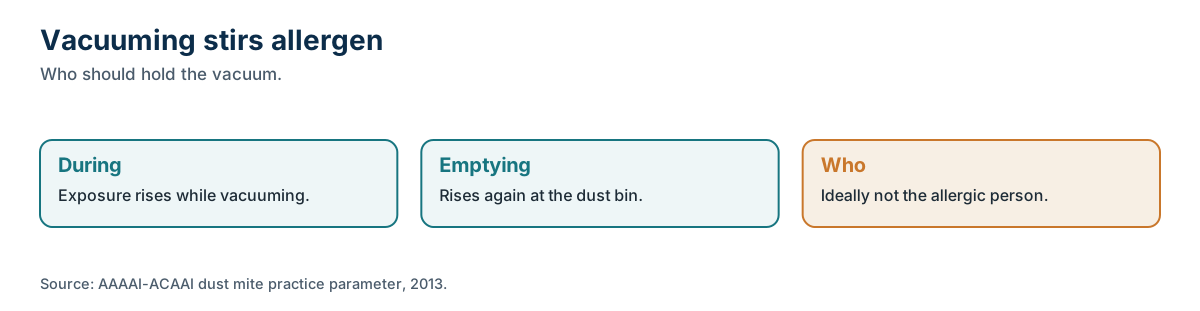
If someone in the house doesn't have the allergy, that person is the better choice to vacuum the bed. How often allergy sufferers should vacuum covers routines in more detail.
Vacuuming a mattress at home
Neither study prescribed a technique in detail, so this part is our practical advice rather than a research finding. Strip the bed completely, including any protector, so the vacuum reaches the cover itself. Use an upholstery tool rather than a floor head, and move it slowly; a fast pass lifts less. Work the whole top surface in overlapping rows, then the side panels, then the edges where the top meets the sides, since dust collects in those folds. If the mattress has tufts or buttons, go around each one. Empty the canister or change the bag outside if you can, because emptying is one of the moments the practice parameter flags for higher exposure. Then let the room settle before anyone allergic comes back in.
Allergen isn't spread evenly
The practice parameter notes that Der p 1 levels can vary widely within a single room, with a coefficient of variation in one study "as high as 80%." Its conclusion is that "the entire room needs to be cleaned as opposed to only areas near the bed or in high traffic areas." For a mattress, that means the whole sleep surface and the sides, not just the middle where you lie.
How vacuuming compares with steam
The carpet studies cited here found both. In the Vojta study (19 homes; the carpet comparison used 11 homes, 5 of them steamed), intensive vacuuming alone lowered carpet allergen, but levels "approached pretreatment values by 4 weeks," while dry steam plus vacuuming kept them lower for up to eight weeks. In the Yu study, whose allergen result came from 15 carpets with measurable allergen, adding dry steam to HEPA vacuuming made only a modest, non-significant difference. Those were carpets, not mattresses. Vacuum before or after steam? looks at how those studies sequenced the two.
What a visit includes
On the vacuum question specifically: our Magnum XP has a built-in vac, and we don't claim more about its filtration than that. The core of a visit is still heat, not suction. We start by inspecting the materials to choose steam output and pass speed, then dry-vapor steam the surface and work the seams, tufts, ridges and edges where dust and shed skin flakes collect. Pricing for this is the standard price; severe or biohazard contamination is quoted as a custom surcharge before we start. Your care label and warranty terms govern whether steam suits your bed; check your warranty before booking.
We call it cleaning. Hub 2 explains the CDC's cleaning and sanitizing terms, and we make no disinfection or health claim. We also don't publish an allergen reduction figure for our own visits, because we haven't run the controlled testing that figure would need.
Where to read next
The dust mite guide sets these vacuuming studies beside the steam and encasement research, and this hub lists every article. For the core distinction behind this one, read killing dust mites vs removing allergen. For what the dust contains besides mite allergen, see what lives in mattress dust.
What we don't know
- Whether the Wu result would hold with weekly rather than daily vacuuming. The study tested daily only.
- How much a professional visit adds to home vacuuming for allergen in a mattress. We found no study that measured it.
- Whether the Jeon result would change over a longer period.
Changelog
- 3 October 2026: First published. Sources accessed on this date.
Sources
- Environmental assessment and exposure control of dust mites: a practice parameter (Portnoy et al., Ann Allergy Asthma Immunol, 2013) · AAAAI and ACAAI
- Daily vacuuming of mattresses significantly reduces house dust mite allergens, bacterial endotoxin, and fungal beta-glucan (Wu et al., J Asthma, 2012) · PubMed
- Effects of vacuuming mattresses on allergic rhinitis symptoms in children (Jeon et al., Allergy Asthma Immunol Res, 2019) · PubMed
- Dust Mites and Cockroaches (accessed 2026-10-03) · National Institute of Environmental Health Sciences (NIH)
- Effects of physical interventions on house dust mite allergen levels in carpet, bed, and upholstery dust in low-income, urban homes (Vojta et al., Environ Health Perspect, 2001) · PubMed Central
- Evaluation of HEPA vacuum cleaning and dry steam cleaning in reducing levels of PAHs and house dust mite allergens in carpets (Yu et al., J Environ Monit, 2009) · PubMed Central
- Magnum XP-Vac product page (maker's claims, accessed 2026-10-02) · Vapor Clean
- Cleaning and disinfecting your school (definitions) · CDC
Last reviewed October 3, 2026. Manufacturer specifications and care instructions change; check the current version for your exact model. This page is general information, not medical advice. How we source and check pages: editorial standards.