
Short answer
The published studies vacuumed before dry steam, and most vacuumed after as well. One carpet study measuring lead dust found that a second vacuum after dry steam added little. Researchers describe dry steam as loosening sticky dust for removal afterward. No study tested the order on a mattress, so treat any sequence as reasoning, not proof.
Key terms used on this page
- Dry steam cleaning:
- The term carpet researchers use for low-moisture, high-temperature vapor cleaning. In the Yu study, dry steam was added to repeated HEPA vacuuming on one half of each carpet and compared with vacuuming alone.
- HEPA filtration:
- High-efficiency particulate air filtration. The practice parameter recommends vacuums with HEPA filtration, or a central vacuum that vents outside, so mite fecal particles stay in the machine instead of going back into the room.
- Settled dust:
- Dust collected from a surface such as a mattress, carpet or sofa, usually with a vacuum and a sampling filter. The practice parameter prefers settled-dust samples over air samples for measuring mite allergen.
- Allergen load:
- The total amount of allergen collected from a surface, as opposed to its concentration per gram of dust. Studies report both. A surface can lose dust and allergen load while the concentration per gram stays about the same. The Vojta study (19 homes; carpet comparison 11 homes, 5 steamed) reported both.
- Mite fecal particle:
- The droppings of dust mites, which carry much of their allergen. The practice parameter notes that vacuuming can remove mite allergens in the form of fecal particles even though it does not remove all live mites.
- Live-mite kill:
- A study outcome that counts whether mites are alive after a treatment. It is different from allergen removal: dead mites and their droppings can stay in the fabric, still carrying allergen, until something removes them.
It sounds like a small question, but it gets at how vacuuming and steam work together. A vacuum removes loose material. Steam applies heat and loosens what's stuck. Which should come first? The research on this is thin, all on carpet, and one of the most useful studies measured lead, not mite allergen. Here's what it does show.
This article is general information about cleaning, not medical advice. For allergy or asthma questions, talk to your doctor or an allergist.
What the researchers said dry steam does
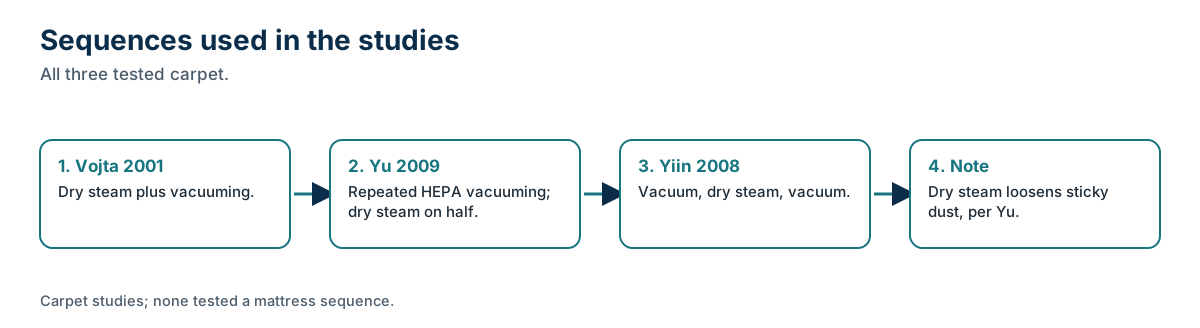
Before testing anything, the Yu team described the method's logic: "Dry steam cleaning is believed to kill dust mites with high temperature vapor (above 100 °C), and simultaneously to soften and loosen sticky dust which is removed by a towel attached to the cleaning head or by subsequent regular vacuuming." That sentence, from their 2009 carpet study, is the clearest statement of why anyone would vacuum after steam: heat loosens material that a vacuum can then collect.
It's a rationale, though, not a result. The word "believed" is doing honest work there.
Study one: vacuum, steam, vacuum on carpet
Yiin and colleagues tested sequence most directly in a 2008 study of 50 homes where children had been exposed to lead. A carpet in the living area of each home was split in two. One half got HEPA vacuuming twice (vacuum, vacuum). The other half got HEPA vacuuming, then dry steam, then HEPA vacuuming again (vacuum, dry steam, vacuum).
Lead loading fell by roughly 29 percent with two vacuum passes and 40 percent with dry steam in the middle. Then came the finding most relevant to this question: "A subset of sample data collected before repeat vacuuming (VAC-DSC) suggested that repeat vacuuming after dry steam cleaning is unnecessary."
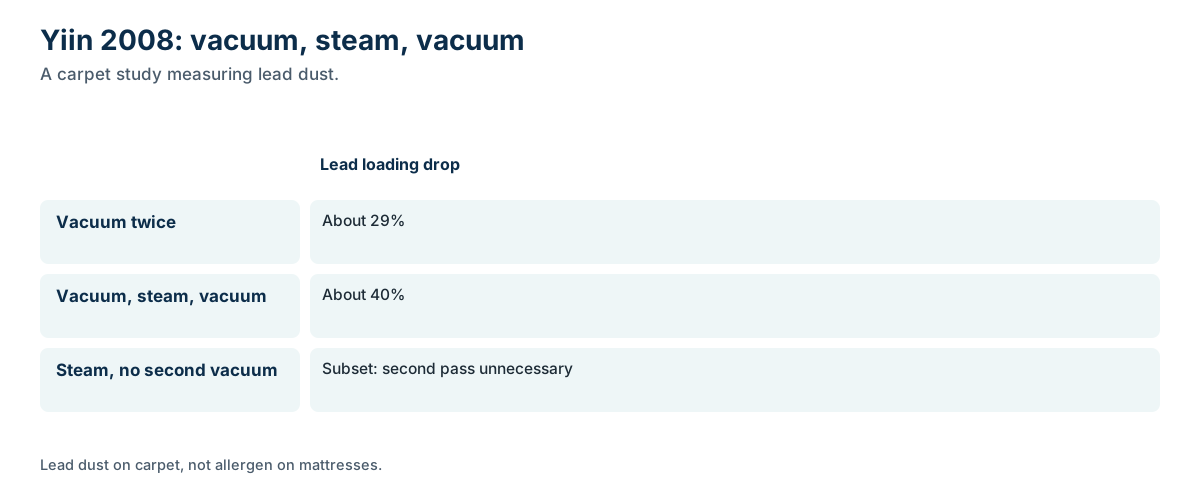
What it measured: lead in carpet dust, by wipe and vacuum samples, before and after cleaning. What it didn't: mite allergen, live mites or mattresses. It tells you something about how dry steam and vacuuming interact on carpet fibers. It doesn't tell you the right order for a bed.
Study two: repeated HEPA vacuuming with and without dry steam
The same group's 2009 study, Yu and colleagues, used 50 urban homes with wall-to-wall carpet and did measure mite allergen. Half of each carpet got repeated HEPA vacuuming alone; the other half got repeated HEPA vacuuming plus dry steam. Samples were taken immediately before and after.
Mite allergen was measurable in only 15 of the 50 carpets, so the allergen comparison rests on those 15. There, allergen loading fell 85.5 percent with dry steam added and 80.8 percent without, a difference that was not significant. The researchers found the difference "was statistically significant only for dust and PAHs," not for mite allergen, and concluded that "intensive HEPA vacuum cleaning substantially reduced the loading of PAHs and HDM allergens in carpets in these urban homes and that dry steam cleaning added modestly to cleaning effectiveness."
The point for sequencing: vacuuming did most of the allergen work in that study, and it was done before and around the steam, not as an afterthought.
Study three: steam plus vacuuming over eight weeks
Vojta and colleagues' 2001 study of low-income urban homes treated carpets once with either dry steam cleaning plus vacuuming or intensive vacuuming alone, then sampled at 3 days and at 2, 4 and 8 weeks. Vacuum-only carpets drifted back toward their starting allergen levels by four weeks, while the steam-plus-vacuum carpets stayed lower for up to eight weeks. The full text reports 19 homes; the carpet comparison used 11 homes, 5 of them steamed; we found no detail on the order of steam and vacuuming within the treatment.
What this means for a mattress
Put the three together and a pattern emerges, with a big caveat. On carpet, researchers vacuumed before steam, steam added something modest, and in the one test of skipping the final vacuum, it didn't seem to matter much. All three studies were on carpet and upholstery. A mattress has a cover, quilting and foam or fiber beneath, and nobody we found has tested the sequence on one.
So here's the reasoning we'd offer, labeled as reasoning. Removing loose dust first makes sense because a vacuum lifts it most easily and it's material heat doesn't need to work through. Steam afterward applies heat to the fabric and folds. Whether a final vacuum adds much is genuinely uncertain, and the only direct test, on carpet and lead, suggested not.
At home, between visits
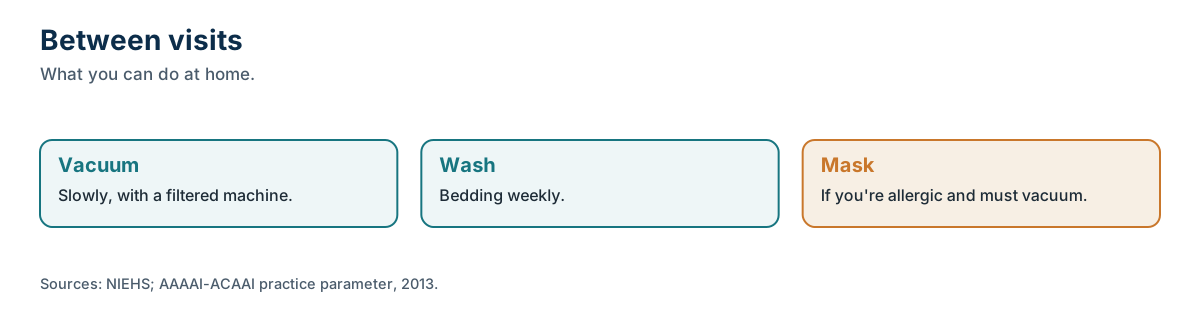
Allergist guidance gives vacuuming a strong recommendation as an ongoing habit. The practice parameter says it "can help remove dust mite allergens, although it is not capable of removing live mites," and the 2012 Wu study found daily mattress vacuuming lowered total mite allergen over eight weeks. That's a routine, not a one-off before a steam visit.
Two cautions from the sources. First, exposure rises while vacuuming and when the bin is emptied, so ideally someone without the allergy does it. Second, NIEHS suggests a "double-layered microfilter bag or a HEPA filter" and wearing a mask, then staying out of the room for 20 minutes afterward.
After a steam visit, follow the drying guidance we give before we leave, and let the mattress dry before making the bed or vacuuming it. How often allergy sufferers should vacuum covers routine frequency.
What a visit includes
We don't publish a fixed vacuum-steam order, and we won't invent one here. The pricing page lists the parts of a visit: the material check that sets steam output and pass speed, dry-vapor sanitation, and steaming of seams, tufts, ridges and edges, where dust and shed skin flakes collect. The Magnum XP we bring has a built-in vac. None of those items changes in price with the sequence question; severe or biohazard contamination is quoted as a custom surcharge before we start.
Your care label and warranty terms govern whether steam suits your bed, so check your warranty before booking. We call the work cleaning; Hub 2 explains the CDC's sanitize definition, and we make no disinfection or health claim.
Why the order is easy to overthink
It's tempting to treat sequence as the secret to a good result. The studies point elsewhere. In Yu's carpets, repeated, slow vacuuming did most of the allergen work whether or not steam was added. In Vojta's, what stood out was how long the steam-plus-vacuum result lasted, not which came first. And Yiin's lead result suggests the step after steam may matter less than people assume. For a mattress owner, consistency probably counts for more than order: regular vacuuming, weekly washing of bedding, an encasing, and humidity kept in check. That's the multi-step picture allergists describe, and no single sequence replaces it.
A note on "HEPA" in these studies
All three studies used HEPA-filtered vacuums, and the practice parameter recommends them. That's a detail of the research, not a claim about our equipment, and we don't attach filter specifications to our service. Hub 1 explains what HEPA vacuuming means and compares methods in HEPA vacuuming vs steam vs extraction.
Where to read next
The dust mite guide has all the studies in one table, and this hub lists every article. Does dry-vapor steam kill dust mites? covers what the dry steam studies measured, and does vacuuming remove mite allergen? covers the vacuuming side in depth.
What we don't know
- Whether vacuuming before, after or both around dry vapor changes allergen in a mattress. No study we found compared orders on a mattress.
- Whether Yiin's lead-dust result on the final vacuum would hold for mite allergen.
- In what order Vojta's steam and vacuuming were done within each treatment.
Changelog
- 3 October 2026: First published. Sources accessed on this date.
Sources
- Cleaning efficacy of HEPA-filtered vacuuming and dry steam cleaning on carpet (Yiin et al., J Occup Environ Hyg, 2008) · PubMed
- Evaluation of HEPA vacuum cleaning and dry steam cleaning in reducing levels of PAHs and house dust mite allergens in carpets (Yu et al., J Environ Monit, 2009) · PubMed Central
- Effects of physical interventions on house dust mite allergen levels in carpet, bed, and upholstery dust in low-income, urban homes (Vojta et al., Environ Health Perspect, 2001) · PubMed Central
- Environmental assessment and exposure control of dust mites: a practice parameter (Portnoy et al., Ann Allergy Asthma Immunol, 2013) · AAAAI and ACAAI
- Dust Mites and Cockroaches (accessed 2026-10-03) · National Institute of Environmental Health Sciences (NIH)
- Daily vacuuming of mattresses significantly reduces house dust mite allergens, bacterial endotoxin, and fungal beta-glucan (Wu et al., J Asthma, 2012) · PubMed
- Magnum XP-Vac product page (maker's claims, accessed 2026-10-02) · Vapor Clean
- Cleaning and disinfecting your school (definitions) · CDC
Last reviewed October 3, 2026. Manufacturer specifications and care instructions change; check the current version for your exact model. This page is general information, not medical advice. How we source and check pages: editorial standards.