
Short answer
No. Mattress sanitation is cleaning, not medical treatment, and we don't claim it cures, treats or prevents allergies or asthma. In studies, heat killed mites and vacuuming removed allergen. But allergist guidance says controlled trials haven't been done to show clinical benefit from heat-based measures, and a Cochrane review of 54 trials found no effect of mite control on asthma.
Key terms used on this page
- Clinical outcome:
- A health result, such as symptoms, lung function or medication use, as opposed to an environmental result such as allergen in dust. A 2008 Cochrane review of 54 trials found no effect of mite control measures on asthma outcomes. We report environmental results only.
- Multifaceted control:
- Using several dust mite measures together, such as encasing, washing, vacuuming and humidity control. The practice parameter says mite covers alone are unlikely to achieve a clinical benefit unless used as part of a more comprehensive plan.
- Allergen removal:
- A study outcome that measures how much mite allergen comes out of a surface, usually in dust samples. The practice parameter summarizes a rug study in which vacuuming, washing and shampooing removed allergen without killing the mites.
- Live-mite kill:
- A study outcome that counts whether mites are alive after a treatment. It is different from allergen removal: dead mites and their droppings can stay in the fabric, still carrying allergen, until something removes them.
- Sham treatment:
- A fake version of a treatment used as a control so participants and lab staff can't tell who got the real one. The Htut trial sham-treated one group of homes, which is why its allergen results carry more weight than an uncontrolled before-and-after test.
- House dust mite:
- A microscopic relative of spiders that lives in house dust and feeds on flakes of dead skin shed by people and pets. NIEHS describes dust mites as a big source of indoor allergens. The two species most studied are Dermatophagoides pteronyssinus and Dermatophagoides farinae.
The short answer is no. Mattress sanitation doesn't cure allergies, treat asthma or prevent either, and we don't claim it does. This article explains why we draw that line so firmly, what the evidence shows on each side of it, and what we think cleaning honestly offers.
This article is general information about cleaning, not medical advice. For allergy or asthma questions, talk to your doctor or an allergist.
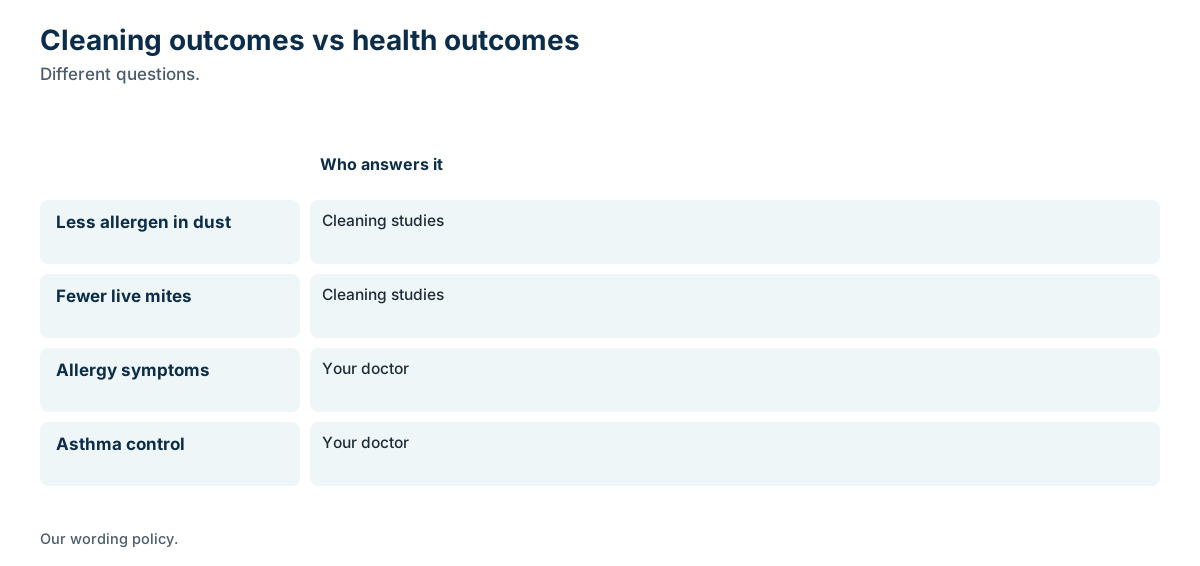
Two different questions
Every study in this hub answers one of two kinds of question.
Cleaning questions. Did mites die? Did allergen in a dust sample go down? Did the total amount of dust fall? These are measured on carpets, furniture, mattresses and lab samples.
Health questions. Did symptoms change? Did lung function change? Did people need less medicine? These are measured in people, and they need clinical trials.
A good answer to the first doesn't answer the second. That gap is the whole reason this article exists.
What the cleaning evidence shows
On the cleaning side, the results are real. A 2004 study of a 96°C steam cleaner reported 100 percent mite mortality in carpet and mattress samples (sample size not reported). The 2012 Wu study (20 volunteers, no control group) found daily mattress vacuuming lowered total mite allergen from 4.07 to 0.42 micrograms over eight weeks. Other studies, covered in the flagship guide, found steam and dry steam lowering allergen in carpets.
Those are environmental results. They tell you what happened to mites and dust.
What the health evidence shows
On the health side, the most authoritative summaries are cautious.
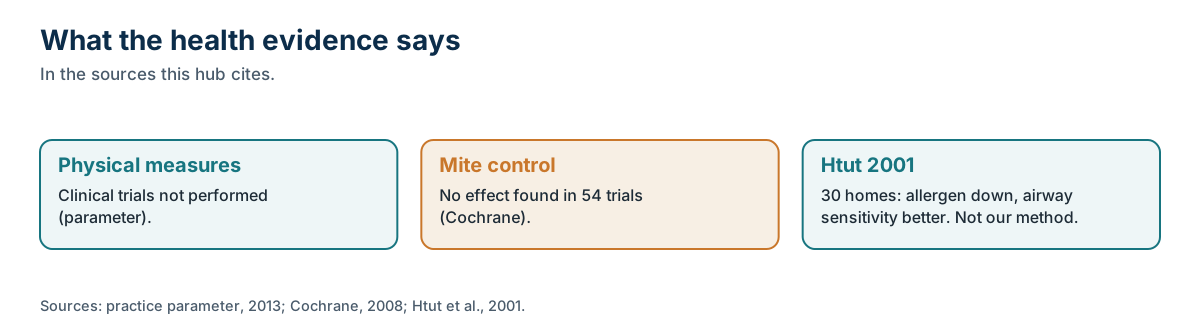
The allergist practice parameter says physical measures to kill mites, "such as heating, freezing, and desiccation, theoretically should be effective; however, controlled trials have not been performed to demonstrate clinical benefit when they are used."
The 2008 Cochrane review pooled 54 trials with 3,002 patients testing physical, chemical and combined measures. Its finding: "we did not find an effect of the interventions." PubMed's record now carries an editorial note that the review predates current Cochrane standards and shouldn't be used for clinical decisions.
The largest single trial, Woodcock and colleagues with 1,122 adults, found impermeable bed covers lowered mattress allergen at 6 months but concluded they seemed "clinically ineffective" as a single intervention.
The studies that measured symptoms
Two studies cited in this hub measured health outcomes as well as dust, and it's worth being straight about them.
The 2001 Htut trial treated mattresses, duvets and carpets with heat and steam in 30 homes of adults with asthma, with a sham-treated comparison group, and measured airway sensitivity (bronchial hyperreactivity) in the residents alongside allergen in dust. The authors reported that treatment "improved the asthmatic patients' BHR by 4-fold." The 2019 Jeon study randomized 40 children with allergic rhinitis; in the group whose mattresses were vacuumed daily for two weeks, rhinitis symptoms and dust weight fell significantly, although "The concentrations of HDM allergens were not changed significantly."
Those are study findings, not claims about our service. Each is a single small trial with a short or narrow scope, neither tested our dry-vapor method on mattresses alone, and the Cochrane review above found no pooled clinical effect from mite control measures. Health conclusions from studies like these belong to doctors weighing all the evidence, not to a cleaning company choosing the results it likes.
Why we hold this line
Three reasons.
It's what the evidence supports. The cleaning results are solid; the health results aren't established. Saying otherwise would be overstating the science.
It's what responsible cleaning claims look like. We don't state an allergen or germ reduction figure for our own service, because that would need our own controlled testing on mattresses, and we haven't done it. Figures from studies belong to those studies, on the surfaces they tested.
It protects you. Someone who believes a cleaning treats their allergies might delay seeing a doctor or drop something their doctor recommended. We'd rather be clear.
What NIEHS says, and what it doesn't
NIEHS describes dust mites as "a big source of allergens" that "can worsen allergies and asthma," and lists household steps to reduce their numbers. It also says "No matter how clean a home is, dust mites cannot be completely eliminated," and its advice for anyone who suspects an allergy is medical, not cleaning: "People who suspect they are allergic to dust mites or cockroaches can see their doctor and get tested."
What we will and won't say
We will say: heat kills dust mites it reaches, the studies cited here found steam treatment killing mites and lowering allergen on the surfaces they tested, and vacuuming removes allergen-carrying dust. Our visits apply dry-vapor heat to mattress surfaces and to seams, tufts, ridges and edges, where dust and shed skin flakes collect.
We won't say: that a visit cures, treats or prevents allergies or asthma; that it makes a bed mite-free or allergen-free; that it disinfects; or that it replaces anything your doctor recommends.
How to spot an overclaim
Whatever you read about cleaning and allergies, a few phrases are worth a second look, because they promise health results the evidence doesn't support:
- "Allergy relief" or "breathe easier." These are health outcomes. Ask for the clinical trial.
- "Eliminates dust mites." NIEHS says complete elimination isn't possible.
- "Allergen-free" or "hypoallergenic bed." No cleaning makes a bed free of allergen.
- A percentage with no study attached. Ask who tested it, on what surface, and whether there was a control group.
- "Doctor recommended." Ask which doctor, recommending what.
None of these phrases appear in our copy, and if you find one that slipped through, we'd want to know.
Why restraint is the stronger position
It might seem that a cleaning company has every incentive to lean into allergy claims. We think the opposite. The cleaning research is genuinely interesting, and it holds up best when it's described accurately: heat on fabric, allergen in dust, on named surfaces at named time points. Stretching it into health promises would make every accurate statement on this site harder to trust.
If allergies are why you're here
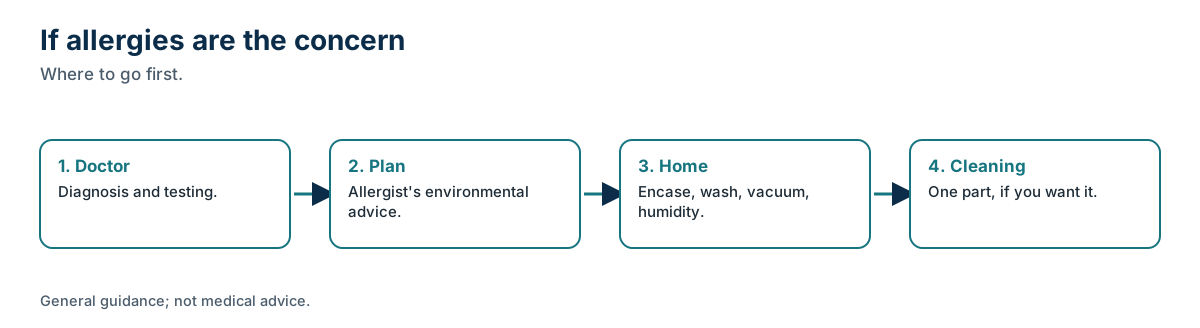
Start with a doctor or an allergist, who can test for a dust mite allergy and advise on what to do at home. The household measures allergists describe, such as encasings, weekly washing, filtered vacuuming and humidity control, are covered in why dust mite control needs more than one step. A cleaning visit can be one optional part of that, if you want it.
What a visit is
So, plainly, here is what you'd be buying: a cleaning, and nothing medical. It covers an inspection of the materials that sets steam output and pass speed, dry-vapor sanitation, and steaming of seams, tufts, ridges and edges. The cost is the standard price; severe or biohazard contamination is quoted as a custom surcharge before we start. Organic cleaning methods are our default. Care labels and warranty terms govern whether steam suits a given bed; check yours before booking.
We use the CDC's distinctions between cleaning, sanitizing and disinfecting; Hub 2 explains the CDC's sanitize definition. What we do is cleaning.
Questions about a visit: call (402) 512-5658.
Where to read next
This hub lists every article, and the dust mite guide sets out each study's results. Killing dust mites vs removing allergen explains the cleaning results in more depth, and can sanitation replace an encasement? covers the measure allergists recommend most specifically.
What we don't know
- Whether any cleaning method changes health outcomes. That's for clinical research, and the Cochrane review we cite didn't find effects from mite control measures.
- Whether future, more rigorous trials, which the Cochrane authors called for, would find something different.
- Anything about your health. Ask your doctor.
Changelog
- 3 October 2026: First published. Sources accessed on this date.
Sources
- House dust mite control measures for asthma (Gotzsche and Johansen, Cochrane review, 2008) · PubMed
- Environmental assessment and exposure control of dust mites: a practice parameter (Portnoy et al., Ann Allergy Asthma Immunol, 2013) · AAAAI and ACAAI
- Control of exposure to mite allergen and allergen-impermeable bed covers for adults with asthma (Woodcock et al., N Engl J Med, 2003) · PubMed
- Eradication of house dust mite from homes of atopic asthmatic subjects: a double-blind trial (Htut et al., J Allergy Clin Immunol, 2001) · PubMed
- Effects of vacuuming mattresses on allergic rhinitis symptoms in children (Jeon et al., Allergy Asthma Immunol Res, 2019) · PubMed
- Dust Mites and Cockroaches (accessed 2026-10-03) · National Institute of Environmental Health Sciences (NIH)
- Daily vacuuming of mattresses significantly reduces house dust mite allergens, bacterial endotoxin, and fungal beta-glucan (Wu et al., J Asthma, 2012) · PubMed
- Eliminating Dermatophagoides farinae and their allergens through high temperature treatment of textiles (Glass and Needham, J Med Entomol, 2004) · PubMed
- Cleaning and disinfecting your school (definitions) · CDC
Last reviewed October 3, 2026. Manufacturer specifications and care instructions change; check the current version for your exact model. This page is general information, not medical advice. How we source and check pages: editorial standards.