
Short answer
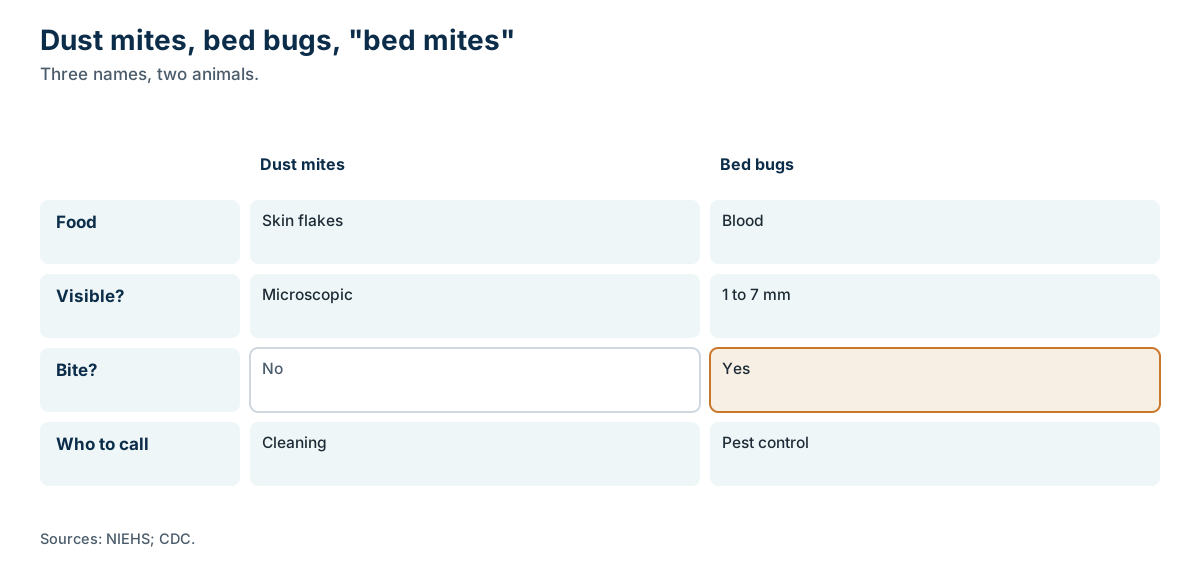
"Bed mites" usually means dust mites: microscopic animals that eat shed skin and don't bite. Bed bugs are visible insects, 1mm to 7mm by the CDC's measure, that feed on blood and hide in mattress seams and furniture. Dust mites are a cleaning and allergen question. Bed bugs need a licensed pest professional; we don't provide pest control.
Key terms used on this page
- "Bed mites":
- A common search term, not a species. When people say bed mites they usually mean house dust mites living in bedding. It is sometimes confused with bed bugs, which are insects visible to the eye.
- Bed bug:
- A small, flat, wingless insect of the Cimex genus that feeds on blood. The CDC says bed bugs range from 1mm to 7mm and are not known to spread diseases to people. Bed bugs are a pest-control problem, not a cleaning problem.
- House dust mite:
- A microscopic relative of spiders that lives in house dust and feeds on flakes of dead skin shed by people and pets. NIEHS describes dust mites as a big source of indoor allergens. The two species most studied are Dermatophagoides pteronyssinus and Dermatophagoides farinae.
- Mite fecal particle:
- The droppings of dust mites, which carry much of their allergen. The practice parameter notes that vacuuming can remove mite allergens in the form of fecal particles even though it does not remove all live mites.
- Relative humidity:
- How much moisture the air holds compared with its maximum at that temperature. Dust mites depend on humid air. NIEHS advises keeping indoor humidity at or below 50 percent, and the practice parameter gives a range of 35 to 50 percent.
- Dermatophagoides:
- The genus name of the common house dust mites. Studies often name the species: D. pteronyssinus, the European house dust mite, and D. farinae, the American house dust mite. Results for one species are not automatically true for the other.
Three names get mixed up in searches about bugs in the bed. Two are real animals with very different habits. The third is a search term. Getting them straight matters, because the right response to one is a cleaning and the right response to another is a pest control company.
This article is general information, not medical or pest control advice. For bites, rashes or allergy questions, talk to a doctor; for suspected bed bugs, a licensed pest professional.
Dust mites
NIEHS describes dust mites as "microscopic, insect-like pests that commonly live in house dust. They feed on flakes of dead skin, or dander, that are shed by people and pets." They're arachnids, related to spiders, and the two species in most research are Dermatophagoides pteronyssinus and D. farinae.
Three things set them apart. You can't see them. They don't bite. And what bothers people isn't the mite itself but the allergen in its droppings, which builds up in bedding, carpets and furniture. The allergist practice parameter notes that "Mattresses, box springs, and pillows are major sources of mites and mite allergens."
Bed bugs
Bed bugs are insects, and the CDC's description is specific: "Bed bugs (Cimex species) are small, flat insects. Bed bugs bite people and animals at night while they sleep, feeding on their blood." They're "reddish-brown in color, are wingless, and range from 1mm to 7mm in size." They "can live several months without a blood meal."
On health, the CDC says "Bed bugs are not known to spread diseases to people," though bites can cause itching, lost sleep and, rarely, allergic reactions. On hygiene, it makes a point that surprises many people: "How clean a place is does not determine whether bed bugs are present."
"Bed mites"
"Bed mites" isn't a species. When people search for it, they almost always mean house dust mites in their bedding. Sometimes they mean bed bugs, or they're trying to name something that's making them itch. Our Omaha bed mites page uses the term because that's what people type, and it explains that bed mites are dust mites.
If you've been searching "bed mites" because of bites, the bites themselves tell you dust mites aren't the cause. Dust mites don't bite.
How to tell which you might have
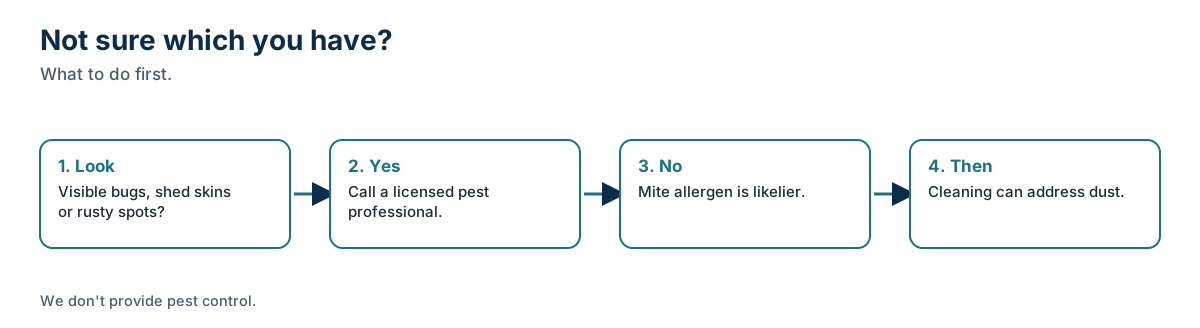
Start with what you can see.
Visible bugs, shed skins or spots. The CDC lists the signs of bed bugs: "Exoskeletons (shed after molting)," bugs in the folds of mattresses and sheets, "Rusty–colored blood spots on mattresses or nearby furniture," and "A sweet musty odor." Any of those points to bed bugs.
Bites in a pattern. The CDC says bed bug bites look like mosquito or flea bites, sometimes "in a straight line," and may take up to 14 days to appear in some people.
Nothing visible, but sneezing or stuffiness in bed. That's the pattern people associate with dust mite allergen. Whether it's actually an allergy is a medical question; an allergist can test for it.
Where each one lives
Dust mites live in the fabric and fill of mattresses, pillows, bedding, carpets and upholstery, wherever skin flakes collect and the air is humid. NIEHS advises keeping humidity "at, or below, 50 percent" to reduce them.
Bed bugs hide close to where people sleep. The CDC lists "The seams of mattresses," box springs, "Bed frames and headboards," dresser tables, cracks and crevices, and even behind wallpaper. It adds that they "tend to live within 8 feet of where people sleep." That reach beyond the mattress is one reason cleaning a mattress isn't a bed bug treatment: they're in the furniture and the room too.

How bed bugs travel
Dust mites mostly stay where they are and build up over time. Bed bugs move. The CDC says they spread "by getting into the seams and folds of luggage, overnight bags, folded clothes, bedding, furniture, and anywhere else they can hide," and that "Most people do not realize they are transporting bed bugs and infecting areas as they travel." It also notes they "can travel over 100 feet in a night." Travel, secondhand furniture and shared sleeping spaces raise the risk; the CDC says you're at higher risk "if you travel frequently and share living and sleeping space where other people have previously slept." None of that applies to dust mites, which arrive with ordinary household dust and live off the skin flakes already in the bed.
Who to call
Bed bugs: a licensed pest control professional. The CDC advises: "If you think you have a bed bug infestation, contact a professional pest control company experienced with treating bed bugs." We don't provide pest control, and we don't treat beds with suspected bed bugs. Our dust mites and bed bugs page says the same.
Dust mites: a combination of household measures, which allergists describe, and cleaning if you want it. The practice parameter recommends encasings, weekly washing of bedding and regular vacuuming. Why dust mite control needs more than one step puts those together.
Bites, rashes or allergy symptoms: a doctor. The CDC suggests speaking with a healthcare provider about allergic reactions to bed bug bites, and an allergist is the person to confirm a dust mite allergy.
What cleaning does for dust mites
Heat kills dust mites where it reaches them. A 1995 study found no live mites in steam-treated lab carpet over four months, and a 2004 study of a 96°C steam cleaner reported 100 percent mite mortality in carpet and mattress samples (sample size not reported). Vacuuming removes allergen-carrying dust; the Wu study found daily mattress vacuuming lowered allergen over eight weeks. Neither is a mattress you sleep on in a lived-in home, and neither is a health outcome.
For dust mites, which is the half of this page we work on, a visit pairs a check of the mattress materials with dry-vapor steaming. The material check decides steam output and pass speed. The steaming covers seams, tufts, ridges and edges, where dust and shed skin flakes collect; mattress seams are also where the CDC says bed bugs can hide, which is why suspected bed bugs are a job for pest control, not for us. Price: the standard price; severe or biohazard contamination is quoted as a custom surcharge before we start. Your care label and warranty terms govern whether steam suits your bed, so check your warranty before booking.
We describe this as cleaning, using the CDC's distinctions; Hub 2 has the CDC's sanitize definition. We make no disinfection or health claims.
Why the confusion matters
Mixing up the two leads to two kinds of mistake. Someone with bed bugs books a mattress cleaning and the bugs survive in the frame and furniture. Someone with dust mite allergen buys a pest treatment, adds insecticide to the bedroom, and the allergen in the mattress stays put. The allergist guidance doesn't recommend mite-killing chemicals in the home for exactly that reason: they have "limited efficacy at lowering allergen levels."
Where to read next
The dust mite and allergen guide covers the dust mite research in full, and the hub lists every article. What lives in mattress dust explains what's actually in the fabric, and killing dust mites vs removing allergen explains why dead mites still matter. Hub 1's glossary defines the allergen reservoir a mattress becomes.
What we don't know
- How often people searching for "bed mites" actually have bed bugs. We haven't seen data on that.
- Whether heat from a mattress cleaning affects bed bugs. It's irrelevant to us, because we refer suspected bed bugs to pest control rather than treating them.
- Which other organisms people mean when they use the term. It's used loosely.
Changelog
- 3 October 2026: First published. Sources accessed on this date.
Sources
- Dust Mites and Cockroaches (accessed 2026-10-03) · National Institute of Environmental Health Sciences (NIH)
- About Bed Bugs (26 April 2024, accessed 2026-10-03) · CDC
- Environmental assessment and exposure control of dust mites: a practice parameter (Portnoy et al., Ann Allergy Asthma Immunol, 2013) · AAAAI and ACAAI
- The use of domestic steam cleaning for the control of house dust mites (Colloff et al., Clin Exp Allergy, 1995) · PubMed
- Eliminating Dermatophagoides farinae and their allergens through high temperature treatment of textiles (Glass and Needham, J Med Entomol, 2004) · PubMed
- Daily vacuuming of mattresses significantly reduces house dust mite allergens, bacterial endotoxin, and fungal beta-glucan (Wu et al., J Asthma, 2012) · PubMed
- Cleaning and disinfecting your school (definitions) · CDC
Last reviewed October 3, 2026. Manufacturer specifications and care instructions change; check the current version for your exact model. This page is general information, not medical advice. How we source and check pages: editorial standards.