
Short answer
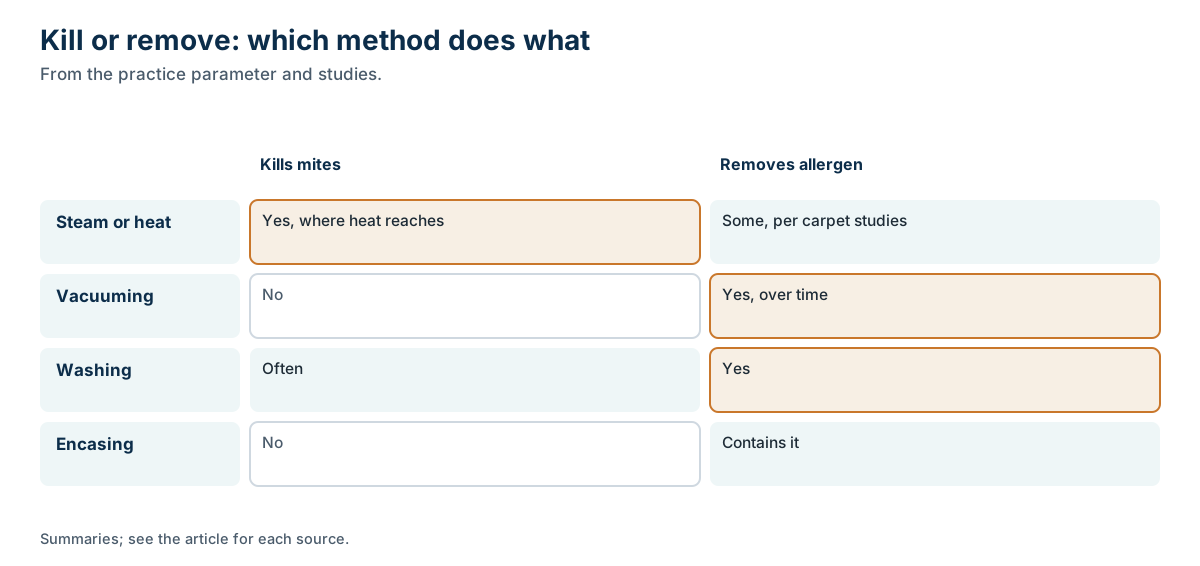
Killing mites stops them making more allergen; removing allergen takes out what's already there. They're separate results. In a rug study summarized by allergists, vacuuming, washing and shampooing removed allergen without killing mites, while autoclaving did both. Heat kills mites it reaches, but the droppings stay until something takes them out.
Key terms used on this page
- Live-mite kill:
- A study outcome that counts whether mites are alive after a treatment. It is different from allergen removal: dead mites and their droppings can stay in the fabric, still carrying allergen, until something removes them.
- Allergen removal:
- A study outcome that measures how much mite allergen comes out of a surface, usually in dust samples. The practice parameter summarizes a rug study in which vacuuming, washing and shampooing removed allergen without killing the mites.
- Mite fecal particle:
- The droppings of dust mites, which carry much of their allergen. The practice parameter notes that vacuuming can remove mite allergens in the form of fecal particles even though it does not remove all live mites.
- Acaricide:
- A chemical that kills mites. The practice parameter does not recommend acaricides for eliminating mite populations, citing limited effect on allergen levels and concerns about chemical agents in the home.
- Mite eggs and heat:
- Dust mite eggs are harder to kill than adult mites. A study summarized in the practice parameter found about 80 percent of eggs survived 40°C, dry heat at 50°C killed them after 3 to 5 hours, and eggs at 60°C died instantaneously.
- Allergen load:
- The total amount of allergen collected from a surface, as opposed to its concentration per gram of dust. Studies report both. A surface can lose dust and allergen load while the concentration per gram stays about the same. The Vojta study (19 homes; carpet comparison 11 homes, 5 steamed) reported both.
Two different claims about dust mites are easy to blur. One is that a method kills mites. The other is that it removes the allergen they make. A treatment can do either without the other, and most of the confusion about steam, vacuums and sprays comes from mixing them up.
This article is general information about cleaning, not medical advice. For allergy or asthma questions, talk to your doctor or an allergist.
Where the allergen actually is
The allergen people react to comes mainly from what mites leave behind, especially their fecal particles. The allergist practice parameter talks about "mite allergens in the form of fecal particles" when it explains why vacuuming helps even though it leaves live mites behind. So a mattress can hold allergen from mites that died long ago. Killing today's mites doesn't touch it.
The rug study that separates the two
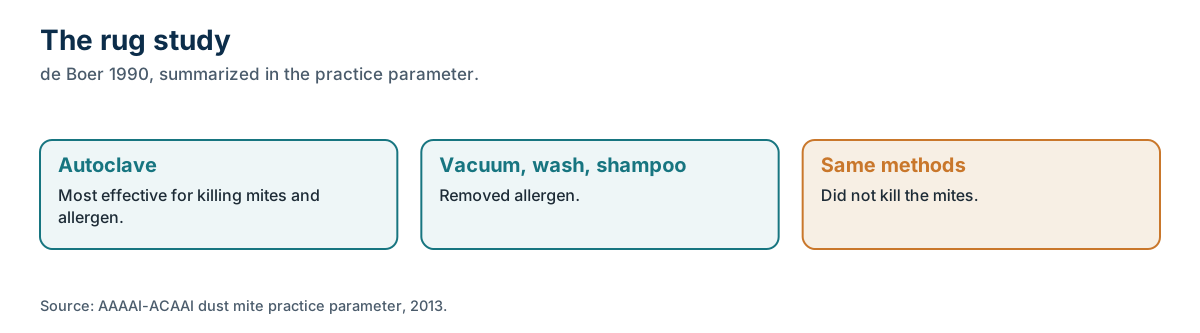
The clearest demonstration is an older study summarized in the practice parameter. Used rugs were "vacuumed, 'wet cleaned,' 'shampooed,' or heated in an autoclave to determine which intervention would be most effective for eliminating live mites and their allergens." The result: "Autoclaving was most effective for killing mites and for eliminating allergens. The other cleaning methods did not kill the mites, although they did remove mite allergens."
That's the whole distinction in two sentences. Three ordinary methods removed allergen and left mites alive. One extreme method, high-pressure steam heat in a sealed chamber, did both. A mattress can't go in an autoclave, but the lesson carries over: removal and killing are separate outcomes.
Methods that kill
Allergist guidance lists physical ways to kill mites: "heating, freezing, and desiccation, theoretically should be effective." Steam studies report mites dying. Colloff's 1995 lab test on carpet squares found no live mites in treated squares over four months, and Glass and Needham's 2004 study of a 96°C steam cleaner reported 100 percent mortality in carpet and mattress samples, without reporting the sample size.
Eggs complicate it. The practice parameter notes "Dust mite eggs are harder to kill than live mites," with about 80 percent of eggs surviving 40°C in one study and eggs at 60°C dying instantly. A treatment that kills adults but not eggs buys time rather than ending the population.
Methods that remove
Removal means taking material out of the fabric. Vacuuming is the main one for a mattress. The practice parameter says vacuuming "is not capable of removing live mites" but removes allergen-carrying particles. The 2012 Wu mattress study, with 20 volunteers and no control group, found total mite allergen fell from 4.07 to 0.42 micrograms over eight weeks of daily vacuuming, mostly because total dust fell.
Washing removes both mites and allergen from bedding, and here the practice parameter makes a point worth quoting in full: "when washing an item, as long as the mites are removed, it is immaterial whether the mites are scalded to death, drowned, or simply washed down the drain still alive." For laundry, removal is what counts. Does washing sheets clean the mattress? explains why that doesn't extend to the bed itself.
Methods that do some of both
Steam treatment can lower allergen as well as kill mites. In Colloff's study, Der p 1 in steam-treated carpet areas of one flat fell by a mean of 86.7 percent. In the Glass study, five passes on carpet cut Der f 1 by 100 percent and two passes by 61.4 percent. And the Htut trial found Der p 1 and Der p 2 in household dust fell and stayed lower for a year after heat and steam treatment of mattresses, duvets and carpets.
Those are real allergen reductions, but on specific surfaces and under specific conditions. None of them shows a steam pass on a mattress removing the allergen built up deep in its layers.
Why sprays fall short
Mite-killing chemicals are called acaricides. The practice parameter's recommendation is direct: "Do not recommend the use of acaricides to eliminate mite populations because of their limited efficacy at lowering allergen levels and concerns about the use of chemical agents in the home." It's the kill-vs-remove problem again. A spray that kills mites leaves their allergen in place, and adds a chemical to the bed you sleep in. Organic cleaning methods are our default, and we don't use acaricides.
Why both matter over time
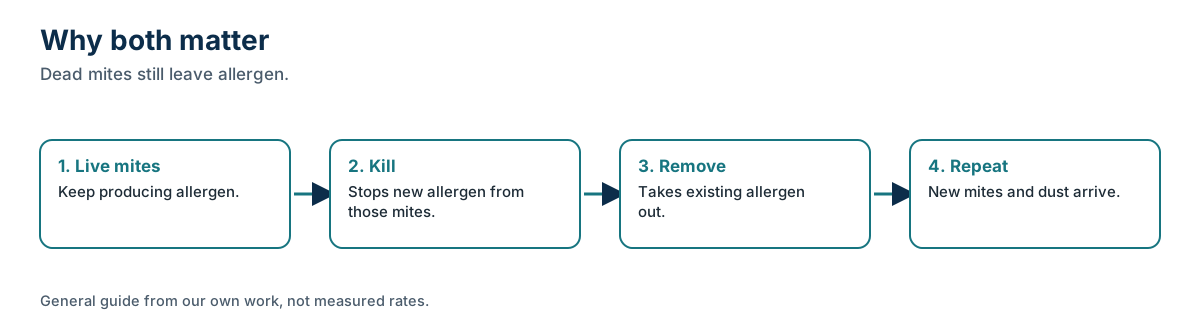
Live mites keep producing allergen, so killing them stops the supply from those mites. Existing allergen stays until it's removed. And new mites keep arriving: NIEHS says "No matter how clean a home is, dust mites cannot be completely eliminated." That's why allergists pair measures rather than relying on one, as covered in why dust mite control needs more than one step.
How to read a claim
When a cleaner or product says it handles dust mites, ask which it means:
- "Kills dust mites." Ask about temperature at the fabric and whether eggs are included.
- "Removes allergens." Ask how it was measured, on what surface, and over what time.
- "Eliminates dust mites." Ask for the study. NIEHS says complete elimination isn't possible.
- A percentage. Ask who tested it, on what, and whether the test was controlled.
What "reduce" should mean
Words like reduce, lower and cut get used loosely in this field. In a study, they mean something specific: a measured drop in one outcome, on one surface, at one time point, usually compared with something. Colloff's 86.7 percent was Der p 1 concentration in carpet in one flat. Wu's 85.1 percent was total allergen in mattress dust after eight weeks of daily vacuuming, in 20 volunteers with no control group. Neither number describes live mites, and neither describes a person's health. When we say a method can lower allergen, we tie it to one of those named results, and when we talk about our own visits, we stick to what we do rather than a number we haven't measured. That's the standard we'd suggest holding any cleaner to, us included.
Where we stand
Our visits apply dry-vapor heat to the sleep surface and to the seams, tufts, ridges and edges where dust and shed skin flakes collect, after an inspection that sets steam output and pass speed for the material. That heat is directed at mites wherever it reaches them. We don't publish a kill rate or an allergen removal rate for our own service, because we haven't run controlled tests on mattresses, and we don't make health claims. It's part of the standard price; severe or biohazard contamination is quoted as a custom surcharge before we start.
Your care label and warranty terms govern whether steam suits your bed; check your warranty before booking. We call the work cleaning, and Hub 2 sets out the CDC's definition of sanitize for anyone comparing claims. Hub 1's glossary defines the allergen reservoir a mattress becomes.
Where to read next
The dust mite and allergen guide covers every study cited here, and the hub lists every article. Does steam kill dust mites in mattresses? goes deeper on the killing side, and does vacuuming remove mite allergen? on the removal side.
What we don't know
- How much allergen a steam pass removes from inside a mattress, as opposed to killing mites at the surface. We found no mattress study that separated the two.
- What share of a mattress's allergen comes from mites alive at the time of treatment versus mites long dead.
- Whether egg survival in the lab study reflects eggs inside mattress fabric.
Changelog
- 3 October 2026: First published. Sources accessed on this date.
Sources
- Environmental assessment and exposure control of dust mites: a practice parameter (Portnoy et al., Ann Allergy Asthma Immunol, 2013) · AAAAI and ACAAI
- The use of domestic steam cleaning for the control of house dust mites (Colloff et al., Clin Exp Allergy, 1995) · PubMed
- Eliminating Dermatophagoides farinae and their allergens through high temperature treatment of textiles (Glass and Needham, J Med Entomol, 2004) · PubMed
- Daily vacuuming of mattresses significantly reduces house dust mite allergens, bacterial endotoxin, and fungal beta-glucan (Wu et al., J Asthma, 2012) · PubMed
- Dust Mites and Cockroaches (accessed 2026-10-03) · National Institute of Environmental Health Sciences (NIH)
- Eradication of house dust mite from homes of atopic asthmatic subjects: a double-blind trial (Htut et al., J Allergy Clin Immunol, 2001) · PubMed
- Cleaning and disinfecting your school (definitions) · CDC
Last reviewed October 3, 2026. Manufacturer specifications and care instructions change; check the current version for your exact model. This page is general information, not medical advice. How we source and check pages: editorial standards.