
Short answer
Rotate most mattresses end to end every so often unless the care instructions say not to, and flip only if the bed is built to be two-sided. Rotation spreads wear so body impressions form more slowly. Care labels use words with federal definitions, such as hot water meaning 112 to 145°F and No steam meaning no steam in any form. Keep the law tag and care label for the life of the bed.
Key terms used on this page
- End-to-end rotation:
- Turning a mattress 180 degrees so head and foot swap, spreading wear. Industry care advice suggests periodic rotation unless the care instructions say otherwise.
- Care Labeling Rule:
- The FTC rule, 16 CFR Part 423, that defines care terms such as hot water and No steam. It covers apparel and certain piece goods, not mattresses.
- Body impression:
- A shallow, lasting dip where someone sleeps. It's a change in shape, not in soil, so a cleaning visit doesn't remove it. Whether an impression counts as a defect is set by each maker's own warranty terms.
- Law tag:
- The required labels on a mattress. The federal 1633 label lists the maker, address, month and year of manufacture, model, prototype ID and certification; state bedding tags such as Pennsylvania's add filling materials.
- Care label first:
- The rule that a mattress's own care label and warranty come before any cleaner's method, ours included. Tempur UK notes that a label stitched inside the cover gives specific care instructions for the item purchased.
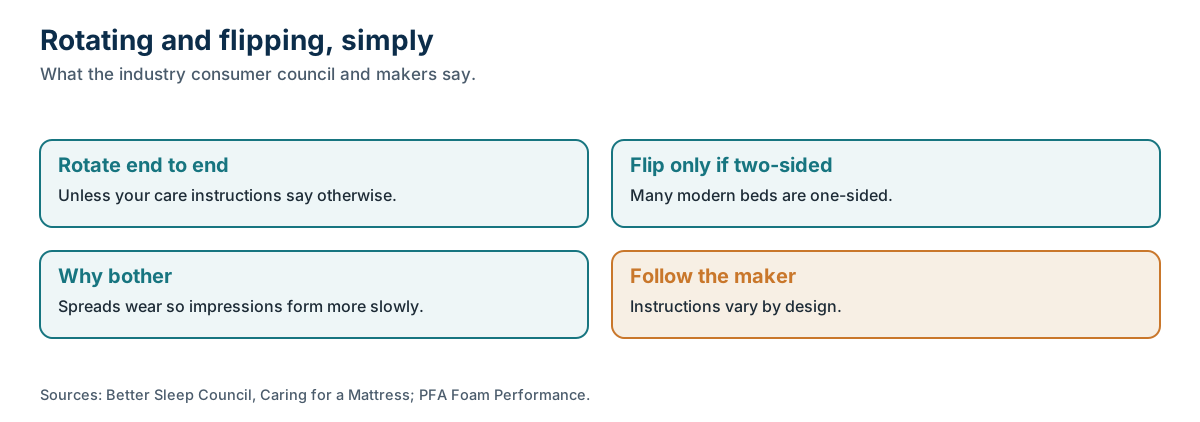
Rotate most mattresses end to end every so often unless the care instructions say not to, and flip only a bed that's built to be two-sided. Rotation spreads wear, so body impressions form more slowly. Care labels use words with federal definitions: hot water means 112 to 145°F, and No steam means no steam in any form. Keep the law tag and any care label for the life of the bed. That's the short version; here's why each matters.
General information about mattress care, not medical advice.
Rotating: the simplest care step
A mattress-industry consumer council's care page says: "Unless your mattress care instructions indicate otherwise, you may want to periodically rotate your mattress from end-to-end and flip it over, if applicable." That's the whole of the mainstream advice. There's no tested interval. Many people rotate at the twice-yearly clock changes, when the same council suggests checking the bed for comfort and support, and some makers suggest more frequent rotation in the first few months while new comfort layers settle.
Rotating takes two people and a minute. Strip the bed, swing the mattress 180 degrees so the head end becomes the foot, and remake it. While it's bare, it's a good moment to vacuum the surface and look for stains, sagging or damage.
A simple way to remember it: rotate at the same time you check the smoke alarm batteries or change the clocks, and set a phone reminder so the next turn is easy to track.
Why it helps
Foam and fiber wear where they're loaded. Each night compresses the same areas, under shoulders and hips, and with repeated loading foam loses some firmness and height. The Polyurethane Foam Association describes flex fatigue tests that compress foam "a few thousand times, or many thousands of times" and measure the firmness lost. It also notes that higher-density foams lose less height, so body impressions may be less noticeable.
Rotating moves the heaviest loads to different parts of the mattress so wear spreads out. It won't fix impressions that are already deep, and it isn't proven to add a set number of years. It's cheap insurance against early, uneven wear.
Flipping: only if the bed is two-sided
Older innerspring mattresses were often built the same on both sides and were meant to be flipped as well as rotated. Many modern mattresses aren't. They're built in layers, with comfort foam or a pillow top on the sleeping side and a firm support core underneath. Flip one of those and you're sleeping on the core. Some makers say their beds never need flipping or rotating at all.
The care label or the maker's website will tell you which kind you have. If you're not sure, rotate but don't flip.
What care label words mean
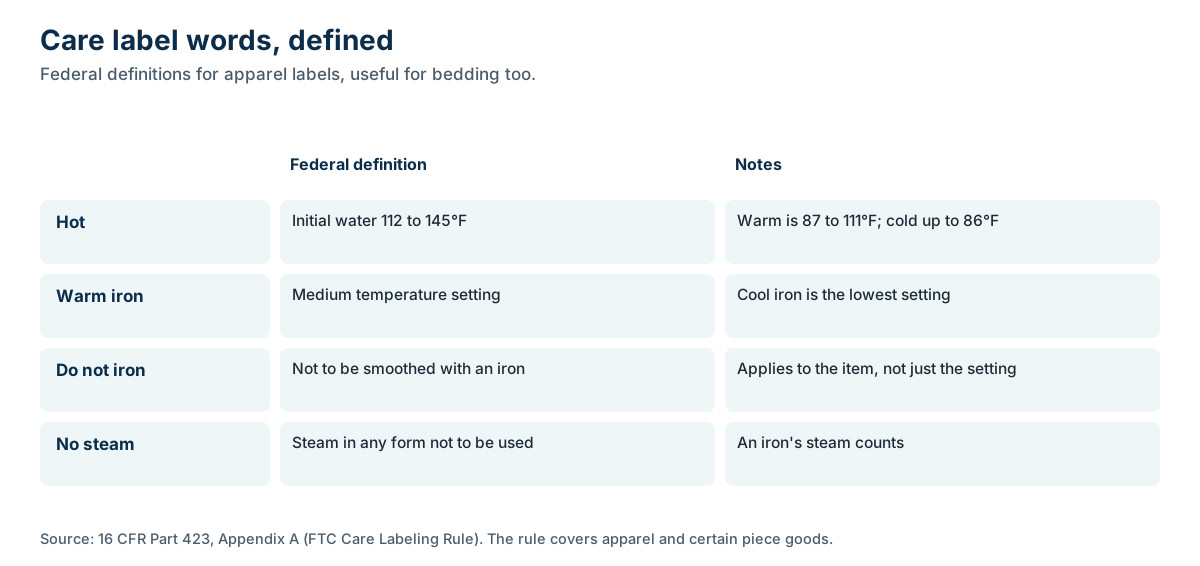
Care instructions use a small vocabulary, and the FTC's care labeling rule, 16 CFR Part 423, gives each term a definition in its appendix:
- Hot / warm / cold water: hot means initial water temperature from 112 to 145°F, warm from 87 to 111°F, and cold up to 86°F.
- Iron, warm iron, cool iron: Warm iron is a medium setting and cool iron the lowest. Do not iron means the item is "not to be smoothed or finished with an iron."
- No steam: "steam in any form not to be used."
- Tumble dry: with no temperature given, a high, medium or low setting can be used.
One caveat: the rule itself covers textile wearing apparel and certain piece goods, not mattresses or most bedding. Mattress and topper makers aren't required by that rule to label care at all, but when they do, they use the same words, so the definitions are a reliable guide to what they mean.
Mattress care labels and steam
Some mattress makers allow steam cleaning and others prohibit it, and the difference usually shows up in the care instructions or warranty terms. We read the label before we start, and if it says no steam, we don't steam. Our article on why some makers allow steam and others prohibit it explains the reasoning on both sides, and the compatibility hub covers specific brands and materials.
Three tags people confuse
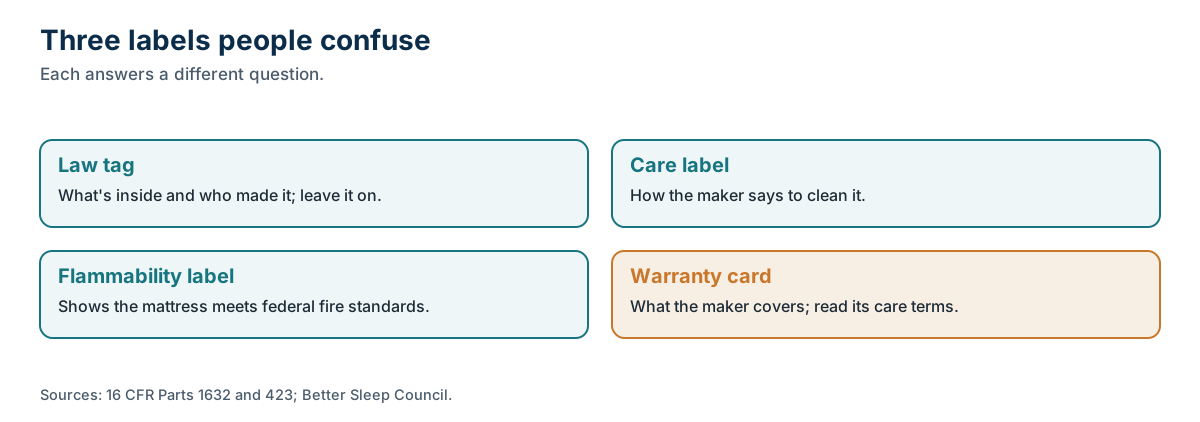
- The law tag lists what's inside the mattress and who made it. It's the tag that warns against removal under penalty of law, and our article on how to read a mattress law tag decodes it. The same consumer council notes it isn't illegal for owners to remove it, but advises keeping it because it identifies the mattress for any warranty claim.
- The flammability label shows the mattress meets federal fire standards. Mattresses and mattress pads fall under 16 CFR Part 1632, the cigarette-ignition standard, and mattresses also meet an open-flame standard explained in our fire barrier article.
- The care label or care card is the maker's cleaning instructions. On mattresses it's often a separate card or a page on the maker's site, and it's frequently tied to warranty terms.
Keep all three. If the care card has gone missing, the maker's site usually has it by model.
Other everyday care basics
- Use a protector and wash it regularly; see protectors vs encasings.
- Support it properly. The consumer council advises a sturdy frame with a strong center support for queen and king sets, and warns against a board between mattress and foundation.
- Keep liquids light. The same page says to avoid soaking the mattress or foundation with any liquid and to blot with mild soap and cold water for stains.
- Air it. Pulling the covers back for a while lets the night's moisture escape; the unmade bed article explains how far that goes.
A full year of these steps is in the seasonal checklist, and the hub links everything else.
Sleep Sanitation's view
This section is our view. Rotating and reading the label are the two cheapest things you can do for a mattress. We check the care label and any steam restrictions before every service, and we'd rather turn down a job than work against what the maker says. Our visits use dry vapor steam with little water, HEPA vacuuming and UV-C light, with a moisture check after service and the built-in bed mite sensor on our UV-C vacuum. See our process or call or text (402) 512-5658.
What we don't know
- How much regular rotation extends a mattress's comfortable life. We found no field study.
- What rotation interval suits different constructions. Makers' advice varies, and we found no comparative testing.
- How often mattress care cards are kept by owners. Many are lost, which makes the maker's site the more reliable reference.
Changelog
- 7 October 2026: First published. Sources accessed on this date.
Sources
- Caring for a Mattress · Better Sleep Council (mattress industry consumer site)
- Replacing a Mattress · Better Sleep Council (mattress industry consumer site)
- 16 CFR Part 423: Care Labeling of Textile Wearing Apparel and Certain Piece Goods · Electronic Code of Federal Regulations (eCFR)
- 16 CFR Part 1632: Standard for the Flammability of Mattresses and Mattress Pads (FF 4-72) · Electronic Code of Federal Regulations (eCFR)
- Foam Performance · Polyurethane Foam Association
- IN-TOUCH Vol. 1 No. 2: Foam density · Polyurethane Foam Association
Last reviewed October 7, 2026. Manufacturer specifications and care instructions change; check the current version for your exact model. This page is general information, not medical advice. How we source and check pages: editorial standards.