
Skip to content

Knowledge Center · Enzyme science

The science of enzymes for mattress stains and odor

This hub explains the science behind enzyme cleaners: what an enzyme is, how proteases, lipases and amylases cut body-fluid soil, where urine odor really comes from, and how dwell time, temperature and pH decide whether the work gets done. It also covers the limits on a mattress, why heat should come after an enzyme, and the homemade-cleaner myths. Where the evidence is thin, we say so.

Monday–Friday, 9am–6pm. Missed a call? We return calls and texts on Saturday and Sunday too.

Short answer

Enzymes are protein catalysts that cut specific bonds in organic soil: protease for protein in blood, vomit and saliva, lipase for body oils, amylase for starch. They need water, time, moderate warmth and a suitable pH, and enough heat destroys them, so heat comes after their dwell time. They break soil down rather than masking it, but they don't disinfect, and they can't reach a soaked core.

By Matthew Brunken · Updated October 12, 2026 · Last reviewed October 12, 2026 · Sources · Editorial standards

Enzyme cleaners are sold for almost every body-fluid accident a mattress sees: urine, sweat, blood, vomit, saliva, body oils. They work, within limits that follow directly from what an enzyme is. This hub explains that science in plain terms, so you can tell what an enzyme product can do on a mattress, what it needs, and where it stops.
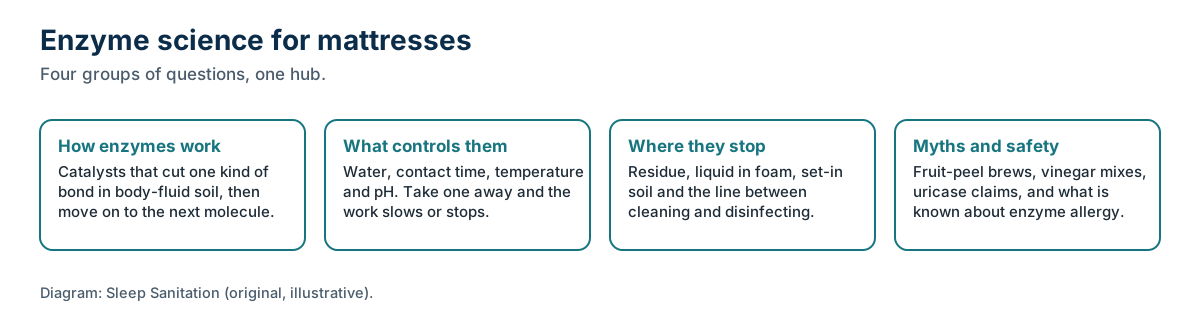
Four cards summarizing the hub: how enzymes work, what controls them, where they stop, and myths and safety
Four groups of questions, one hub. Diagram: Sleep Sanitation (original, illustrative).

This hub is general information about cleaning chemistry, not medical advice and not a product recommendation.

What an enzyme does

An enzyme is a protein that acts as a catalyst. OpenStax's biology text describes enzymes binding their target at an active site, making a specific bond easier to break, and returning "ultimately unchanged." Most cleaning enzymes split bonds using water, a reaction called hydrolysis. Start with how enzyme cleaners work.

Enzymes are specific. Each family targets its own kind of soil.
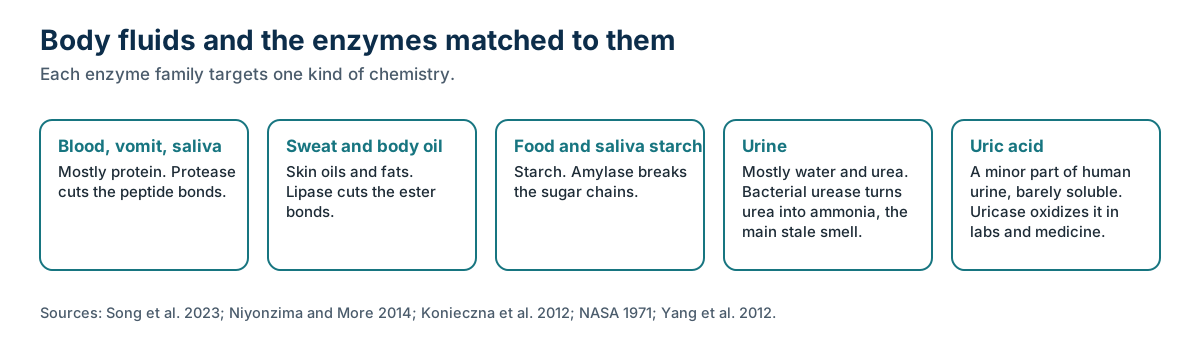
Five cards matching body fluids to enzymes: protease for blood, vomit and saliva; lipase for sweat and body oil; amylase for starch; urease turning urine urea into ammonia; uricase for uric acid
Each enzyme family targets one kind of chemistry. Diagram: Sleep Sanitation (original, illustrative).

Our stain chemistry hub already matches enzymes to specific stains in which enzyme for which stain. This hub goes underneath that: why enzymes behave the way they do.

Where urine odor comes from

The sharp smell of old urine is mostly ammonia, made by bacteria using the enzyme urease to split urea. Uric acid gets blamed on many labels, but in human urine it's a minor, barely soluble component, and its role in mattress odor hasn't been measured. Urease, uricase and urine odor sets out what each enzyme actually does, including uricase.

What controls an enzyme
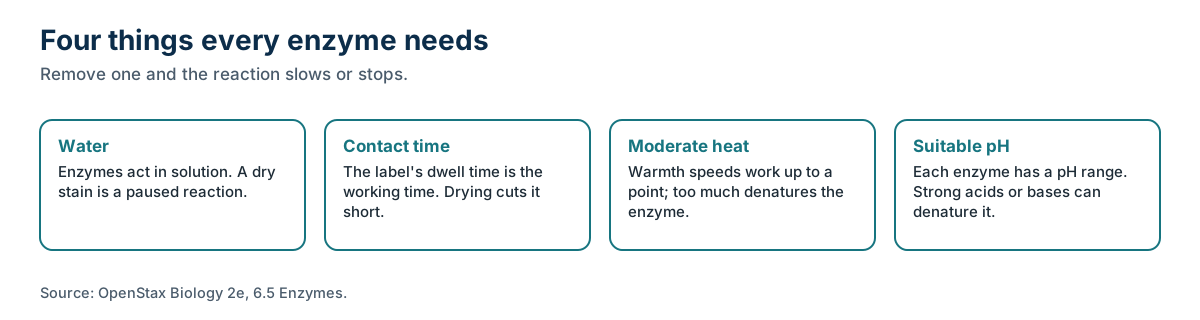
Four cards: water, contact time, moderate heat and suitable pH, each needed for an enzyme to work
Remove one and the reaction slows or stops. Diagram: Sleep Sanitation (original, illustrative).

Dwell time explained shows why enzymes only work while the area is damp, and why the fix for a short dwell isn't more liquid. Temperature and pH explains the working range and why mixing vinegar or bleach into an enzyme product works against it. Does steam heat destroy enzyme cleaners? explains denaturation and why heat should come after the enzyme's dwell, not before.

Where enzymes stop

Enzymes vs fragrance separates breaking down an odor source from covering it. Limits of enzyme treatment covers the big ones on a mattress: liquid in foam, residue, a saturated core. Why old stains resist enzymes explains what time and heat do to soil. And are enzyme cleaners disinfectants? explains the federal line between cleaning and germ-kill claims.

Myths and safety

DIY enzyme cleaner myths looks at fruit-peel ferments, which studies show are strongly acidic with variable activity, and at popular mixing advice. Enzyme safety and allergy reports what factory studies found about enzyme sensitization and what that does and doesn't mean at home.

Related articles in other hubs

The practical side of urine treatment lives in our accidents hub, including enzyme treatment and dry vapor steam together and can enzyme cleaner damage memory foam?. Materials that need care with proteases, such as wool, are covered in what your mattress is made of. Masking in the nose is covered in fragrance masking vs odor removal.

The short version

Enzymes are good at one thing: breaking down the organic soil in body fluids so it lifts more easily and feeds fewer odor-causing bacteria. They need water, time, moderate warmth and a reasonable pH. Heat destroys them, so heat comes second. On a mattress, the liquid they come in is the main constraint. They don't disinfect, they don't fix a soaked core, and a homemade ferment isn't a substitute.

How we handle evidence here

We lean on textbooks, peer-reviewed reviews, extension guides and federal agencies. Product makers' claims are labeled as their claims. We don't name or rank enzyme products, and where we found no study, as for uric acid odor inside a mattress, we say so.

Sleep Sanitation's position

This section is our view. Enzyme treatment is part of our urine and organic odor work, and it's included in the standard visit: $249 for the first mattress. We apply it sparingly to the mapped area, give it the time the product label sets, blot, and only then use low-moisture dry vapor and airflow. Every visit also includes HEPA vacuuming and UV-C light, a moisture check after service, and the built-in bed mite sensor on our UV-C vacuum. Severe or biohazard urine or odor contamination carries a surcharge, and we tell you before any work starts. We serve Lincoln, Omaha and surrounding towns. Call or text (402) 512-5658, or email info@sleepsanitation.com.

What we don't know

  • How much body-fluid soil a typical enzyme application breaks down in a mattress, as opposed to laundry or lab tests.
  • Whether uric acid crystals contribute meaningfully to returning urine odor in mattresses.
  • Whether consumer use of liquid enzyme spot cleaners causes sensitization.

Changelog

  • 12 October 2026: First published. Sources accessed on this date.

How enzymes work

What an enzyme is, how it cuts body-fluid soil, and the chemistry of urine odor, from urease to uricase.

What controls them

Dwell time, temperature and pH, and why steam heat comes after an enzyme, not before.

Where they stop

Enzymes versus fragrance, the honest limits on a mattress, old stains, and why cleaning isn't disinfecting.

Myths and safety

Homemade fruit-peel cleaners, vinegar and peroxide mixes, and what's known about enzyme allergy.

Defined terms

The vocabulary of mattress cleaning methods

Every article in this Knowledge Center uses these words the same way. Each term has its own link, so you can point anyone (or any search engine) straight to the definition.

Catalyst
A substance that speeds up a chemical reaction without being used up by it. Enzymes are biological catalysts; OpenStax notes they return to their original state after each reaction.Source: Biology 2e, 6.5 Enzymes
Active site
The pocket on an enzyme where its target molecule binds and the reaction happens. Its shape and chemistry make each enzyme specific to one kind of molecule.Source: Biology 2e, 6.5 Enzymes
Hydrolysis
Splitting a chemical bond using a water molecule. Proteases, lipases and amylases in cleaners are hydrolases, which is one reason they need a damp stain to work.Source: Microbial proteases and their applications (Song et al., Frontiers in Microbiology, 2023)
Denaturation
Loss of a protein's folded shape, usually from heat or extreme pH. A denatured enzyme is still present but can no longer bind its target, so it stops working.Source: Biology 2e, 6.5 Enzymes
Enzyme working range
The band of temperature and pH in which an enzyme works well. Inside it, warmth speeds reactions; outside it, activity falls and the enzyme can denature.Source: Biology 2e, 6.5 Enzymes
Uricase (urate oxidase)
An enzyme that oxidizes uric acid, ultimately to allantoin and carbon dioxide. Most mammals make it; humans lack a working copy. Medical uricases are used to treat gout.Sources: Uricases as therapeutic agents to treat refractory gout: Current states and future directions (Yang et al., 2012); Uric acid transport and disease (So and Thorens, J Clin Invest, 2010)
Allantoin
The far more soluble compound that uric acid becomes after uricase acts on it. Most mammals excrete allantoin; humans excrete uric acid instead.Source: Uricases as therapeutic agents to treat refractory gout: Current states and future directions (Yang et al., 2012)
Eco-enzyme (garbage enzyme)
A homemade ferment of fruit or vegetable peels, sugar and water. Reviews report variable enzyme activity and an acidic pH of roughly 2.9 to 3.7 after fermentation.Sources: A systematic review on garbage enzymes and their applications in environmental processes (2024); Recent trends in utilization of citrus fruits in production of eco-enzyme (2023)
Enzyme sensitization
Developing an allergic immune response to an enzyme protein, usually after breathing it as dust. Documented mainly in detergent and enzyme factory workers.Sources: Respiratory disease in industry due to B. subtilis enzyme preparations (Little and Dolovich, 1973); Incidence of respiratory sensitisation and allergy to enzymes among employees in an enzyme producing plant (Larsen et al.)
Pesticidal claim
A product claim to prevent, destroy, repel or mitigate a pest, including microbes. EPA says such claims make a cleaning product a pesticide that must be registered.Source: Determining If a Cleaning Product Is a Pesticide Under FIFRA

Frequently asked questions

How do enzyme cleaners work?+

They contain enzymes, protein catalysts that each bind one kind of molecule and cut a specific bond using water. Proteases cut protein, lipases cut fats and oils, amylases cut starch. The pieces are easier to lift and give bacteria less to feed on.

How long should an enzyme cleaner sit?+

As long as the product label says. Enzymes only work while the area is damp. On a mattress, keep the amount small rather than pouring more to keep it wet.

Does steam kill enzyme cleaners?+

Enough heat denatures enzymes, and steam is far hotter than their working range. Heat can also set protein stains. Use the enzyme first, give it the full dwell, blot, then use heat.

Is uric acid what makes urine smell?+

Mostly not in human urine. The sharp smell is mainly ammonia that bacteria make from urea using urease. Uric acid is minor and barely soluble; its role in mattress odor hasn't been measured.

Are enzyme cleaners disinfectants?+

No. They break down organic soil. Products claiming to kill germs must be registered with the EPA.

Do homemade fruit-peel enzyme cleaners work?+

Their enzyme activity varies and can't be measured at home, and they're strongly acidic. We wouldn't use one on a mattress.

Sources

  1. Biology 2e, 6.5 Enzymes · OpenStax (Rice University)
  2. Microbial proteases and their applications (Song et al., Frontiers in Microbiology, 2023) · PubMed Central
  3. Concomitant production of detergent compatible enzymes by Bacillus flexus XJU-1 (Niyonzima and More, Braz J Microbiol, 2014) · PubMed Central
  4. Microbial ureases (Microbiol Rev, 1989) · PubMed Central
  5. Bacterial Urease and its Role in Long-Lasting Human Diseases (Konieczna et al., 2012) · PubMed Central
  6. Composition and Concentrative Properties of Human Urine (1971) · NASA
  7. Uricases as therapeutic agents to treat refractory gout: Current states and future directions (Yang et al., 2012) · PubMed Central
  8. Uric acid transport and disease (So and Thorens, J Clin Invest, 2010) · JCI (J Clin Invest)
  9. Stain Removal for Washable Fabrics (FCS2-840) · University of Kentucky Cooperative Extension
  10. Remove Stains from Blood · University of Georgia Extension, Textiles
  11. Cleaning and disinfecting your school (definitions) · CDC
  12. Determining If a Cleaning Product Is a Pesticide Under FIFRA · US Environmental Protection Agency
  13. A systematic review on garbage enzymes and their applications in environmental processes (2024) · Ecotoxicology and Environmental Safety (ScienceDirect)
  14. Recent trends in utilization of citrus fruits in production of eco-enzyme (2023) · Journal of Agriculture and Food Research (ScienceDirect)
  15. Respiratory disease in industry due to B. subtilis enzyme preparations (Little and Dolovich, 1973) · PubMed Central
  16. Incidence of respiratory sensitisation and allergy to enzymes among employees in an enzyme producing plant (Larsen et al.) · PubMed Central
  17. Managing the Risk of Occupational Allergy in the Enzyme Detergent Industry (Basketter et al., 2015) · PubMed Central
  18. How To Clean a Mattress in 9 Steps · Purple
  19. Chemistry 2e, 4.2 Classifying Chemical Reactions · OpenStax (Rice University)

Last reviewed October 12, 2026. Each article in this hub lists its own sources. This page is general information, not medical advice. See our editorial standards for how sources are chosen and checked.

Ready for a cleaner bed?

Call or text to book. Tell us how many mattresses and your town, and we'll confirm a time and your price.

First mattress $249 in any size. See the pricing page for the full price list and current offers.

Monday–Friday, 9am–6pm. Missed a call? We return calls and texts on Saturday and Sunday too.

Call Text Book