
Short answer
Most of the stale smell of old urine is ammonia. Bacteria in the stain make an enzyme called urease that splits urea, the main solid in urine, into ammonia and carbon dioxide. Uric acid is a separate, minor part of human urine that is barely soluble. Uricase can break it down, and some products cite it, but we found no study measuring uric acid odor inside a mattress.
Key terms used on this page
- Urease:
- An enzyme made by many bacteria that splits urea into ammonia and carbon dioxide. It is the reason a fresh urine stain turns into an ammonia smell as it sits.
- Uric acid:
- A normal, minor component of urine. NASA's table of urine constituents lists its solubility in water as very low, far below that of urea. Many cleaning guides blame uric acid for odor that returns after cleaning; we haven't found a study measuring that inside a mattress, so we treat it as a plausible explanation, not a proven one.
- Uricase (urate oxidase):
- An enzyme that oxidizes uric acid, ultimately to allantoin and carbon dioxide. Most mammals make it; humans lack a working copy. Medical uricases are used to treat gout.
- Allantoin:
- The far more soluble compound that uric acid becomes after uricase acts on it. Most mammals excrete allantoin; humans excrete uric acid instead.
- Ammonia odor:
- The sharp smell of stale urine. It comes from bacteria breaking down urea after the accident, so it tends to grow over the first days rather than being strongest at the start.
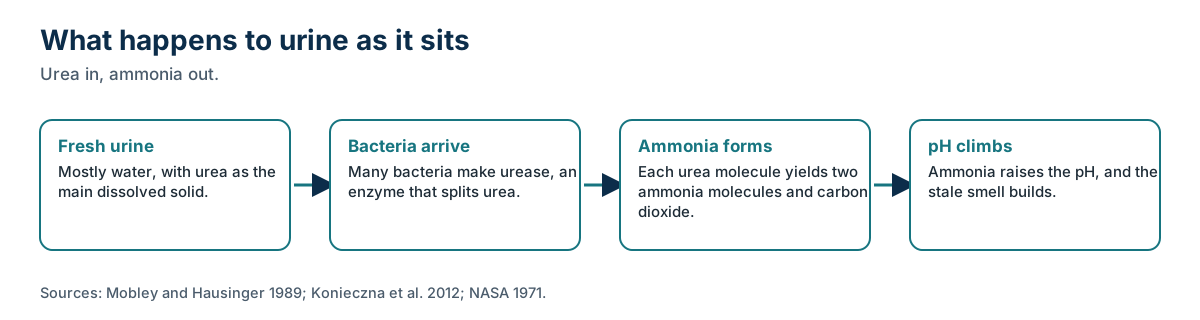
The sharp, stale smell of old urine is mostly ammonia, and an enzyme makes it. Many bacteria produce urease, which splits urea, the main dissolved solid in urine, into ammonia and carbon dioxide. Uric acid gets more attention on product labels, but in human urine it's a minor, barely soluble component. The enzyme that breaks it down, uricase, is real and well studied in medicine. What it contributes inside a mattress hasn't been measured.
General information about urine chemistry and cleaning. Not medical advice.
Urea and urease: where the ammonia comes from
NASA's 1971 analysis of human urine lists urea as by far the largest dissolved component after water. Urea on its own has little smell. The change comes from bacteria.
The 1989 review Microbial ureases and Konieczna and colleagues' 2012 review describe the reaction: urease splits urea into ammonia and carbamate, and the carbamate "spontaneously converts into the second ammonia molecule and carbonic acid." The ammonia is then protonated, and "this process results in pH increase." Urease is common across bacteria, so a damp stain at body temperature is a good place for it to happen.
That's why a fresh accident often smells mild and an old one smells sharp. Our accidents hub follows that change layer by layer.
What that means for enzyme treatment
Notice which enzyme is doing the damage. Urease isn't a cleaning ingredient; it's how bacteria make ammonia. The cleaning job is the opposite: break down the organic soil that bacteria feed on and remove what's there, so less ammonia is produced and what's present can leave as the area dries.
Ammonia itself is a small, volatile molecule. It isn't something a protease or lipase cuts. It leaves as the area airs and dries, and it keeps being made while urea and bacteria remain. That's the logic of treating the source and then drying the area well.
Uric acid: real, but a small player in human urine
Uric acid is the end product of purine breakdown in people. So and Thorens explain in a 2010 JCI review that humans and great apes lost a working uricase gene during evolution, so we excrete uric acid where most mammals break it down further. They describe it as "a weak organic acid with a pK a of 5.75," present mostly as urate at body pH.
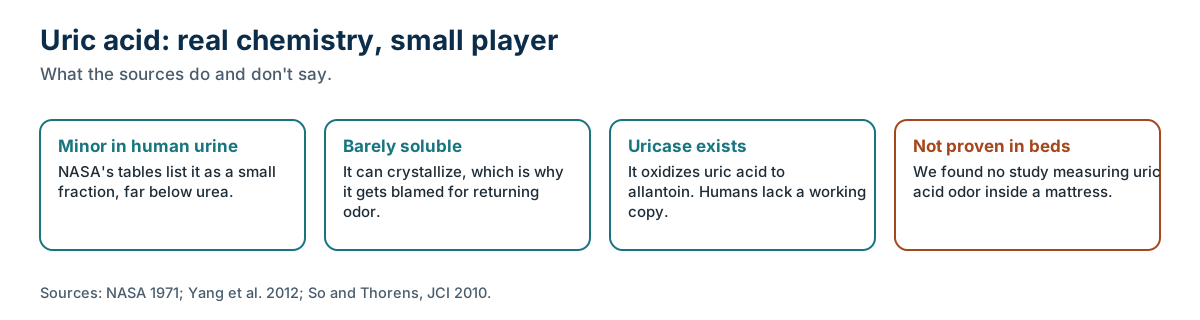
NASA's tables list uric acid as a minor constituent with very low water solubility, far below urea. Because it can crystallize, many cleaning guides blame it for odor that returns on humid days. That's plausible. We haven't found a study that measured it inside a mattress.
Uricase: what it does
Uricase, or urate oxidase, is well characterized because of its medical use for gout. Yang and colleagues describe it "catalyzing the oxidation of urate into hydrogen peroxide and 5-hydroxyisourate," which "spontaneously decomposes to allantoin and carbon dioxide." Allantoin is far more soluble than uric acid.
Two cautions follow. First, uricase is an oxidase, not a hydrolase, and it needs oxygen and the right conditions to work. Second, a label naming uricase tells you an ingredient, not a result on your mattress. We'd treat any product's claims about uric acid crystals as the maker's claim unless it publishes test data.
Sleep Sanitation's view
This section is our view. We focus on what's well supported: urine on a mattress becomes ammonia through bacterial urease, and the fix is to break down and remove the organic soil sparingly, then dry the area well. We use enzyme treatment on urine and organic odor jobs, and we don't name or promote a particular product. Our visits use dry vapor steam with little water, HEPA vacuuming and UV-C light, with a moisture check after service and the built-in bed mite sensor on our UV-C vacuum. Enzyme treatment is part of our urine and organic odor work and is included in the standard visit; severe or biohazard contamination carries a surcharge, and we tell you before any work starts. See our accidents hub or call (402) 512-5658.
What we don't know
- Whether uric acid crystals contribute meaningfully to returning odor in mattresses. We found no study.
- How quickly urease activity builds in a mattress stain at bedroom temperatures. Published data come from medical and soil settings.
- Whether uricase in consumer cleaners measurably lowers uric acid in fabric under home conditions.
Changelog
- 12 October 2026: First published. Sources accessed on this date.
Sources
- Composition and Concentrative Properties of Human Urine (1971) · NASA
- Microbial ureases (Microbiol Rev, 1989) · PubMed Central
- Bacterial Urease and its Role in Long-Lasting Human Diseases (Konieczna et al., 2012) · PubMed Central
- Uricases as therapeutic agents to treat refractory gout: Current states and future directions (Yang et al., 2012) · PubMed Central
- Uric acid transport and disease (So and Thorens, J Clin Invest, 2010) · JCI (J Clin Invest)
Last reviewed October 12, 2026. Manufacturer specifications and care instructions change; check the current version for your exact model. This page is general information, not medical advice. How we source and check pages: editorial standards.