
Short answer
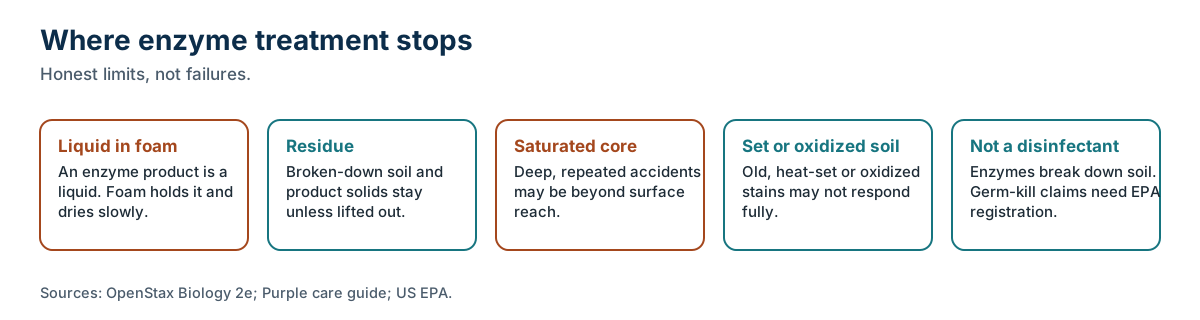
Enzyme treatment has real limits on a mattress. It's a liquid, and memory foam and other foams hold liquid and dry slowly. It breaks soil down but doesn't lift it out, so residue stays unless blotted. It can't reach a core soaked by large or repeated accidents. Old, heat-set or oxidized stains may not fully respond. And it isn't a disinfectant.
Key terms used on this page
- Enzyme cleaner:
- A cleaning product that uses enzymes to break down organic soils such as urine, sweat, vomit or blood. Several mattress makers mention them for urine stains, including Purple and Avocado. They are liquids, so how much is applied matters as much as what is applied. Sleep Sanitation uses enzyme treatment on urine and organic odor, sparingly.
- Saturated core:
- A mattress whose interior layers, not just the cover and quilting, were soaked by a large accident or several in one place. Surface treatment can't reach all of it. Some saturated cores improve with treatment and drying; some don't, and we say so before charging for work that won't help.
- Moisture load:
- The total amount of water a cleaning process puts into a mattress, whether from spray, steam condensate, shampoo or rinse. It is the main thing that decides how long a mattress takes to dry.
- Heat-set stain:
- A stain that has become harder to remove because heat fixed it in place. Kentucky Extension warns never to iron stained fabrics because heat sets stains, and Georgia Extension says stains set by heat will be difficult to remove.
- Pesticidal claim:
- A product claim to prevent, destroy, repel or mitigate a pest, including microbes. EPA says such claims make a cleaning product a pesticide that must be registered.
Enzymes are a good tool with clear limits. On a mattress, the biggest one is that they come in a liquid, and foam holds liquid. They also break soil down without removing it, they can't reach a core that's soaked through, they struggle with old or heat-set stains, and they don't disinfect. Knowing those limits is how you use enzymes well.
General information. Your mattress maker's care instructions and warranty terms govern your decision.
Limit 1: it's a liquid, and foam holds liquid
Every enzyme product works in water. Memory foam, polyfoam and latex absorb liquid and release it slowly. Purple's care guide says not to steam clean memory foam, latex or adjustable mattresses "since the heat and water could damage its materials." The enzyme isn't the issue; the liquid load is. Our accidents hub covers memory foam in detail.
The answer is the smallest amount that covers the soil, the label's dwell time, blotting, and if needed a second light round, never a soak. See dwell time explained.
Limit 2: broken down isn't removed
An enzyme cuts big molecules into small ones. OpenStax describes the enzyme releasing its products after the reaction; those products are still in the fabric. Smaller pieces lift and dissolve more easily, but they still need lifting. Product ingredients such as surfactants, stabilizers and fragrance can also remain. What isn't blotted dries in place and can attract soil.
Limit 3: the saturated core
A large accident, or several in the same place, can soak through the comfort layers into the core. A saturated core can't be reached from the surface without adding as much liquid as the accident did. Some improve with careful treatment and long drying. Some don't. Our guide to cleaning or replacing after urine lays out how to decide.
Limit 4: old, set and oxidized soil
Time and heat change soil. Dried protein needs to rehydrate before an enzyme can work on it, and heat can fix it to fibers; Georgia Extension says heat-set stains "will be difficult to remove." Body oils that sit for months can yellow. We explain that in why old stains resist enzymes.
Limit 5: cleaning is not disinfecting
Enzymes break down organic soil. They don't kill germs, and products that claim to must be registered with the EPA. See are enzyme cleaners disinfectants?.
Sleep Sanitation's view
This section is our view. We use enzyme treatment on urine and organic odor jobs, sparingly, and we follow it with low-moisture dry vapor and airflow rather than more liquid. Every visit ends with a moisture check. If a mattress has a saturated core or contamination we don't think will respond, we say so before charging for work that won't help. Ordinary urine accident treatment is included in the standard $249 first-mattress price; severe or biohazard contamination carries a surcharge, and we tell you before any work starts. Every visit also includes HEPA vacuuming, UV-C light and the built-in bed mite sensor on our UV-C vacuum. Call or text (402) 512-5658, or email info@sleepsanitation.com.
What we don't know
- How much enzyme product residue remains in a mattress cover after blotting. We found no study.
- How deep a typical light enzyme application penetrates different foams.
Changelog
- 12 October 2026: First published. Sources accessed on this date.
Sources
- Biology 2e, 6.5 Enzymes · OpenStax (Rice University)
- How To Clean a Mattress in 9 Steps · Purple
- Stain Removal for Washable Fabrics (FCS2-840) · University of Kentucky Cooperative Extension
- Remove Stains from Blood · University of Georgia Extension, Textiles
- Determining If a Cleaning Product Is a Pesticide Under FIFRA · US Environmental Protection Agency
Last reviewed October 12, 2026. Manufacturer specifications and care instructions change; check the current version for your exact model. This page is general information, not medical advice. How we source and check pages: editorial standards.