
Short answer
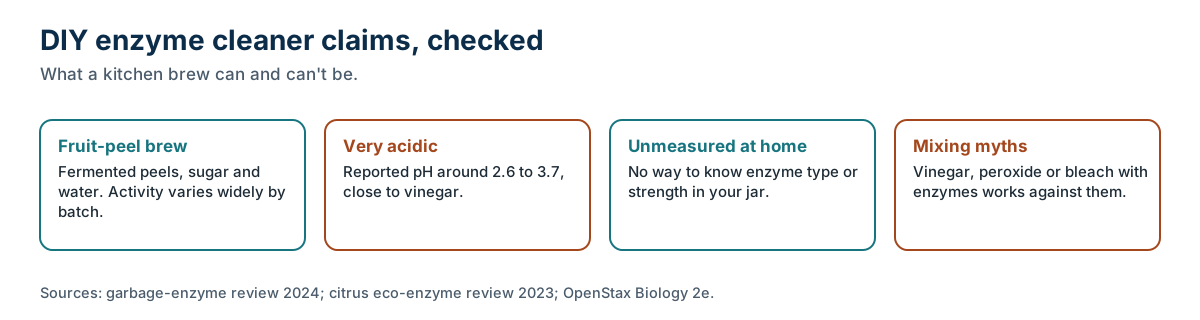
Homemade enzyme cleaners, often called eco-enzyme or garbage enzyme, are fermented fruit peels, sugar and water. Studies report some protease, amylase and lipase activity, but it varies with the peel and how it was made, and the brew is strongly acidic, around pH 2.6 to 3.7. You can't measure what's in your jar. Mixing enzymes with vinegar, peroxide or bleach works against them.
Key terms used on this page
- Eco-enzyme (garbage enzyme):
- A homemade ferment of fruit or vegetable peels, sugar and water. Reviews report variable enzyme activity and an acidic pH of roughly 2.9 to 3.7 after fermentation.
- Denaturation:
- Loss of a protein's folded shape, usually from heat or extreme pH. A denatured enzyme is still present but can no longer bind its target, so it stops working.
- Enzyme working range:
- The band of temperature and pH in which an enzyme works well. Inside it, warmth speeds reactions; outside it, activity falls and the enzyme can denature.
- Acid-base neutralization:
- A reaction in which an acid and a base produce a salt and water. Vinegar and baking soda react this way, releasing carbon dioxide as they use each other up.
Homemade "enzyme cleaners" are real ferments, not real recipes for a known product. Made from fruit peels, sugar and water left for months, they can contain some enzyme activity, but studies show it varies widely and the liquid ends up strongly acidic. Mixing kitchen staples with a store-bought enzyme product has a different problem: it changes the conditions the enzymes need.
General information. Not a recipe, and not product advice.
What "eco-enzyme" actually is
A 2023 review of citrus eco-enzyme describes it as "fermented solution made from a mixture of sugar, fruit peels, and water mostly in a ratio of 1:3:10," and, bluntly, as "a type of vinegar made by fermenting food waste with sugar." It lists protease, amylase, lipase, cellulase and pectinase as the most common activities, while noting they depend "on the source and the conditions under which they were produced."
A 2024 systematic review of garbage enzymes, focused mostly on composting and wastewater uses, reports acidic pH "in range of 2.9–3.7" after fermentation.
Myth: it works like a commercial enzyme cleaner
There's no way to know at home which enzymes your jar contains or how active they are. Commercial products are formulated and labeled; a home ferment isn't. And the acidity matters: OpenStax notes that "extreme environmental pH values (acidic or basic) can cause enzymes to denature." A brew at pH 3 is a hostile setting for many enzymes, including some of the ones it may contain.
On a mattress there's also residue: sugars and plant solids in an acidic liquid that can't be rinsed out.
Myth: vinegar boosts an enzyme cleaner
Vinegar is acidic and can move a mix outside an enzyme's working range. It also adds more liquid. Vinegar's own odor fades; it doesn't break down protein or oil. See temperature and pH.
Myth: baking soda and vinegar make an enzyme-like foam
The fizz is an acid-base reaction. OpenStax's chemistry text classifies such reactions as producing a salt and water; here carbon dioxide is released too. The two neutralize each other. Our viral recipes article takes that recipe apart in detail.
Myth: peroxide or bleach plus enzyme is stronger
Oxidizers and enzymes are separate tools. Oxidizers can damage enzyme proteins and many fabrics. Use one product at a time, as labeled, and see our hydrogen peroxide article before trying peroxide on a mattress.
Myth: hot water helps a DIY enzyme mix
Warm can help, but hot can denature the enzyme and set protein stains. Georgia Extension suggests a cool-water soak first for blood, a protein stain. See does steam heat destroy enzyme cleaners?.
Sleep Sanitation's view
This section is our view. We understand the appeal of a free, homemade cleaner, and fermenting peels is a fine composting project. On a mattress, we'd blot fresh accidents with plain absorbent cloths and use a labeled product sparingly, or call us. We use enzyme treatment on urine and organic odor jobs, applied sparingly and before heat. Our visits use dry vapor steam with little water, HEPA vacuuming and UV-C light, with a moisture check after service and the built-in bed mite sensor on our UV-C vacuum. Enzyme treatment is part of our urine and organic odor work and is included in the standard visit; severe or biohazard contamination carries a surcharge, and we tell you before any work starts. Call or text (402) 512-5658.
What we don't know
- Whether any eco-enzyme formulation measurably cleans body-fluid soil from mattress fabric. We found no study.
- How long enzyme activity lasts in a stored homemade ferment.
Changelog
- 12 October 2026: First published. Sources accessed on this date.
Sources
- A systematic review on garbage enzymes and their applications in environmental processes (2024) · Ecotoxicology and Environmental Safety (ScienceDirect)
- Recent trends in utilization of citrus fruits in production of eco-enzyme (2023) · Journal of Agriculture and Food Research (ScienceDirect)
- Biology 2e, 6.5 Enzymes · OpenStax (Rice University)
- Chemistry 2e, 4.2 Classifying Chemical Reactions · OpenStax (Rice University)
- Remove Stains from Blood · University of Georgia Extension, Textiles
Last reviewed October 12, 2026. Manufacturer specifications and care instructions change; check the current version for your exact model. This page is general information, not medical advice. How we source and check pages: editorial standards.