
Short answer
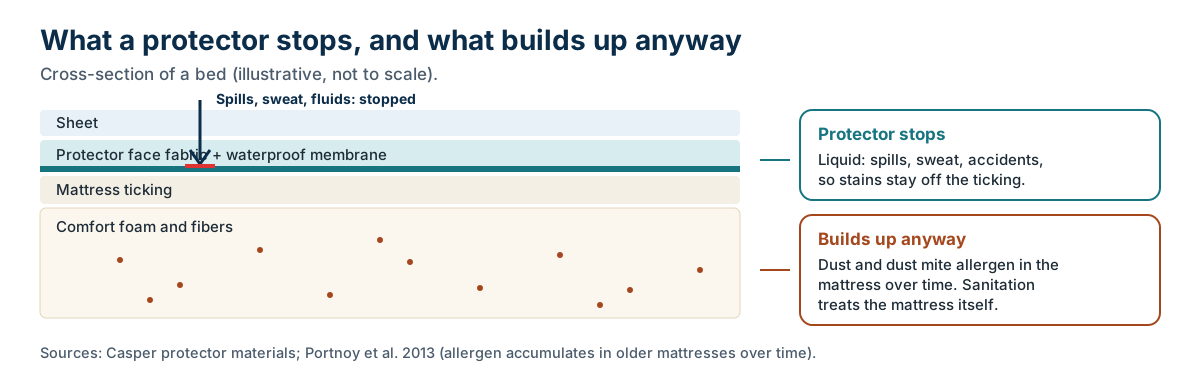
A protector stops liquid at the surface. It doesn't stop the slow build-up the allergist practice parameter describes: older mattresses 'are likely to have larger numbers of bed mite and to have accumulated increased concentrations of bed mite allergen over time.' A fitted protector also leaves the underside open, and washing it cleans the protector, not the mattress. Sanitation treats the mattress itself.
Key terms used on this page
- Moisture vapor transmission:
- How much water vapor passes through a fabric or membrane. Higher means more breathable; woven microfiber encasings let air and water vapor pass freely.
- Six-sided encasement:
- A cover that zips closed around the whole mattress, top, bottom and sides. NIEHS advises encasing mattresses and pillows in allergen-impermeable covers.
- Stain clause:
- The warranty term that excludes stained or soiled mattresses. Purple, Saatva and Avocado all exclude stains in their own warranty terms.
More
Allergen build-up
Older mattresses are likely to have more bed mites and higher accumulated allergen concentrations.
100%
Mite mortality
High-temperature steam (96°C) killed 100% of bed mites in treated mattresses and carpet in an Ohio State study.
Washing the protector
Cleans the protector
- Removes what's on the protector
- Restores the stain barrier
- Doesn't reach the mattress underneath
Sanitizing the mattress
Treats the mattress
- Dry vapor steam, 212°F+ at the surface
- HEPA vacuuming of the mattress
- UV-C light treatment
- Moisture check before we leave
This is the mechanism. For the cost decision, see is mattress sanitation worth it with a protector?.
General information about mattress care, not medical advice. For allergy or asthma questions, talk with your doctor.
Build-up happens anyway
The allergist practice parameter: "Older furniture and mattresses are likely to have larger numbers of dust mite and to have accumulated increased concentrations of dust mite allergen over time." NIEHS: "No matter how clean a home is, dust mites cannot be completely eliminated."
What passes, and what's left open
- Vapor: breathable protectors pass sweat vapor by design; see moisture vapor transmission.
- The underside and lower sides: a fitted protector covers the top and skirt only.
- What was there before: a protector on a used mattress protects what's already inside.
Washing the protector ≠ cleaning the mattress
Washing removes what's on the protector. See does washing sheets clean the mattress?.
What sanitation adds
High-temperature steam treats the mattress itself. In Glass and Needham (2004), steam at 96°C produced 100% bed mite mortality in treated mattresses and carpet. Our visits verify the mattress surface at 212°F or higher with a temperature gun, then HEPA-vacuum the mattress.
See the protector plus sanitation routine.
Sleep Sanitation's view
This section is our view. Sleep Sanitation serves Omaha, Lincoln and surrounding towns. Every visit includes dry vapor steam, HEPA vacuuming, UV-C light treatment, the built-in bed mite sensor on our JIGOO UV-C mattress vacuum and a moisture check before we leave. We take your protector off at the start of the visit, so you don't need to strip it first; wash it yourself per its care label while we work or afterward. The first mattress is $249. Call or text (402) 512-5658, or email info@sleepsanitation.com. Office hours are Monday to Friday, 9 to 6, and we return calls and texts on weekends.
Changelog
- 15 October 2026: First published. Sources accessed on this date.
Sources
- Environmental Assessment and Exposure Control of Dust Mites: A Practice Parameter (Portnoy et al., 2013) · PubMed Central (Annals of Allergy, Asthma & Immunology)
- Eliminating Dermatophagoides farinae spp. and Their Allergens Through High Temperature Treatment of Textiles (Glass and Needham, 2004) · PubMed (Journal of Medical Entomology)
- Dust Mites and Cockroaches · National Institute of Environmental Health Sciences
Last reviewed October 15, 2026. Manufacturer specifications and care instructions change; check the current version for your exact model. This page is general information, not medical advice. How we source and check pages: editorial standards.